



After the hottest summer on record, UK food supply is teetering on the brink. What needs to be done to help farmers and secure our food system?
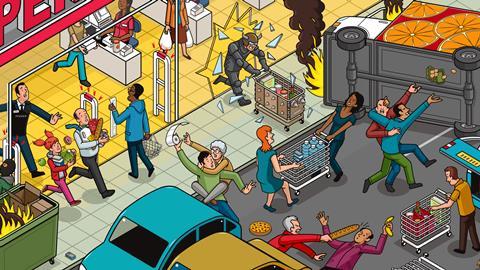
Empty shelves, riots on the streets over food and eventual societal breakdown may sound like something from the pages of a JG Ballard novel. But experts warn this scenario could well come to pass if summers like the one we’ve just had continue.
Food shortages are now a very real prospect over the coming months, multiple food sector insiders are warning, as a result of terrible growing conditions in both the UK and key overseas regions. Last month, the latest in a long line of alarming reports by think tank the Energy & Climate Intelligence Unit showed milk supply was down by more than 240 million litres due to heat impacts.
Meanwhile, British arable crop growers are predicting the worst harvest on record. At the same time, potato growers have warned of smaller crops, onion growers are facing their “most challenging season ever” and brassicas are down 50%. If that wasn’t alarming enough, the government has begun cautiously suggesting the population should start thinking about stockpiling crucial food items “just in case”.
But should any of this come as a surprise? A report published by the National Preparedness Commission last year, penned by Tim Lang, emeritus professor of food policy at the University of London, warned that the UK was not prepared for major food supply disruption.
“I don’t think Britain is prepared for major shocks. And it’s certainly not prepared for multiple shocks,” Lang said at the time, citing food shortages experienced as a result of the pandemic, the invasion of Ukraine and ongoing Brexit challenges. “There’s a gap between the official risk and resilience framework, which presents a picture that all is OK, and the realities that people in senior and frontline roles read differently.”
Against this backdrop, food bosses were warned earlier this year by Will Wilson, founder of sustainability consultancy 507climate, that businesses faced potentially insurmountable challenges in meeting industry climate goals.
“There were people in that meeting from major food and logistics companies involved in efforts to reduce carbon and make their supply chains more sustainable,” says Jonathan Kittow, the meeting organiser and founder of consultancy Simply Supply chain. “Their jaws [when Wilson argued they weren’t doing enough] simply hit the floor. Will left us in no doubt that we’re on the edge of something completely cataclysmic.”
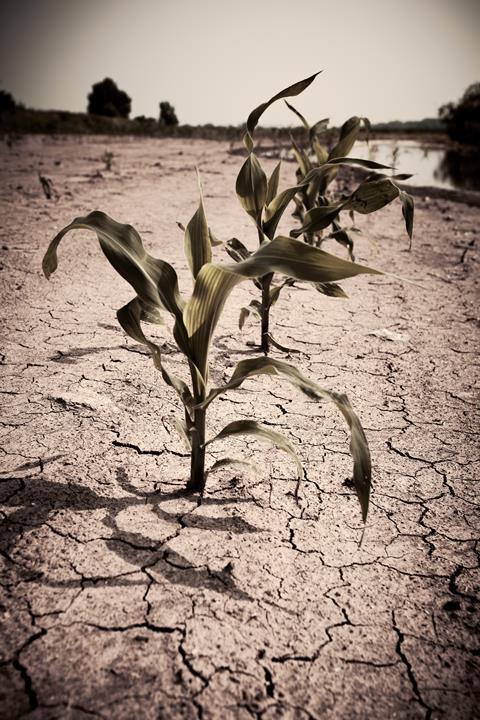
If Wilson’s message sounded apocalyptic, it was because the evidence he presented left little room for optimism. Nor is he alone in his concerns. In April this year, the UN’s Food and Agriculture Organization (FAO) and World Meteorological Organization (WMO) warned extreme heat was pushing global food systems “to the brink”, with rising temperatures increasingly threatening crop yields, livestock production and food supply chains worldwide. And that scenario is only expected to get worse with the developing El Niño weather pattern, which the UN said last month was “supersizing before our eyes”.
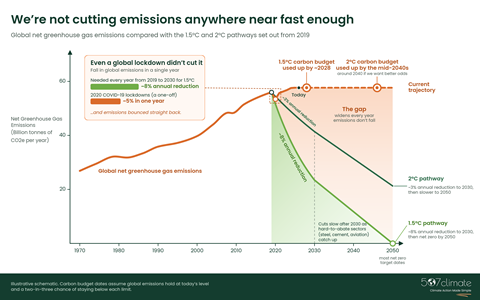
Speaking to The Grocer after that Simply Supply Chain meeting, Wilson describes the current outlook as “bleak”. And drawing on his company’s analysis of official climate data (see graph, p34), he stresses “we’re not cutting emissions anywhere near fast enough”. That data shows a steady rise in net global greenhouse gas emissions from 26.9 billion tonnes of CO2e per year in 1970 to almost 60 billion tonnes in 2019.
The problem, Wilson argues, is that governments, businesses and global climate bodies such as the Intergovernmental Panel on climate change or the Science Based Targets initiative remain fixated on net zero targets for 2040, 2050 or even later, with baselines effectively artificially set as late as just a few years ago, rather than at any point from 2019 or earlier.
That means insufficient attention is being paid to cumulative emissions, he says: “For every year you’re not on the pathway, you’re basically taking too much of the budget – and the rate at which you then need to reduce emissions massively increases.”
According to Wilson, limiting warming to 1.5°C would have required global emissions to fall by about 8% a year from 2019 onwards. Yet even in 2020, when Covid lockdowns brought large parts of the global economy to a standstill, emissions fell by just 5.7% before rebounding. “We bounced straight back up,” he says.
The consequence is that the world’s remaining carbon budget is being exhausted far faster than policymakers and industry appear willing to acknowledge, he adds, leaving food businesses facing climate risks on far shorter timescales than many of their adaptation plans currently assume.
As a result, Wilson argues the planet’s remaining 1.5°C carbon budget could be exhausted by 2028, with the 2°C budget following in the mid-2040s unless emissions reductions accelerate dramatically.
Whether it can do that remains to be seen, especially given that some of the companies responsible for the highest emissions have watered down elements of their climate ambitions in recent years.
Industry resilience
There are also, of course, many concerns for UK food and drink businesses in the here and now. The impact of the climate crisis is already being felt across global agricultural systems – and after the hottest summer on record caused some of the most challenging food production conditions the country has ever seen, UK food production is also in the firing line.
Alongside Lang’s stark warnings, 2026 has delivered yet more evidence of our supply chains’ vulnerability. Amid many warnings of reduced harvests due to heat stress and water scarcity, plus falls in livestock production for similar reasons, a National Audit Office (NAO) report last month warned government must “strengthen the food supply chain’s resilience”.
Meanwhile, a Cold Chain Federation study published in June warned that national resilience planning largely overlooked the chilled and frozen supply chains that underpin almost half of all food and drink produced and sold by UK manufacturers, which is “not acknowledged as critical national infrastructure”.
The industry’s concerns are not theoretical. An NFU survey published last December found 68% of farmers had seen an increase in drought over the past decade, while 70% reported more frequent heatwaves and heat stress. And for many farming businesses, the impact has been financial as well as operational, with average weather-related losses topping £40k per business.
The worsening conditions faced by food producers show “just how exposed UK food supply chains are to climate shocks”, says Alys Bannister, sustainable farming campaign manager at campaign group Sustain. “Drought and extreme heat have hit crops, livestock, water availability and working conditions, and farmers are now facing a third poor harvest in a row. The ECIU estimates this could be the smallest cereals and oilseed harvest on record, costing farmers around £550m.
“Livestock farmers have been drawing on winter feed and growers have faced restrictions on water. Without faster action to adapt, the price shocks and supply disruption we’ve seen this year will worsen – hitting the poorest hardest.”
And the UK cannot simply “import its way out of this”, she stresses. “The UK Imports about 80% of its fruit and 47% of its veg, much of it from regions facing the same heat and drought. Resilience requires long-term investment, not just a response when drought hits. Healthy soils are critical infrastructure against heat and flooding, but farmers need financial support and advice to transition to nature-friendly and agroecological systems.”
This is not to say nothing is being done. Farmers, suppliers, processors and retailers are all trying to keep food on shelves for consumers for years to come.
Regenerative farming has been long touted as a magic pill for this problem. In the past month alone, Fyffes and Kellogg’s unveiled regen-ag commitments, while First Milk reported a fall in emissions thanks to following the strategy.
It is now a “massive movement in farming”, says Tom White, regenerative farming manager at Yeo Valley, which started rolling out regen farming strategies – such as diverse cropping, soil health improvements and changing the way cows graze and are managed – in 2018.
This summer, it reaped the rewards. “While we were not immune to the drought, we probably stayed productive for longer,” White says. “Protecting ourselves entirely from these things is not reasonable to expect, but we can definitely do stuff that mitigates the impact.”
Farmers are also making other changes. Soft fruit grower S&A Produce has cut its water consumption by around 30% this year thanks to investment in storage and run-off systems, while veg grower AH Worth constructed a 80,000 cubic metre reservoir to help offset reliance on the national grid.
The NFU says more needs to be done to support farmers to make these changes, because while they are “doing all they can to make the food system resilient, we still have this really fragile system”, says Paul Tompkins, NFU vice-president.
He suggests attaching a target to each government department that looks at what it can do for food production, because “I’ve stood on farms where they just aren’t growing, because they don’t have sufficient water or energy to the site. It’s bonkers. This is why farmers get frustrated: because they see a frighteningly fragile food system yet the decision-making is happening beyond their farmgates.”
Key to this are farmers’ relationships with the retailers, which through long-term partnerships and other methods are trying to encourage farmers to continue investing in food production, according to Andrew Opie, director of food and sustainability at the BRC.
“Retailers have also got much more adept in their sourcing,” he adds, explaining that retailers are increasingly building climate risks into their sourcing plans and becoming more “nimble”.
While this doesn’t help farmers at home, it does help keep food on shelves in the face of an increasingly unpredictable landscape.
Government response
Despite warnings of looming catastrophe if it doesn’t act, the UK government’s response to climate change’s impact on the food and drink supply chain has arguably been negligible and often left to the industry.
That’s the verdict from none other than the NAO. The organisation’s damning report in September blasted the government – and Defra in particular, which it said had been blindsided by the increasing threat of a major food supply emergency and had failed to “encourage businesses, households and communities to strengthen resilience”.
Although food has been designated as one of 13 Critical National Infrastructure sectors essential for the country to function properly, the report found that, to date, Defra had largely relied on the private sector to manage potential disruptions to food supply.
“This has been possible because of the resilience in the UK food system, which can source from all over the world, and commercial incentives on businesses to invest against risks and respond during a crisis,” the report states.
“However, the sector’s ability to withstand catastrophic events that cause severe disruption has not been tested and Defra’s actions in recent years have not been sufficient to ensure the supply chain is resilient to such events.”
Wilson warns that with El Niño threatening to wreak havoc on supply chains, this could be the year the chickens come home to roost for Defra and the wider government’s lack of preparedness. He says government regulation has overwhelmingly been “light touch” or with “indirect impact” on the supply chain, and there’s a policy void that has exacerbated the industry’s lack of readiness.
He points out, for example, that “when it comes to the fishing industry and climate it’s essentially totally unregulated. Marine sediment, mud, silt and other blue carbon stores (such as kelp and seagrass) are not formally accounted for in the UK’s national reporting for tracking progress toward net zero, yet studies show UK seabed habitats hold hundreds of millions of tonnes of organic carbon.
“And disturbances like bottom trawling or offshore development release vast quantities of these uncounted emissions.”
The NAO report says Defra should make better use of existing frameworks – such as using the government’s ‘CNI Knowledge Base’ tool to identify critical food supply chain infrastructure – and learn from approaches in other countries. It also says there are opportunities to strengthen preparedness by increasing the transparency of the government’s planning assumptions and testing these with local government and industry.
More widely, analysis by the independent Climate Action Tracker (CAT) project praises the Labour government for stepping up measures to tackle climate change, but warns of the impact of a breakdown in the cross-party consensus on climate that previously dominated British politics.
It highlighted the government’s Clean Power 2030 Action Plan, a cornerstone of its programme, which will mostly phase out fossil fuels from the electricity grid while increasing the share of low-carbon technologies from 65% in 2024 to more than 95% by 2030.
“The target is ambitious and should be commended as clear, decisive policy that will bring the UK in line with European leaders like Denmark and Portugal,” reckons the CAT. Nonetheless, “stalled progress prior to the change in government in 2024 has meant that, without immediate and rapid change, the UK can no longer be considered a leader in global climate action”.
Looking ahead, Bannister feels there is “some movement in the right direction”, citing the government’s Farming Roadmap 2050, which was published in June and at least “sets a direction”. Unfortunately, many food and drink businesses appear to be talking the talk but not walking the walk.
Data from Lumina Intelligence’s Climate-Smart Intelligence report 2026 showed that while more than half (54%) of respondents say climate resilience is either ‘very important’ or ‘extremely important’ to their company, just 6% say it has been embedded in their corporate strategy.
Such inaction is inexcusable given “we know what the solutions are”, according to Alex Wijeratna, senior director at climate advocacy group Mighty Earth: “Short, local supply chains; supporting farmers to transition to agroecological methods that boost soil health; and growing more climate-resilient plant proteins. Our food systems need a major overhaul.”
The NFU’s Tompkins agrees and thinks that “if more people were aware of it, they’d be more concerned, as I am, that our food resilience is built on fragile foundations. It’s frighteningly fragile here in the UK.”
Should meat and dairy advertising be restricted?
Meat and dairy producers should face sweeping new bans on advertising and marketing, according to climate researchers at Newcastle and Oxford Universities, backed by campaign group Sustain.
In an August report, they called for PM Andy Burnham to give councils greater devolved powers to tackle climate change, alongside obesity.
They claim the government is lagging behind on greenlighting the ambitions of many local authorities to take action on foods that would help tackle climate change. They also say that under Burnham’s drive to give authorities more power, they should be allowed to enforce greater restrictions on advertising.
The report stated that 278 of 317 English local authorities had declared a climate emergency, while many had already begun introducing policies such as serving more plant-based foods, sourcing locally and using accredited sustainable produce.
Some councils are restricting the advertising of certain foods with high environmental impact as part of climate change reduction ambitions, the report said. But the research reveals significant gaps and the authors are calling on the government to provide clear universal standards, support and leadership.
The UK Committee on Climate Change has long called for a reduction in the consumption of meat and dairy products, and the report says climate change should be treated in the same way as obesity, with almost a quarter of local councils in England having a policy aimed at restricting the advertising of less healthy foods.
“This suggests that restricting the advertisement of food products with a high environmental impact may have the potential to reduce diet-related environmental impact,” the report says. “To date, the extent to which advertising policies aim to promote climate-friendly diets has not been systematically explored.”
The idea has been given short shrift by the industries it would target. “Banning advertising for an entire category of nutritious food is a very blunt instrument,” says Lucas Daglish, sustainability manager at the British Meat Processors Association.
“Not all meat has the same environmental footprint. How and where in the world livestock is produced matters, and policies that categorise all meat as ‘high carbon’ risk ignoring those differences and undermining producers who are investing heavily in more sustainable production.”







No comments yet