






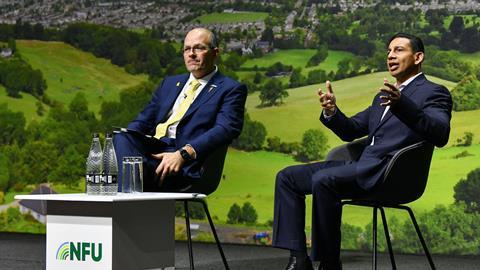
There wasn’t a tractor to be seen at the NFU Conference this year where, with the spectre of Inheritance Tax largely dispelled, it was back to business as usual.
With a focus on “resilience” and self-sufficiency, the conference looked to the future rather than dwelling on the not-so rosy past.
But even though the looming ‘Family Farm Tax’ threat has been largely neutered, things still look pretty bleak. Food production in the UK is in decline, and while many agreed this needed to change, the concrete plans on offer feel lacklustre.
The conference was kicked off on Tuesday morning by president Tom Bradshaw, who called for an increase in UK food production and told members of the farming union that a “resilient food system isn’t optional in a time of geopolitical uncertainty – it is a cornerstone to national security”.
Bradshaw – who by Wednesday afternoon had been re-elected for another two years as NFU president – also took aim at sluggish progress on farming-focused government policy, including its target for 50% of public sector food to be procured from local sources and its efforts to clamp down on illegal meat imports, while calling on the wider supply chain for greater support for the sector.
“Everything you see on the grocery shelf is underpinned by a farmer or by a grower so, yes, resilience means a supply chain where the burden of risk is shared, not just shouldered by price-taking farmers and growers,” he said.
His concerns were echoed by Professor Tim Lang, emeritus professor of food policy at City St George’s University, who said “we are not getting the leadership on food security”.
Lang put the case forward for a ‘Food Security and Resilience Act’, which would facilitate the shift from ‘just in time’ logistics to ’just in case’, emphasising that we are not prepared for supply chain shocks – as has been illustrated in recent weeks, with weather-related shortages taking hold across the UK and Europe.
But to build this model, farmers needed more confidence – something they currently lack. The most recent NFU confidence survey, published last year, showed farmer confidence was at an all-time low.
Both government policies and retailer support are needed to help turn this around, so it was lucky that both attended the conference this year and made valiant efforts to prove they were on side.
Defra is ‘listening’ to farmers
While many previous Defra secretaries have been booed as they take to the NFU stage, Emma Reynolds appears to have the union largely on side (no doubt helped by the role she played in the partial u-turn on Inheritance Tax reform).
She announced a raft of farmer-friendly programmes, worth a not-to-be-sniffed-at £345m, to show the government is “taking action to back farmers”. The measures – which included changes to the Sustainable Farming Incentive (SFI) and a boost for farming technology – were broadly welcomed.
Reynolds also teased the unveiling of the Food and Farming Partnership Board, which she said would “reset how we work together” (its first meeting will be next month), alongside a promise that a new Land Use Framework would launch “soon”.
She is clearly trying to mend bridges with farmers damaged earlier in this government’s tenure both by the Treasury and its catastrophic IHT policy, as well as by Defra itself, following last year’s premature closing of the SFI. But despite these efforts, several questions still remain unanswered.
Unlike some of her predecessors, Reynolds is clearly across her brief, and knows exactly what to say and when. However, while spending considerable time saying, “I hear you”, “we are listening” and “recognising” the work that farmers do, she spent far less time addressing core concerns around trade deals, surging costs for horticulture businesses or flooding. But what else should we really expect from a consummate politician?
And ultimately, Reynolds can only ride the goodwill wave of the IHT success for so long. Soon, she will have to really prove herself to this difficult crowd.
As farmers call for more stability, many hope she will have a long enough tenure – her predecessor stayed in post for just over a year – to give her the opportunity to enact real change.
Tesco boss makes some noise
The other big draw for the conference this year was Tesco UK CEO Ashwin Prasad, who spent much of his time trying to convince farmers that he is, like Reynolds, listening.
Prasad underlined this point largely by repeating the key asks of farmers back to them, before outlining three areas he said would help strengthen resilience across the sector: policies for growth, what Tesco and its partners are already doing, and opportunities for the sector.
In fairness, Prasad was clear and struck a confident tone, making all the right noises to emphasise that Tesco cared about its farmers.
“I genuinely believe we have a really valuable role to play in helping to build the future of the food industry in this country, and we’ve already made progress,” he said.
However, beyond pointing to a handful of positive initiatives – such as Tesco’s low carbon concept farm and its Sustainable Farming Groups – Prasad failed to tackle the most significant challenges. He dodged questions on long-term contracts, the devaluing of product through a race-to-the-bottom pricing model and the continued use of imported meat in Tesco products. Progress on any of any of these would bring a massive boost to UK farmers.
While Prasad’s appearance may have felt slightly underwhelming, it is a positive sign that the UK’s biggest retailer wants to be seen backing British farming.
As we move on from the IHT saga and the union returns to business as usual, the onus is now on the entire supply chain to put their words into meaningful action. We are, after all, staring down the barrel of a food security crisis.







No comments yet