
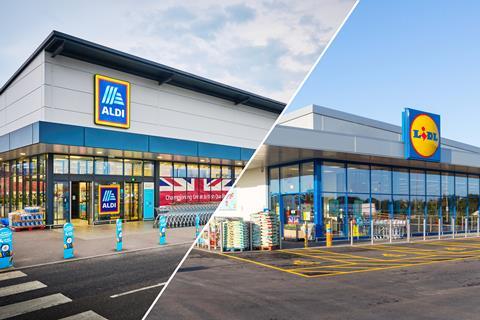
The average unit price of products bought from Lidl is 9% higher than those bought from Aldi, a gap that has increased from 6% in two years, The Grocer can reveal.
Lidl’s average unit price (AUP) stands at £1.72, having climbed from £1.62 in two years, while Aldi’s is £1.57, having risen from £1.52. It means the gap between the two has grown from 10p to 15p, according to Worldpanel by Numerator data seen by The Grocer [12 w/e 3 November 2024 vs 12 w/e 4 October 2026].
AUP is drawn from the barcodes of take-home groceries scanned by a panel of thousands of shoppers, considering only price per pack, including any loyalty discounts claimed. Because the data is blind to what the products are, a growing gap can reflect changing shopper choices driven by retailer customer strategies as much as it can movement in comparable prices.
The two discounters have pursued diverging strategies in recent years, with Lidl investing in its Plus app, which offers discounts on a personalised selection of products, while Aldi eschews loyalty in the conviction everyday low pricing will drive growth in the long term.
Lidl has increased funding for rewards in its loyalty app by 60% this year and added new features including points with every purchase and a scan & shop function.
Aldi has boasted of investing £340m in lowering prices for all shoppers so far in 2026, while Lidl has invested £400m in “price cuts and promotions”, including exclusive loyalty offers.
The data shows Lidl has a bigger share of brands in its sales mix, making up 12.1% of the total, compared with 7.5% at Aldi, [Worldpanel 12 w/e 4 October 2026]. Within own label, sales of Lidl’s premium Deluxe range have grown by 14% year on year [Worldpanel 52 w/e 4 October 2026].
In Grocer 33 tests using a basket of 33 comparable items, Aldi has come out cheapest on six of the nine occasions the two discounters have met since October 2024, with Lidl winning the most recent three.
Read more: Lidl boss answers Aldi chief over loyalty discounts
Josh Holmes, head of research at Retail Economics, said the widening AUP gap was likely down to the product mix changing as Lidl attracted more new customers overall and used loyalty to influence choices. Lidl’s total sales have grown by 7.1% year on year, pushing its market share from 8.2% to 8.6%, while Aldi’s sales have risen by 0.4% and its share has slipped from 10.6% to 10.5% [Worldpanel 12 w/e 4 October 2026].
“Lidl’s higher branded sales share suggests it appeals to shoppers who want to save without giving up familiar favourites,” said Holmes. “It’s also seen a bigger increase in shopper numbers than Aldi in recent figures, which could be changing what’s going through its tills.
“The discounters also now take slightly different approaches to delivering value,” he added. “Aldi continues to invest heavily in keeping everyday shelf prices low and makes that promise front and centre. Lidl competes hard on price too, while putting more emphasis on member offers and rewards through Lidl Plus. Those offers can change what goes into the basket, as well as what shoppers pay.”
Read more: Revelations in the CMA’s decision that Aldi and Lidl are not limited-range discounters
Sales of Aldi’s premium own-label Specially Selected range have also grown amid demand for luxury dine-in options. In March it boasted of being the UK’s second most popular supermarket for premium own-label food and drink, with Specially Selected sales up by 11% year on year [Worldpanel 12 w/e 22 February 2026].
A Lidl spokesperson said: “Worldpanel’s average unit price metrics simply reflect the variety of products that customers choose to put in their baskets, not like-for-like pricing. Variations in average unit price are instead driven by a wide range of basket factors and consumer behaviour, including, for example, our stronger sales of branded and higher-value items such as fresh meat and alcohol, larger value-pack sizes, and strong growth in our premium Deluxe range.
“The only way to accurately show true price differences is through transparent, like-for-like comparisons. This is clearly demonstrated by the Grocer 33, where Lidl won the last three consecutive price tests. Our commitment to unbeatable value is also further reinforced by our £400 million investment into price cuts and promotions since the start of the year.”

No comments yet