




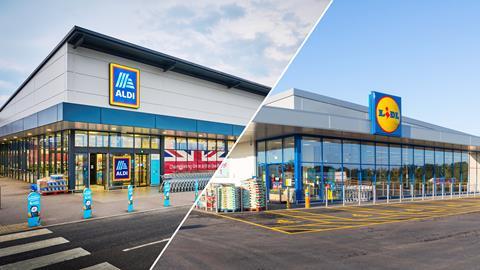
Aldi and Lidl tend not to be overly keen to talk details of store and range size, and it seems they may have good reason.
Behind a front of ‘nothing to see here, we’re just the same old limited-range discounters’, it turns out they have changed rather fundamentally over the past 15 or so years, with potential regulatory consequence.
The nub of a Competition & Markets Authority decision delivered on 7 August, concluding a consultation, is that they are no longer limited-assortment discounters (LADs) but large grocery retailers (LGRs). As a result, they should have to follow the same competition rules as other major supermarkets, according to the 80-page provisional decision. Specifically, they should be designated as LGRs under the 2010 Controlled Land Order, which already bans seven retailers – Tesco, Sainsbury’s, Asda, Morrisons, Co-op, M&S and Waitrose – from using restrictive clauses in land deals to block rivals from opening nearby.
So, what led the CMA to conclude they had changed so dramatically? And what happens now?
They run supermarkets
If there were any doubt, the CMA cleared it up by eliciting hard numbers from Aldi and Lidl themselves.
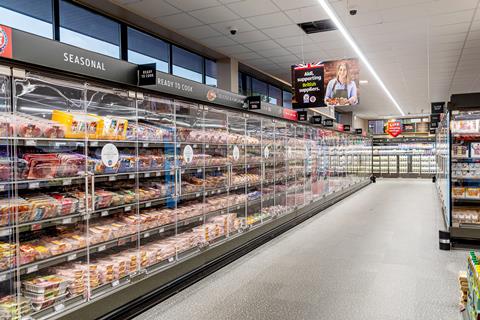
A supermarket, or large grocery store in the language of the 2010 order, has a net sales area (NSA) of more than 1,000 sq m. When the order was drawn up, Aldi and Lidl’s stores were as small as 500 sq m. Today, 87% of Lidl GB’s, 80% of Lidl NI’s and 72% of Aldi’s stores have an NSA of more than 1,000 sq m, and they are spread across considerable parts of the UK.
As an aside, the numbers also confirm that Lidl has grown to have a bigger UK retail footprint than Aldi, despite having fewer stores. Lidl GB’s larger average store size gives it a UK NSA of 1,244,600 sq m compared to Aldi’s 1,171,800 sq m. And that’s not even counting Northern Ireland, where Lidl NI has 44 stores and Aldi has no presence.
They sell full grocery ranges
That is to say, they serve the full weekly shop, by reasoning of the CMA.
Aldi and Lidl have been adamant they sell fewer than 3,000 products each. It turns out this is not the case, as they were each counting multiple product variants as a single SKU, as reported by The Grocer this week. The true number, according to the CMA, is 4,000-5,000 in the vast majority of stores each of them operates.
In any event, to talk only of total numbers was missing the point, as The Grocer argued in an article in May. The CMA confirms: “A more limited number of SKUs… does not necessarily preclude a finding that the grocery retailer offers a ‘full range of groceries’, provided core categories are represented.”
In the 2010 order, Aldi and Lidl were considered to have ranges of just 1,000 grocery lines each, which were not “close substitutes” to those of LGRs, meaning they did not operate in the same market.
While their ranges may still be smaller, they now span each of nine broad grocery categories which also informed the 2010 order, from ambient to chilled & frozen, fresh produce, bakery and household. Notwithstanding fewer options per category, “the CMA identified no material gaps in Aldi’s, Lidl GB’s or Lidl NI’s ranges at the level of the broad product categories of groceries as defined in the order”.
Yes, 90% of Aldi’s range may be own label, and more than 80% of Lidl’s, versus just 30%-40% in a Tesco of the same size. But “the CMA provisionally considers that a limited presence of branded products does not constitute a materially limited grocery range, particularly where the retailer offers products across the core grocery categories”. Plus, M&S’s range is also 90%-plus own label.
Not only that, but “each of Aldi, Lidl GB and Lidl NI make public statements about their range and the extent to which it is sufficient for those doing a main weekly shop”, says the CMA.
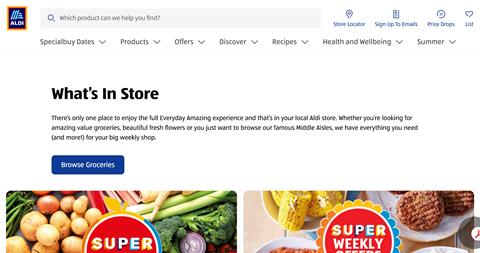
The report wheels out a boast from Aldi’s website that “we have everything you need (and more!) for your big weekly shop”; one from Lidl GB’s saying “you’ll find all you need for your weekly shop”; and Lidl NI’s claim that it sells “all the bits and bobs of an average family’s shop”.
In addition, Sainsbury’s submitted analysis using Worldpanel data which showed “Aldi and Lidl GB have 40%-60% of their volumes sold as part of a main shop, with Aldi having the highest proportion amongst grocery retailers and Lidl GB the third highest”.
Sainsbury’s also submitted that “Aldi and Lidl’s close to 20% share of all UK take-home grocery spending cannot be explained by occasional or supplementary purchases”. In 2008, the year of the market investigation that informed the 2010 order, Aldi and Lidl’s shares were 1.3% and 1.5% respectively.
If more were needed, a 2025 Mintel report used a consumer survey to consider the extent to which grocery retailers were used for main grocery shopping. “Aldi and Lidl had the fourth and fifth largest shares of respondents for main grocery shopping, with both larger than Morrisons,” says the CMA.
They compete with other supermarkets
To further assess whether Aldi and Lidl operate in the same market as LGRs, the CMA looked at the extent to which they place “competitive constraints” on them. This would be evidenced by “internal grocery price benchmarking and any price-matching activity”.
It didn’t have to look far for the latter. “Four of the seven LGRs [Tesco, Sainsbury’s, Morrisons and Co-op] have an explicit price-matching scheme, with three of these being an Aldi Price Match and the other LGR having schemes against Aldi and Lidl GB,” says the decision.
Internally, “five of the LGRs regularly benchmark to Aldi and Lidl GB”.
The competitive constraint was also evident through shoppers switching. Morrisons highlighted a 2023 Pricer poll to which 56% of respondents had switched their whole weekly shop to Aldi and Lidl from traditional supermarkets.
They should face the same rules
Aldi and Lidl may still be cheaper, but they no longer have a limited assortment, the other requirement of being classed a LAD. And they meet all the requirements to be classed as LGRs, including each having the buying power of their own wholesale function which purchases direct from suppliers rather than an intermediary.
The provisional decision is subject to a further consultation, with a final verdict due in October.
Iceland executive chair Richard Walker welcomed the news on LinkedIn: “If major supermarkets are competing for the same customers, in the same communities, they should be competing under the same rules.”
The decision also stands to leave Iceland as the only one of the UK’s 10 biggest grocers not covered by the rules. Like Aldi and Lidl, it was seen as distinct in the 2010 order, but as a frozen food retailer. The CMA has not considered adding it.
Aldi and Lidl have both said it will not change their expansion programmes.
Stephen Springham, partner at property consultancy Knight Frank, tends to agree. He sees it as a “necessary levelling of the playing field” and a “yielding of a mild competitive advantage”, potentially adding some “complexity” for Aldi and Lidl – “but not a massive obstacle to ongoing expansion endeavours”.
Still, says grocery lawyer Mark Jones, partner at Gordons, “that doesn’t mean Aldi and Lidl will take this lying down”.
On the basis their ranges remain about half the size of Tesco’s in an equivalent-sized store, a quarter of Asda’s and about 2,000 SKUs shy of M&S’s, “they could seek to persuade a court they still sell ‘significantly’ fewer products”, Jones says.
“I suspect they would lose that fight, but it doesn’t mean they won’t try.”
The CMA may have already asked them to provide details of their land deals. If it hasn’t, it “most likely will” in the event they are designated as LGRs under the order, adds Jones.
If such information were to reveal restrictions, “the CMA would assess if those restrictions contravene the order and, if they do, tell Aldi and Lidl to take steps to remove those restrictions”.
Since 2020, the regulator has named and shamed Tesco, Sainsbury’s, Asda, Morrisons, Co-op, M&S and Waitrose for breaching the order. Will Aldi and Lidl be next to feel the heat?





No comments yet