





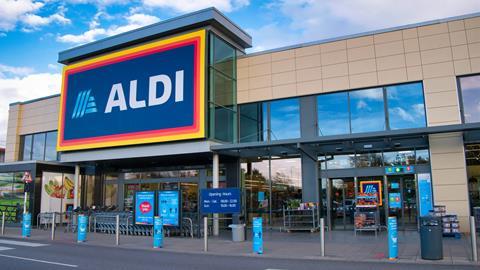
Everyone loves a ringside seat at a public spat between the country’s biggest supermarkets, and that’s what the CMA gave us this week.
The drama came in the form of some no-holds-barred consultation responses from Sainsbury’s, Morrisons, Iceland and Aldi, which the CMA made public yesterday.
The row – and consultation – centres on whether Aldi and Lidl should still be allowed to put clauses in property deals to stop competition opening nearby, a practice that’s been outlawed for other major supermarkets since 2010.
Competition is being “distorted” by Aldi and Lidl’s ability “to restrict entry and expansion by competitor grocery retailers in local markets”, Sainsbury’s raged, while Morrisons complained that the discounters’ ranges are “broad and attractive” to shoppers – not a phrase you’d necessarily expect to hear from a mainstream rival.
Is Aldi missing the point?
Aldi and Lidl were not included in the 2010 order that banned restrictive covenants because they were considered ‘limited assortment discounters’, distinct from the ‘large grocery retailers’ that were in scope – namely Tesco, Sainsbury’s, Asda, Morrisons, Co-op, M&S and Waitrose. In arriving at this distinction, the Competition Commission, predecessor to the CMA, considered the much smaller size of Aldi and Lidl’s ranges.
Thus, a big row has developed around exactly how many products the discounters actually sell nowadays. Iceland has posited that Aldi and Lidl’s ranges have “more than quadrupled” in the past decade to over 4,500 each, while in its defence, Aldi insists its core range is a very specific “2,005 products, representing approximately 7%-10% of the 20,000 to 30,000 SKUs typically offered by large grocery retailers”.
“Even when including any products on ‘trial’ and those considered regionally specific, seasonal lines and groceries included in Aldi’s Specialbuy range, we offer no more than approximately 2,703 grocery SKUs at any time.”
But it seems to be missing the point. Yes, the market investigation that led to the 2010 order focused considerably on range size, as well as store size, but its purpose in doing so was to assess whether the retailers operated in the same market. Key to that was whether customers would be able to switch from one to the other for a similar shopping mission.
“The key to identifying stores that are in the same market is assessing the extent to which customers regard different stores as effective substitutes for each other,” the investigation said.
“That is, the stores that should be included in the same market are those to which customers will switch when the store at which they are currently shopping increases its prices. By identifying those stores that are in the same market, we can analyse the effectiveness of competition in that market.”
Putting the boot in
This is why Morrisons’ amusing declaration of the attractiveness of Aldi and Lidl’s ranges is actually a killer point.
To show that Aldi and Lidl undeniably cater for a full grocery shopping mission, Morrisons only needs to point to the discounters’ own marketing materials and independent switching data (both of which it does, neatly, in its response).
In just two sentences, Morrisons shows why Aldi’s SKU count argument is irrelevant. “The fact that Aldi and Lidl stock fewer SKUs does not mean that they do not offer a full basket of groceries that satisfies customers’ requirements. Instead, it simply reflects the fact that for any given product, Aldi and Lidl stock fewer different brands and/or pack sizes, which does not prevent customers from purchasing all the groceries they need.”
Not to be outdone, Iceland puts the boot in as well, arguing it is “pertinent” that Aldi and Lidl “hold themselves out as ‘supermarkets’” in their marketing, where they compare their offerings to other supermarkets’ to “induce customer switching”.
“It is untenable for Aldi and Lidl to suggest that they offer a sufficient range of groceries which would enable customers to complete a full shop at their stores; but an insufficient number or range of groceries to warrant designation,” it said.
For its part, Sainsbury’s points out that Aldi and Lidl now account for 18.9% of all UK take‑home grocery spending. “A share of this magnitude cannot be explained by occasional or supplementary purchases; it reflects households allocating a substantial proportion of their overall weekly grocery budget to Aldi and Lidl, consistent with use for the main grocery shop.”
Aldi’s says there are other reasons its operating model “fundamentally differs” to that of supermarkets covered by the order.
“We do not operate e-commerce, click & collect or home delivery services, butchery or fishmonger counters, delicatessens, pharmacies, opticians, cafés, or 24-hour stores. We do not sell tobacco products or newspapers. Our stores are significantly smaller, with a standard net sales area of approximately 1,230 square metres.
“Large grocery retailers have core product ranges of between 20,000 and 30,000 SKUs, between 10x and 15x bigger than Aldi’s core range. They represent more than 80% of total grocery spending.
“Consumers clearly understand that discount supermarkets are different and offer smaller ranges.”
The CMA is due to publish its provisional decision in July and final decision in September. Until then, Aldi and Lidl will be hoping the regulator doesn’t pay a visit to one of their stores, lest it notice the number of people who are, very clearly, doing a full weekly grocery shop.



1 Readers' comment