




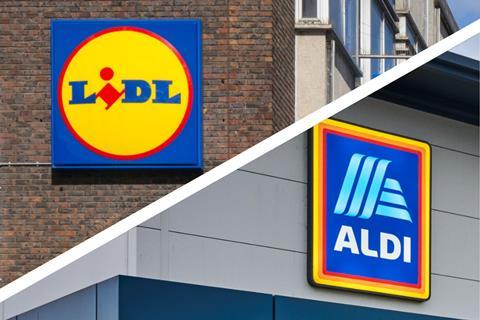
Aldi and Lidl understated the size of their grocery ranges by about 40% by counting multiple product variants as one, according to the Competition & Markets Authority.
The revelation is in the CMA’s 80-page decision that Aldi and Lidl are no longer limited assortment discounters (LADs) and should face the same competition rules as large grocery retailers (LGRs) such as Tesco, Sainsbury’s and Asda.
Both Aldi and Lidl have maintained they have a core range of fewer than 3,000 products, but in fact they offer an average 4,000-5,000 grocery lines in the vast majority of stores, according to the CMA.
The discrepancy is because both “manage multiple product variants within a case as a single SKU”.
“Aldi explained that each case may contain up to four variants, for example four different flavours, all sharing the same case code, brand, weight (with minor variance) and price,” said the CMA.
The CMA counted each variant individually “as this better reflects the range available to consumers and provides a more consistent comparison with the LGRs, which count similar variations separately”.
“Aldi reported having 2,000-3,000 total products… but when splitting out variants had 4,000-5,000 SKUs,” it said. It made a similar finding with regard to Lidl.
The CMA also disregarded a distinction relied on by Aldi and Lidl between permanent and temporary lines, deciding that both are “available to consumers”.
“Any temporary or geographically limited availability is better reflected through an average SKU count, which gives proportionally less weight to such products,” said the report.
The report is the outcome of a consultation on whether Aldi and Lidl should be banned from using restrictive clauses in land deals to block rivals from opening nearby. The ban already applies to seven of the country’s biggest grocers – Tesco, Sainsbury’s, Asda, Morrisons, Co-op, M&S and Waitrose – under the 2010 Controlled Land Order.
At the time of the order, Aldi and Lidl were judged to be distinct as LADs, selling only 1,000 lines each, and not in direct competition with LGRs.
Aldi has cited its current range size in arguments that it remains a LAD and should not be added to the order. In a response to the consultation earlier this year, Aldi said its core range was just 2,005 lines, “representing approximately 7%-10% of the 20,000 to 30,000 SKUs typically offered by LGRs”.
“Even when including any products on ‘trial’ and those considered regionally specific, seasonal lines and groceries included in Aldi’s Specialbuy range, we offer no more than approximately 2,703 grocery SKUs at any time,” Aldi said.
In fact, its 4,000-5,000 lines puts it much closer to an LGR, with M&S offering 6,000-7,000 in an equivalent-sized store, according to the CMA.
The numbers have been a point of contention between retailers, with Iceland telling the CMA: “Public sources indicate that each of Aldi and Lidl currently range around 4,500 SKUs.”
Larger stores
The CMA also found that 87% of Lidl GB’s stores and 72% of Aldi’s had a net sales area or more than 1,000 sq m (11,000 sq ft) – big enough to be classed as a large grocery store under the order. At the time of the order their stores were as small as 5,400 sq ft.
The decision to add them to the order is provisional and subject to a further consultation.
Welcoming the decision on Linkedin, Iceland executive chair Richard Walker said: “If major supermarkets are competing for the same customers, in the same communities, they should be competing under the same rules.
“A level playing field supports greater local choice, encourages continued investment in communities and ensures that retailers compete on the things that really matter to shoppers: price, value, service and quality.”
Iceland also falls outside the 2010 order, as it was judged distinct as a frozen food retailer. The CMA has not considered adding the retailer.
Both Aldi and Lidl have said the decision will not affect their expansion plans. Neither provided further comment on the range size revelation in the CMA report.



No comments yet