
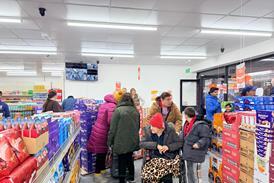






Asda chairman Allan Leighton has insisted the supermarket is “edging forward” and showing positive signs of momentum, despite annual results revealing further sales decline.
Overall sales dropped 3.3% to £2.1bn in the year to 31 December, with like for like sales down 3.1%. Adjusted EDITDA, not including rent, was down by a third (33.1%) to £746m.
Leighton was upbeat, insisting the decline was almost entirely down to Asda being “whacked” by the implementation of its ‘Project Future’ to decouple its systems from Walmart in August.
A bungled implementation left shelves empty and shut down online shopping, which Leighton previously warned would set back Asda’s turnaround by six months and have implications on its full-year sales.
Core systems were now “stabilised”, though online shopping remained inhibited “a tad”. Leighton said Asda had returned to growth in quarter one of the current financial year, with like for like sales up by of 1.2% in March. The supermarket also ended 2025 with an “eight-year high” of 95% availability.
Investment into its Rollback promotion cycle and price cuts during the year had helped Asda open up a 4-7% price gap on its traditional big four rivals, Leighton said. It was still some way behind his target of 5-10% but was positively impacting sales “now”.
A “large slug” of the hit to EBITDA had been as a result of Asda’s price investment, which had “always” been planned, Leighton said.
Read more: Has Asda’s turnaround run out of steam before it’s left the station?
Beyond grocery sales, Asda’s pharmacy, fuel, George clothing, online and optical businesses were all “doing well in their markets”, Leighton said, accounting for 47% of revenues. Convenience sales through its Express stores were also “ahead of the market”, though Leighton declined to give a figure.
Cost cutting as well as the sale and leaseback of Asda stores by private equity owner TDR had helped reduce overall debt by £500m to £3.1bn. Asda had £2.1bn in liquidity on its balance sheet, Leighton added.
“We’ve still got plenty to do,” he said. “Stable core systems, tick. Stable leadership exec team now in place, tick. Capital structure stable, tick. We’ve got some momentum edging forward.”
Middle East crisis incredibly ‘spikey’
Asda’s market share dropped by a full percentage point to 11.4% in 2025, according to Worldpanel by Numerator data. It was the only major UK supermarket to record sales fall at Christmas, down by 4.2% year on year in the 12 weeks to 28 December. It led to a major sell off of its bonds in January as investors grew tetchy about its performance.
Latest Worldpanel data has Asda’s share at 11.5% in the 12 weeks to 22 February 2026, with sales down 2.6% year on year.
Now 18 months into to his second major attempt to turnaround the supermarket, Leighton said “positive momentum” provided evidence turnaround plan was working.
He maintained it would take five to 10 years to see the plan through.
“I’m happy when we’ve got some momentum and we’re edging forward. You don’t suddenly make great leaps. Day by day by day, you just have to get better,” he said.
Asked whether conflict in the Middle East posed a threat to progress, he said: “I don’t see anything as holding back the recovery of the business.
“It’s a bit difficult to tell what the impact will be at this moment in time because everything’s so spiky and changes on an hour to hour, day by day basis.”
He said some cost price increase requests from suppliers were “inevitable”, but the amount Asda had fielded so far was “sub a trickle”. It would look at any request “one by one”, Leighton said.







No comments yet