




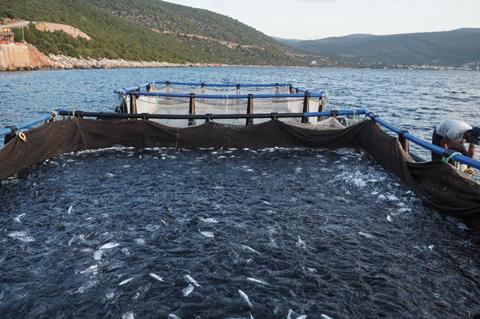
Compassion in World Farming has said there is “room for improvement” as it benchmarks sea bass and sea bream producers for the first time.
Building on the back of its Salmon Welfare Scorecard, Compassion launched its first Sea Bass and Sea Bream Welfare Scorecard on Tuesday, in a bid to increase supply chain transparency.
Comparing 13 of the world’s largest producers against 11 welfare criteria, the charity said, “most producers did not communicate widely about their welfare practices and their communication focused on one or two criteria”.
The criteria includes publicly available information, from commitments, to policies and reports, covering areas such as stocking density, humane slaughter and welfare assessment.
Each parameter was scored independently and presented on a five-tier scale that can be tracked over time to monitor progress.
Read more: Consultations open on four new fisheries management plans
Compassion conceded five out of the 13 communicated about most of the of the criteria, but, it said, “there is still significant room for further improvement in transparency, reporting and policy development”.
“More than half of the seafood consumed today is farmed, making aquaculture the fastest-growing food sector worldwide”, said Dr Daniel Sanchez, senior research manager for fish welfare at the organisation. “With this rapid expansion comes a responsibility to implement and uphold policies and practices that ensure good welfare.”
The producers assessed in the 2025 Sea Bass and Sea Bream Welfare Scorecard included: Abalioglu, Avramar, Cooke, Cromaris, Galaxidi, Gloria Maris, Gruppo del Pesce, Gumusdoga, Kefalonia, Kiliç, Philosofish, Sursan and Waterhouse.
CIWF has measured across 11 parameters including: enclosure, feed and feeding, genetics, health planning and treatments, humane slaughter, welfare assessment, mortality, preadator management, stocking density, training and husbandry, and environmental parameters.
Key findings and recommendations revolved around stocking density, humane slaughter and genetics.
The charity revealed that only four producers achieved a tier above 1 for fish stocking density, with Abalioglu, Avramar and Kefalonia, reaching Tier 4 having set a maximum stocking density of 15kg/m3, in line with CIWF’s recommended limit for sea bass and sea bream welfare.
However, most producers do not disclose the actual densities reached during production, making it impossible to verify whether commitments are being met, the charity said.
Read more: Tesco suspends salmon supply from Bakkafrost farm
Reporting was weakest in the genetics category, with only Kefalonia scoring above Tier 1, which “raises concerns about the development of breeds whose welfare impacts have not been adequately tested”.
The strongest performing parameter was humane slaughter, with most producers reaching Tier 3 or above, which the charity said indicated it was a “highly topical issue, marked by a mix of commitments and varying levels of implementation”.
The next Sea Bass and Sea Bream Welfare Scorecard will be published in late 2027.
Sanchez added: “We work with the food industry to identify welfare issues and encourage producers to adopt higher welfare practices and more sustainable solutions.”






No comments yet