





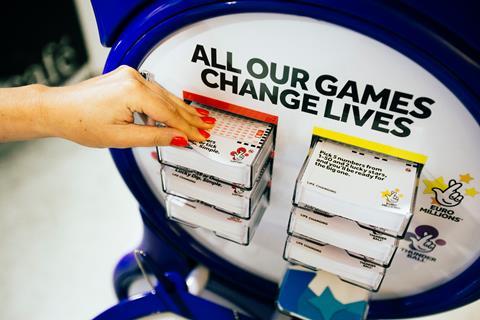
The New Lottery Company and Northern & Shell have lost a legal battle against the Gambling Commission over the awarding of the National Lottery licence.
The companies, owned by media tycoon Richard Desmond, had challenged the “fairness and integrity” of the competition process for granting the fourth 10-year lottery licence to Allwyn.
They argued the Gambling Commission was in manifest error in scoring TNLC’s bid as a ‘fail’ in key elements of the competition criteria and that it breached transparency obligations. The claimants were seeking damages of over £1bn in compensation for lost profits.
The case also focused on modifications made to the agreement to manage delays to Allwyn’s takeover caused by litigation from unsuccessful bidders. The claimants alleged it resulted in a National Lottery contract “significantly different” from that on which TNLC had bid.
The High Court dismissed TNLC’s claims, finding that the Gambling Commission conducted a “rigorous, methodical and fair process which resulted in rational conclusions which it was entitled to reach”.
It upheld the commission’s assessment that TNLC did not meet mandatory requirements and it did not make a manifest error in its scoring, with the court noting Allwyn’s score was 87.2%, Camelot 85.7% and TNLC 57.5%.
“In my judgment, the commission reached a lawful and objectively justifiable outcome,” said Justice Joanna Smith. “There are no grounds for the court to find that the commission did not assess tenders on an equal basis.
“Accordingly, the claimants have failed to establish that TNLC had any real chance of winning the competition. The claimants are therefore not economic operators who have suffered or risk suffering loss and damage.”
The judge also found the delays to Allwyn’s transition were not caused by Allwyn but by factors outside its control, such as litigation brought by unsuccessful applicants Camelot, IGT and TNLC, as well as IGT needing a commercial agreement for the technology transfer from Camelot to Allwyn.
Justice Smith said the need for licence modifications came from “the hostile litigation” pursued by Camelot and IGT, alongside a lack of co-operation and a “lengthy and difficult period of negotiations”, which fundamentally undermined Allwyn’s ability to progress the transition.
“Although the challenged modifications were foreseeable, they were not substantial in that they did not change the economic balance in favour of Allwyn in a manner that was not provided for in the competition version of the enabling agreement and fourth licence,” the judgment said.
“Even if that is wrong, the claimants have not established that any breach has caused them to suffer a loss. There is no real prospect on the available evidence that TNLC would have won a fifth National Lottery contract.”
An Allwyn spokeswoman said: “We welcome the clear and comprehensive judgment, which confirms that the Gambling Commission ran a fair and lawful licence competition, properly awarding the fourth National Lottery licence to Allwyn. The court further found that both good causes and Allwyn have suffered significant losses due to the delays caused by litigation brought by the unsuccessful applicants.
“It also draws a line under a long-running series of allegations about the integrity of the competition process, many of which were withdrawn during the proceedings, with the remainder rejected by the court.
“The judgment provides clarity and legal certainty, and our focus now is on delivering for players and increasing funding for good causes. That means moving faster on innovation such as New Lotto and Powerball, which we announced earlier last week.”
The Gambling Commission said: “This judgment makes clear that the Gambling Commission ran a fair and robust competition to award the fourth National Lottery licence, and that none of the contested changes to the licence, in the course of its implementation, were substantial or contrary to the relevant procurement regulations.”










No comments yet