





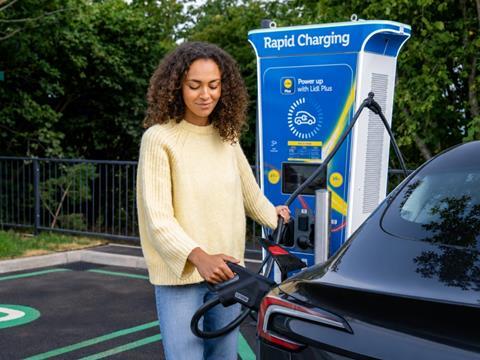
Lidl has reduced the tariffs for electric vehicle charging for loyalty member shoppers.
The discounter has reduced the charging rate from 62p/kWh to 59p/kWh for electric vehicle drivers with Lidl Plus.
The supermarket said those taking advantage of the discount would save approximately £4 per session, adding up to an annual saving of £529.
It comes as Lidl is investing £10m this financial year in its charging network, including the installation of about 100 new rapid chargers at existing stores.
This is in addition to the discounter’s £25m investment into its charging network since 2017, with a third of Lidl GB stores currently offering rapid EV charging.
“For over 30 years, we’ve focused on giving customers the best possible value on their groceries, and our EV network is an extension of that promise,” said Richard Taylor, chief real estate officer at Lidl GB.
“By expanding our rapid chargers, we’re making it as simple and affordable as possible for shoppers to top up while they shop – helping EV drivers save money and supporting more sustainable everyday habits,” he added.
Lidl is also committing to installing rapid chargers in the majority of its newly built stores, “bringing high-speed charging directly to local communities”.
The discounter said that unlike most supermarkets, which rely on third-party operators, Lidl owned its charge points outright.
This “unique business model” meant the retailer could “take a customer-centric approach”, it said. Lidl is the first supermarket in the UK to integrate EV payments directly into its own loyalty app, via Power up with Lidl Plus.
In the past year, EV charging at Lidl GB stores has powered 49.1 million miles of electric driving.
According to a recent report from the Society of Motor Manufacturers and Traders, the number of fully electric cars on UK roads has increased threefold since the end of 2022, reaching more than 2.1 million vehicles.
Despite the growth, a Department for Transport report revealed that almost half of EV drivers (47%) feel there are not enough public charge points to meet demand, and nearly a quarter (24%) are dissatisfied with local availability.







No comments yet