




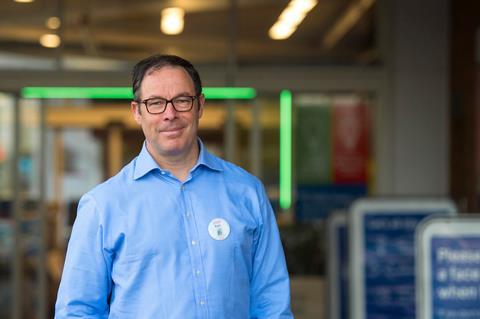
Tesco boss Ken Murphy has pledged the supermarket will do “whatever it can” to keep the cost of the weekly shop down in the face of uncertainty over the Iran war.
“That commitment matters more than ever,” he said in a statement accompanying Tesco’s preliminary annual results.
The supermarket exceeded its own expectations in the financial year, beating profit targets and posting 4.6% revenue growth, with UK like-for-like sales up 4.2%. Sales excluding fuel reached £66.6bn, adjusted to a 52-week basis to 22 February 2026. On a constant currency basis revenues grew 4.3%.
Tesco’s adjusted operating profit nudged up to £3.15bn, outperforming its own estimates of £2.9bn-£3.1bn after a strong showing over Christmas.
Tesco’s share price rose 3% in early trading this morning.
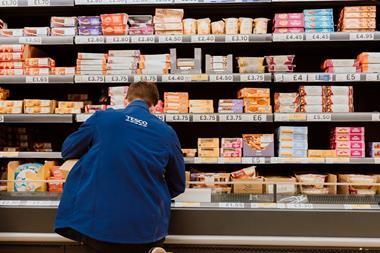
Doubling down on Tesco’s strategy of gaining market share through significant price investments, Murphy repeated the supermarket’s pledge to triple the number of products in its Everyday Low Prices scheme to 3,000.
Tesco’s market share was up 24bps in the year to 28.5%, having reached a decade peak in December.
Murphy said the supermarket was “committed to doing whatever it can to help keep down the cost of the weekly shop”.
“With the conflict in the Middle East creating further uncertainty for consumers and the economy more broadly, that commitment matters more than ever,” he said.
“Over the last year, despite cost pressures from new regulation, we have increased our investments in keeping prices low, further improving quality and offering even better service. Customers are choosing to shop more with us as a result, leading to our highest market share for over a decade.”
Murphy pointed to Tesco’s Save to Invest programme, which has funded the supermarket’s investments in pricing and staff pay by delivering £2.2bn of savings over the past four years. It today announced a further £500m savings target for the new financial year.
The uncertainty created by the war in the Middle East also led Tesco to widen its profits outlook for the current financial year further than previously planned.
“Much will depend upon the duration of the conflict and in particular, the potential implications for UK households and the economy more broadly,” the supermarket said.
It predicted adjusted operating profits of between £3bn and £3.3bn for 2026/27.
“This is careful and conservative guidance in the face of the Middle East war and to avoid accusations of profiteering,” said Bernstein analyst William Woods.
“We think with higher food inflation and higher fuel prices, they should be able to reach at least the upper end of this range.”
Tesco’s continued run of growth and high profits has set a high bar for the coming year, according to Shore Capital analyst Clive Black.
”Against multi-year tough comparatives, Tesco did another truly commendable job in FY26 to gain both volume and value, market share; and that tough comparative is going to be part of the FY27 story, especially for H1,” he said.
Despite that, he maintained Tesco’s worth as a “high-class defensive stock”, especially after this morning’s announcement of a further £750m share buyback programme.
“Steady EPS growth, a still decent dividend and earnings yield (from the buyback) mean that in terms of total shareholder return, we keep our positive stance on this asset-rich, cash generative and so high-class defensive stock.”


No comments yet