



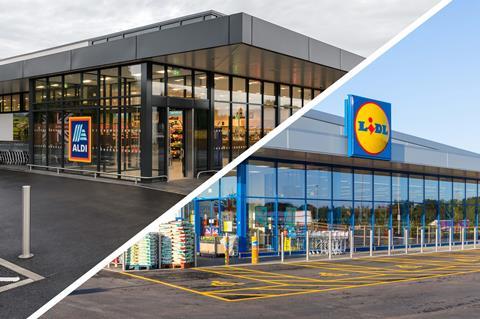
Aldi and Lidl will be subject to same land rules as other major supermarkets, the Competition & Markets Authority has decided.
The competition regulator has confirmed the two discounters will be banned from using restrictive clauses in property deals to block rivals from opening nearby. The decision brings Aldi and Lidl in scope of rules that have applied to seven other major UK supermarkets – Tesco, Sainsbury’s, Asda, Morrisons, Co-op, M&S and Waitrose – since 2010.
“The rules ensure supermarkets compete freely – and ultimately ensure shoppers have more choice about where to buy, and how much to pay for, their groceries,” the CMA said.
The CMA’s announcement today finalises its provisional decision in August that Aldi and Lidl compete for the same weekly shoppers as other major supermarkets, and should no longer be considered separately as ‘limited assortment discounters’.
Read more: Revelations in the CMA’s decision that Aldi and Lidl are not limited-range discounters
The CMA said interested parties including Morrisons, Waitrose and Iceland had all supported its provisional decision to designate Aldi and Lidl as ‘large grocer retailers’ (LGRs) under the 2010 Controlled Land Order.
Aldi and Lidl using restrictive clauses to block rivals
Morrisons said: “The CMA’s designation of Aldi and Lidl as LGRs is particularly important in light of the provisional decision’s finding that Aldi and Lidl are both using restrictive covenants and exclusivity agreements in their land agreements in order to limit competition in the supply of groceries in the UK.”
The provisional decision report revealed that a 10% sampling exercise of Lidl GB’s existing land agreements had found 10-20% of them contained a restriction on grocery retailing nearby. The same exercise by Aldi revealed similar restrictions in its land deals.
Once designated under the order, a retailer cannot include any prohibited restrictions in new land agreements, and existing agreements can be reviewed by the CMA.
Waitrose said the significant expansion of Aldi and Lidl over the past 16 years meant they did not only compete with existing LGRs for customers, “but also for suitable grocery retail sites”.
“Waitrose has encountered, first hand, restrictions secured by Lidl which restrict the ability of other grocery retailers to open new stores and shield Lidl from local competition,” the supermarket said.
“Waitrose requests that, immediately after designation, the CMA requires the review of all land dealings across Aldi’s and Lidl’s respective estates.”
Iceland said: “Aldi and Lidl deliberately position themselves as non-specialist, mainstream supermarkets serving the essential grocery needs of the nation.
“It is untenable for Aldi and Lidl to advertise that they offer a sufficient range of groceries for a customer to complete a full weekly shop; but an insufficient number or range to warrant designation as an LGR.
“They cannot have it both ways.”
Read more: Only 26 sites on the UK market could provide Aldi or Lidl a new location
Since 2020, the regulator has named and shamed Tesco, Sainsbury’s, Asda, Morrisons, Co-op, M&S and Waitrose for breaching the order.
“We put in place rules to stop big supermarket chains from blocking rival stores opening in their area, and now those rules apply to Aldi and Lidl,” said Juliette Enser, CMA executive director for competition enforcement.
“This will help level the playing field and make sure shoppers get the best choice of products and prices in their area.”
Both discounters said it would not impact their expansion plans.
“The CMA’s decision does not change our commitment to invest in the UK and work towards our long-term ambition of 1,500 stores, bringing high-quality, affordable food to more communities, while ensuring that we comply with any relevant obligations under the Controlled Land Order,” said an Aldi spokesperson. “We will invest a record £900m next year in 40 new stores and continued improvements to our distribution network.”
A Lidl spokesperson said: “As a discounter, we have always welcomed and embraced competition within the market and our focus remains on continuing to open new stores and bringing our high-quality, lowest-priced groceries to even more communities. The CMA’s decision regarding our status under the Controlled Land Order will not impact our steadfast momentum and growth.”
It leaves Iceland as the only one of the UK’s 10 largest bricks-and-mortar supermarkets that remains exempt from the order. Like Aldi and Lidl, it was considered distinct from other major supermarkets when the order was drawn up, but as a frozen food retailer rather than a limited assortment discounter. The CMA has not considered adding it to the order.







No comments yet