




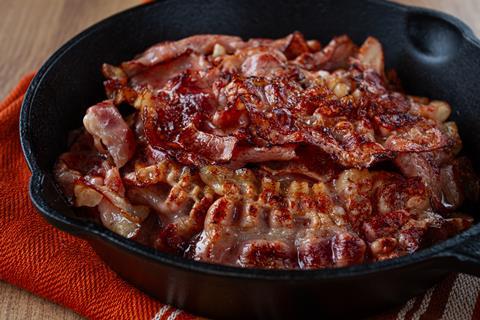
Meat sector bosses have urged “common sense” in the debate over the use of cancer-linked nitrites in bacon, despite a big uptick in demand for nitrite-free options in recent weeks.
Sales of nitrite-free bacon have surged since the launch of a campaign in October calling for larger volumes of the product to be stocked in supermarkets, alongside demands from scientists in the Coalition Against Nitrites (including food safety expert Professor Chris Elliott), for the Food Standards Agency to ban the use of the chemical in the curing of pork.
Spend on nitrite-free bacon was up 21.7% in the 12 weeks ending 25 January, with volumes up 19.6% [Worldpanel by Numerator].
But despite an increase in consumer demand for nitrite-free options, industry experts have said that the science on nitrites in processed meat products remains “inconclusive”.
Rod Addy, director general of the Provision Trade Federation, said that the major research from the International Agency for Research on Cancer was “focused on processed red meat rather than nitrites per se”.
“And from a common-sense perspective, does it make sense to single out a single, ingredient as the cause of something? That smacks to me of sensationalism,” he told The Grocer.
“The reality is, science is a lot more complicated than that, and cancer is a lot more complicated than that,” he added.
Addy’s comments were met with a stern response by the Coalition Against Nitrites, with a spokesperson for the campaign group agreeing with his call for “common sense”, but also arguing “when safer alternatives exist, it makes no sense to add a carcinogenic chemical to food”.
“For the health of the nation, to reduce pressure on our NHS and for the long-term commercial success of the food industry, the common-sense position is to heed the calls of the world’s leading food scientists, senior figures from all major political parties and an overwhelming majority of the public,” said the spokesman. “It’s common sense for all bacon and ham to be nitrite-free.”
However, the meat industry’s point of view was supported by the FSA, whose deputy director of science and research Professor Rick Mumford said that while it was understood processed meat increases the risk of bowel cancer and other illnesses, “the exact cause of these risks remains unclear”.
Read more: Bacon backlash over cancer fears drives sales slump
Addy agreed the sale of nitrite-free options were likely to continue to grow, adding “most pork suppliers now offer some sort of nitrite-free alternative within their ranges”. At the same time, British Meat Processors Association CEO Nick Allen said its members had “been implementing new methods to get nitrite use as low as possible without jeopardising public health”.
Allen added the trade body’s members had achieved up to a two-thirds reduction in the need for nitrite use in products, which is well below the FSA limits.
But despite this, Jason Aldiss, executive director at AIMS, stressed the “current debate risks oversimplifying a complex issue”.
“Removing nitrites is not risk-free – it is a question of risk substitution, and any move in that direction must be grounded firmly in science and food safety outcomes.”
Aldiss added that “nitrites are not simply an ingredient choice – they are a highly cost-effective food safety control” and their removal will have “direct cost consequences across the entire supply chain” with smaller businesses experiencing a disproportionate amount of the cost.
This was echoed by Mumford, who said “there is no evidence that removing nitrates or nitrites makes processed meat safer”.






No comments yet