





Britain’s declining domestic food production is weakening the country’s ability to withstand conflict and other serious disruption, NFU president Tom Bradshaw has warned.
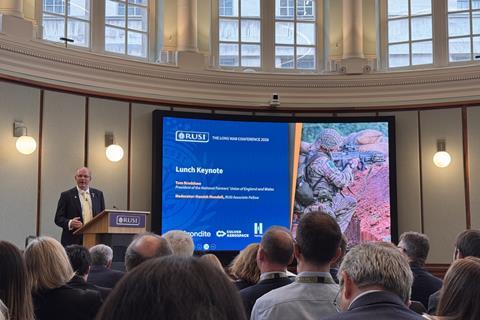
In a keynote address at the Royal United Services Institute conference, Bradshaw said the food system was “under attack” and that food had already been “used as a weapon of war”.
“We have seen access to grain restricted, global supply routes disrupted and attacks on the infrastructure that stores and distributes food,” he added. “We have seen how quickly a conflict thousands of miles away can drive up the cost of producing food here at home.”
He warned that for years food security had been taken “for granted” which has shaped food policy and is “no longer fit for purpose”.
“Britain cannot simply assume that food will always be available from somewhere else, in the quantities we need, at a price we can afford,” he added, also warning that as production falls, capacity that makes production possible such as skills, infrastructure and facilities falls too.
“Food forms part of our national security. The government now says the same – food security is national security. But, we now urgently need to move beyond saying it,” said Bradshaw.
Addressing defence experts, senior members of the armed forces and politicians, Bradshaw set out how Britain could strengthen its national resilience by investing in domestic food production, supporting profitable farm businesses and embedding food and farming in the prime minister’s forthcoming 10-year plan.
The farming union leader called on the government to undertake a “proper” assessment of the food production capacity Britain would need during a serious or prolonged disruption.
He called on the government to “face up to the investment required” and “set a clear target for domestic food production”.
“Above all, we need a long-term partnership between government, farmers and the wider food supply chain,” he said. “Because government cannot create the resilience I’m talking about today all on its own. It relies on farm businesses being profitable now, rather than expecting them somehow to reappear when the country needs them.”









No comments yet