



Extending sugar taxes to include unhealthy foods beyond the soft drinks levy could cut adult obesity in the UK by 16%, new research commissioned by government health advisers has found.
However, the modelling shows it would also lead to higher food prices, with some products, including the most sugar-laden chocolate and sugary snacks, likely to see cost hikes of up to 30%.
Influential nudge body Nesta, which has been a major influence on government moves to tackle the obesity crisis, has recommended that ministers stop short of bringing in such new taxes because of the impact they would have on shoppers.
Last year, Nesta was among groups to back an umbrella group of more than 40 health bodies that called on the government to build on the success of the Soft Drinks Industry Levy by introducing new levies on unhealthy food, underpinned by the nutrient profiling model score.
However, subsequently Nesta commissioned the consultancy Oxford Economics to model the impact of what would be the first UK tax to be based on the NPM, which is already used to determine ‘less healthy’ food in other policies, such as the junk food advertising ban that came into force in January.
The research concludes that such taxes could be an effective model for a tax policy designed to reduce obesity rates in the UK. As well as the 16% reduction in obesity, it could raise up to £1.6bn in revenue for the Treasury, it notes.
However, the tax would likely increase the average price of a typical food basket for consumers by around 1%, it found.
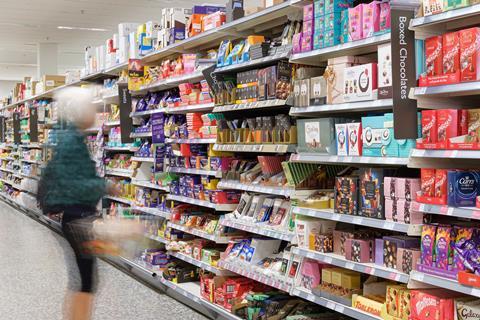
The economists claim while groceries classed as ‘healthy’ under the NPM would not increase in cost, for some of the most unhealthy products – such as chocolates and sugary snacks – prices under the tax could rise by almost a third.
The research used data on food purchases from 30,000 GB households under Worldpanel by Numerator’s Take Home panel.
It considered the likely impact of an NPM-based tax on UK food prices, adult calorie and salt intake, and tax revenue. It included looking at the likely response from food producers, to estimate the scale of reformulation among foods that would be in scope of the tax, as well as the consumer response to likely price changes.
The research assumed that unhealthy foods (those with an NPM score of over four) were taxed at 6p per kilo for every one point increase in NPM.
An unhealthy pizza scoring NPM 4 would pay £0.06 per kilo in tax, while an unhealthy chocolate scoring NPM 20 would pay £1.02 per kilo, assuming no reformulation.
Healthy products would pay zero tax.
With such a tax rate, the research found NPM taxes could lead to reductions of 2.5%-3% in terms of calories consumed (45-59 calories) and a 1% reduction in salt consumed per adult per day.
It found this could lead to a 16%-19% reduction in adult obesity rates in the UK over five years
“Overall, OE modelling estimated that the average food basket bought for consumption at home would become around 1% more expensive,” found the study.
However, it added: “Price increases were larger in categories with a high share of unhealthy products. For example, chocolates and other sugary foods saw average price increases of around 10%. This is lower than recent inflation-driven increases, such as the over 18% rise in chocolate prices in 2025.
“Some of the unhealthiest products might see higher-than average price rises, up to 25% to 30% for some chocolates and other sugary foods.
“In practice, prices could rise by less if producers absorbed some of the tax, rather than passing on 100% of the costs to consumers.
“In reality, producers might absorb some of the costs of the tax, which might lead to lower price increases for consumers (and potentially slightly lower health impacts).”
Crunch talks
Today’s findings come out after The Grocer revealed yesterday that food industry leaders will meet ministers tomorrow for crunch talks over plans to ramp up the existing model of the NPM to move to a new 2018 model, which would classify thousands more products as unhealthy.
The researchers said that while the modelling conducted was on the existing 2004 NPM model and was completed before the proposed NPM update was published in January, they believe the update to the NPM model was unlikely to change the mechanism or impact of an NPM-based tax.
“Because the tax is based on the continuous NPM score, rather than a single nutrient, updates to the model may change how producers reformulate, but not whether they do so,” it found.
Hugo Harper, director of healthy life at Nesta, said: “Obesity can lead to people suffering from debilitating conditions such as diabetes, as well as costing the NHS around £12bn a year.
“Our analysis adds to the evidence that shows taxation can be a highly effective lever for reducing obesity. Too many previous government health measures have failed to make an impact because they have been small-scale or relied on individual willpower, when what is sold and marketed to us has made it harder to have a healthy diet.
He added: “While a tax based on a more holistic measure of food could reduce obesity rates in Britain and raise additional revenues for public health, any tax on unhealthy food is likely to come with some cost to consumers. Our analysis shows that a tax can be designed so that higher prices fall on unhealthy foods, but the reality is that many people are already struggling with food prices.
“We believe the government should move forward with implementing the healthy food standard, which was announced in the 10-year plan for health. A policy that sets targets for the largest grocery retailers in the UK, such as the healthy food standard, would reduce obesity rates while having very little impact on food prices.”




No comments yet