






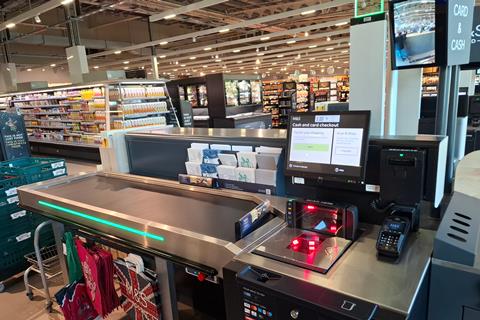
M&S chairman Archie Norman has blamed self-checkouts for encouraging usually “honest people” to shoplift.
The proliferation of self-checkouts had removed a “human link” in shopping and the technology had to improve, Norman told The Telegraph.
“When normally good, honest people come in and they’re buying their shopping and it doesn’t scan, and there’s nobody manning the checkouts, they’re saying: ‘It’s not my fault and I don’t have much time so if I can’t get my strawberries through, I’ll just put them in my basket’,” he said.
The solution was not to “bring back in-person checkouts” but “it does mean you’ve got to make the technology easier for people to use,” Norman added.
M&S has adopted self-checkouts widely across its Food Halls, having begun testing the technology as long ago as 2002. In 2024 it began adding bigger self-checkouts with a conveyor belt, designed to cater for a trolley shop.
Norman drew a distinction between shoplifting linked to self-checkouts and the violence and intimidation referred to by M&S retail director Thinus Keeve in a call for police in London to do more earlier this month.
“When you have gangs of kids coming in and sweeping the shelves, that’s a police event and it requires an active police response,” said Norman.
“When something like that starts to become common it says to everybody, including ordinary citizens, that it’s not safe.”
Keeve and M&S CEO Stuart Machin wrote to the mayor of London and the home secretary calling for urgent action after a large group of young people caused a disturbance and attempted to access shops on Clapham High Street, including M&S.
Keeve said: “In the past week alone we have had gangs forcing open locked cabinets and stripping shelves, two men brazenly emptying the shelves of steak and walking out, a large group of young people ransacking a store before assaulting a security guard, a colleague headbutted trying to defuse a situation and another hospitalised after having ammonia thrown in their face.
“It is worse in London, but it is happening across the country, and it is becoming routine, because it seems there are no consequences.”
Read more: Annual cost of shopworker abuse as high as £1bn, analysis finds
Latest ONS data yesterday showed shoplifting offences declined by 1% in the year ending December 2025, to 510,000.
“Retail theft is a significant challenge for retailers, with our own figures showing 5.5 million detected incidents of theft last year,” said BRC crime policy adviser Lucy Whing.
“While ONS figures likely underestimate the issue, as it only captures reported incidents, it aligns with our own data showing high levels of shoplifting in recent years. The causes are manifold, but the rise in organised crime is particular worrying as gangs systematically target one store after another across the country.
“Retail theft also contributes to rising levels of violence and abuse against staff, with 1,600 incidents every day.”
“Fortunately, there are some signs of progress, with the government and the police taking steps to address retail crime through the Crime and Policing Bill which will soon receive Royal Assent,” Whing added.
The legislation will abolish the £200 threshold for so-called ‘low-level’ theft and create a specific offence of assaulting a retail worker.
“It is vital that the police make full use of this new legislation so we can bring these numbers down once and for all,” said Whing.










No comments yet