





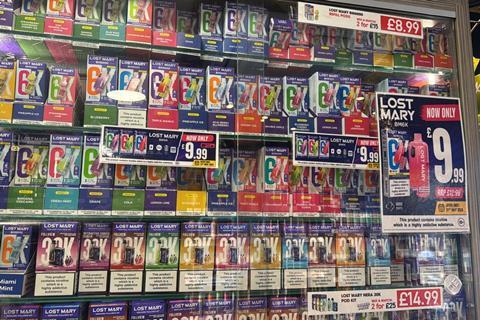
The government’s claim that adapting gantries and till areas to comply with the proposed vape display ban will cost a convenience retailer just over £150 is a “serious underestimate”, the ACS has warned.
It follows the Department of Health and Social Care launching a 12-week consultation earlier this month, which included proposals to restrict displays of vaping and nicotine products as part of its efforts to stop young people vaping.
In its impact assessments, the government has assumed convenience retailers and small shops would opt for additional storage with a smaller footprint and upfront cost to comply with regulations, such as under-counter storage or drawer units rather than additional display cabinets.
It had also factored in the possibility that retailers could receive funding for storage from manufacturers, similar to when previous display regulations were introduced for tobacco.
On this basis, it has estimated the final storage costs for convenience retailers and small shops would be £156.20 per store on average, totalling £6.6m for the 43,940 stores in England overall.
“This is a serious underestimate, and we will be submitting evidence from members in the coming weeks that sets out the real cost and impact of changing gantries, which easily runs into four figures per store,” said ACS external affairs director Chris Noice.
Government is also proposing a minimum notice period of six months would be enough time to update their stores to comply with the necessary changes.
As part of the open consultation, the government is also proposing to introduce plain white packaging on vapes, permit one regulated form of branding, and restrict flavour names.
It has evaluated the impact this would have on business elements such as transaction times, training costs, and profits.
The impact for c-stores
Convenience retailers have warned these proposals will trigger an operational “nightmare”.
“My concern isn’t the objective of the proposals, it’s that government continues to underestimate the cost and issues of implementing them,” said Nisa retailer Neil Godhania. “Small retailers don’t have dedicated compliance teams like the major supermarkets do.
“Every new regulation means more staff training, store refits, changing fixtures, updating procedures and time taken away from serving customers and investing into our communities, they really need to understand the impact and reality of running an independent convenience store.
“We’ll need to redesign vape displays, replace existing merchandising, retrain almost 70 members of staff, update our procedures and spend management time ensuring every store is compliant. All of that comes at a cost without any additional income.”
Londis retailer Nishi Patel said: “All my vapes and liquids are on the shop floor. People prefer to shop vapes because of their flavours and look; it improves the customer experience. So how am I supposed to find that space behind the gantry?
“I’ve dedicated five meters worth of shelf space to vapes and liquids. Not only will I lose out on vape sales, which account for 15% of my overall turnover, but if I must substitute that space which is currently for spirits, I would lose sales there too.
“Having my vapes on the shop floor also saves time for the staff behind the counter. Putting vapes behind the tills in plain white packaging in restricted displays will make transaction times go up massively.”
Best-one retailer Kay Patel has created a digital poster about the proposed new rules and the key issues. He has sent it to 300 retailers with the aim of raising awareness and encouraging retailers to respond to the consultation.
“These proposals add significant costs and operational challenges for us,” said Patel. “This is not a DIY project, there would be a lot of work involved to change our stores, and the six-month timeframe they are proposing is not enough. We’re stretched and short-staffed enough as it is because we can’t afford it. The impact this will have on transactions times and customer experience is going to be a nightmare.”
ACS said it was unnecessary for government to implement a display ban as well as plain white packaging.
“It is important that the government strikes a balance between ensuring that vapes are not appealing to young people, whilst also ensuring that there are viable and available alternatives for people seeking to switch away from tobacco,” added Noice.
“We do not believe that putting all nicotine products on the same footing in store (behind a gantry) achieves that balance. If the appeal of these products is to be reduced in all settings through the introduction of plain packaging, there is no reasonable need for a display ban for these products as well as this would cause unnecessary operational challenges and additional costs for retailers.”
The industry pushback comes despite wide public support for hiding vapes from view, with 65% agreeing vapes shouldn’t be visible in shop windows while 8% disagree with the plans, according to an exclusive survey of 2,000 people conducted by Find Out Now for The Grocer.
The number of vape users who agree with a retail display ban outweigh those who oppose it by 38% to 24%.
The research also found 54% of Brits agree that vapes should be restricted to white packaging, including a third of vape users. Some 6% of the general population and 20% of vape users disagree with the proposal.










No comments yet