


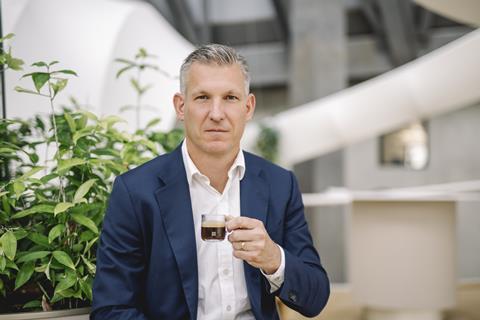
Nestlé’s turnaround under new CEO Philipp Navratil has taken hold, as organic growth accelerated to 3.5% and plans to sell its remaining ice cream businesses to its Froneri joint venture have reached “advanced” stages.
Arriving this morning after a month of investor pressure over Nestlé’s recall of contaminated baby formula, the results showed market share trends improving significantly, with group volume share now flat.
The business’s billionaire brands gave their “best performance in a decade” to win positive volume share growth, though underlying profits at the group fell 8.4% thanks to higher input costs.
Under Navratil, and predecessor Laurent Freixe, Nestlé has pursued an internal measure of volumes it calls real internal growth (RIG), backed by major cost savings.
While headline revenues were down 2% to CHF 89.5bn (£85.8bn), RIG held at 2024’s level of 0.8% growth. RIG accelerated over the course of the year, with volume growth of just 0.2% in H1 handily beat by H2’s 1.4% growth. Q4 saw a particularly strong perfromance, as 4% organic growth beat the analyst consensus by 60 basis points.
And while no major divestments were completed, Nestlé has announced it will merge its Nutrition and Nestlé Health Science divisions into a single business, while “sharpening” its portfolio around four key businesses.
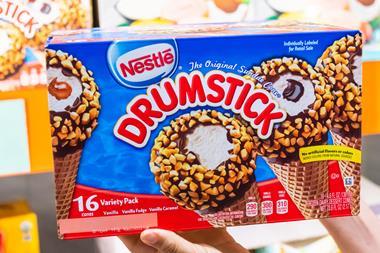
Its Food & Snacks division is expected to see further divestments, and the company is in “advanced negotiations” to sell the remainder of the ice cream businesses in six markets that it still owns to €5.5bn-turnover joint venture Froneri, which was formed in partnership with French PE firm PAI Partners in 2016.
Negotiations would see Nestlé sell the businesses in Canada, Chile, Peru, China, Malaysia and Thailand to Froneri, which was recently subject to a €3.6bn reinvestment by PAI.
Why is Nestlé making 16,000 job cuts and what has been the reaction?
“We are accelerating our strategy,” said Navratil. “We are focusing our portfolio on four businesses, led by our strongest brands, with prioritised resources and a simplified organisation. We are upgrading our marketing and innovation and increasing investment behind high-potential growth platforms, which now have an expanded scope and represent 30% of sales.”
A 50-basis-point bump to marketing’s share of sales helped drive “targeted” growth investment, and RIG was positive across all of the conglomerate’s geographic zones.
With pricing up 2.8% compared to last year’s 1.5% increase, the group’s overall organic growth improved to 3.5% from 2.2% the prior year.
Nestlé has now completed its recall of potentially contaminated infant formula.
The company expects growth for 2026 to be between 3% and 4%, with higher RIG compared to 2025.
Bernstein analyst Callum Elliott called the results “a solid set of numbers, belying the doom and gloom surrounding the stock over the past few weeks” in the wake of the infant formula crisis.
“The combination of strong Q4, solid FY guide, and coherent strategic update marks a strong start to the Navratil era, and we expect that the stock should react favorably today, having lagged significantly in the year to date.”
This story was amended on 19 February 2026 as an earlier version included factual inaccuracies. It stated Nestlé intended to sell its 50% stake in Froneri rather than offloading the remaining ice cream businesses still owned by the group to the Froneri joint venture. Nestlé plans to keep its holding in the joint venture alongside PAI Partners.
No comments yet