




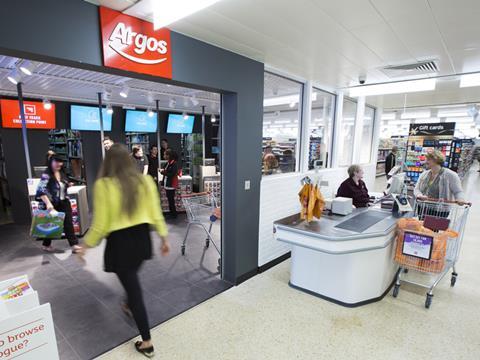
Investors in Sainsbury’s welcomed news this morning that the retailer had finally sealed a deal to sell Argos.
Shares in the FTSE 100 group raced 3.5% higher to 368p as markets in London opened today. It means Sainsbury’s stock is now up more than 12% so far this year.
Analysts also reacted positively in the immediate aftermath of the statement going out early this morning.
William Woods of Bernstein said the sale for £120m marked the end of a long, but ultimately failed, saga of the 2016 Argos acquisition.
The Sainsbury’s management team, led by Mike Coupe and John Rogers, paid £1.4bn for Argos when the deal was first struck. Woods noted the exit from Argos underlined the “continued capital destruction of food retail management teams who dream that they are anything but ‘boring’ supermarkets”.
“The dream of tying together omnichannel shopping across food and non-food didn’t really work, Argos and Sainsbury’s didn’t have the perfect customer overlap, and the categories are tough,” he added.
“We think this is a positive step for Sainsbury’s today, despite the miserly proceeds, enabling management to focus on the core food strategy and remove the permanent overhang of volatile Argos results.”
Woods also called the team behind Argos’ new owner, Swift, “strong operators” who were well respected in the industry.
Cut-price deal
AJ Bell investment director Russ Mould compared the cut-price deal to shoppers heading to Argos for a bargain.
“As often seems to be the case with UK supermarkets, Sainsbury’s has cycled between trying to cover lots of different areas and a focus on the core activity of selling food and essentials to households,” he said. “Right now, there is a pronounced swing to the latter.
“Argos’ weak and inconsistent sales have been an impediment to the business and the price agreed with Swift Partners reflects that. The market reaction indicates investors are relieved the situation has been resolved.”
Manjari Dhar of RBC described the sale as “a good strategic step” that would allow Sainsbury’s to focus more closely on its core operations in food.
“We note a somewhat modest net cash contribution [from the deal], but even so we think this removes a reason not to buy the shares for investors, and will allow the market to focus more on the core Sainsbury’s business, which has performed very well in recent years,” she said.
“Long-term commercial agreements with Argos, including rental income from stores inside Sainsbury’s stores and relating to Nectar, will create further value.”
A ‘good outcome’ for all
Clive Black at Shore Capital, which is Sainsbury’s house broker, reckoned the deal was a “particularly good outcome for shareholders in the here and now, plus tomorrow, too”.
“Sainsbury’s should benefit from enhanced focus with improved margin, returns and cashflows, which we think the equity market should like; future uncertainty and distraction being removed is also a major positive point that we believe can support the ongoing group equity rating. It has not been easy, but we commend CEO Simon Roberts and his team on this work.”
Black was also highly complimentary to the team behind Swift, which he said was led by “some of the greatest retail/consumer/business talent in the UK”.
“Argos is going to a quite outstanding new home, one where we can imagine that focus or, put another way, an independence dividend, could emerge in time, drawing upon the leadership, financing, innovation and technology skills of the new directors,” he added.
“Swift takes on an Argos that is self-improving, quarter on quarter, through the ‘more Argos more often’ plan, noting a period of quite sustained volume growth in recent times, against the backdrop of a fragile UK general merchandising market.”
Finally, Matthew Clements of Barclays also thought the sale would be a positive catalyst for Sainsbury’s shares, given it removed a volatile earnings stream and also £250m of net debt linked to leases.
“The [Argos] business has been a drag on growth, margins and free cashflow generation,” he said. “We were not always convinced at the ability of the two businesses to be separated given integration in the years since the acquisition, but discussions with JD.com in September 2025 [which ultimately failed] indicated a divestment was feasible.”



No comments yet