



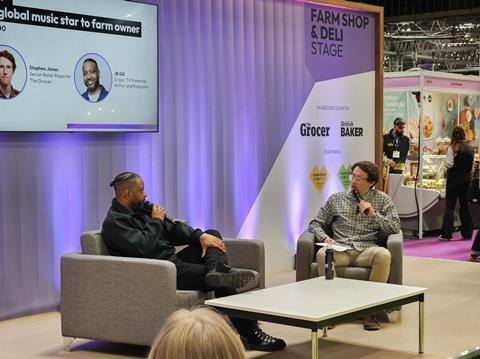
Kelvin Fletcher never intended to become a farmer. Known for two decades as Andy Sugden in Emmerdale, his real-life move into agriculture was sparked not by ambition, but circumstance. “Covid was a huge catalyst and that prompted the whole farming chapter that I live now,” he told The Grocer editor-in-chief Adam Leyland as part of a series of interviews and panels at this year’s UK Food & Drink Shows.
Plans to move to the US fell through, and instead he and his wife Liz bought a small farm in the Peak District “with no aspiration to farm. This is the irony, I played a farmer for 20 years.”
Early on, Fletcher felt underestimated. Turning up to a viewing in flip‑flops and an old Ford Fiesta, he recalls the estate agent’s assumptions: “Heard my accent, looked at the car… so that put a bee in my bonnet. And I like to prove people wrong.”
Farming quickly proved tougher and more emotional than expected. Losing livestock hit particularly hard. “I won’t be ashamed or shy to say it was heartbreaking. That was my first real heartbreak of our little farming chapter.”
Fletcher now runs a low‑input, mixed family farm and says agriculture has reshaped his life. “I’ve never had an industry that can teach me or give to me what farming has given me so far.” For him, success looks very different now. “I honestly couldn’t choose between being knee-deep in muck on my own little farm and walking the red carpet at the Oliviers. Both give me the same sense of achievement.”
Elsewhere, pop star‑turned‑farmer JB Gill says his route into farming was shaped by both his upbringing and a desire to reconnect people with where food comes from.
With Caribbean heritage, Gill explains that “that connection to where your food comes from and how you get your food is a lot closer” in small island communities, an approach that later inspired him to farm in the UK. Now running a premium turkey business, he is passionate about tackling society’s growing distance from food production, lamenting that “with farming as an industry you don’t get to see it, and when you see it it’s the end product”.
Education, he believes, is key. While his own children have grown up on the farm, Gill stresses the need to reach others, too. “If you don’t teach people to understand the food cycle,” he says, “you’re not able to get that information out there.” He’s also sure that the day-to-day of farmers up and down the country isn’t understood by policymakers or the public at large. Despite that, “I’ve never met a farmer who doesn’t love doing what they do, despite how hard it is being out in all weathers. They love to do it.”
Plant-based wins
One of the most successful rebrands in recent years has been the almost unanimous industry move from ’vegan’ to ’plant-based’. According to Carol Rhead, marketing and insight director at Compass Group, the shift has made a “huge difference” to how meat-free food is viewed, both within the food and drink sector and by the public at large. Just four years ago, plant-based food accounted for just 29% of Compass business. It’s more than 60% now.
Owning that foodservice space has been a key move for Redefine Meat. Jack Vandersteen, head of marketing at the meat substitute brand, explains that getting the products right for chefs and caterers meant they could make sure they were really good from the start. “We see ourselves as the gateway to vegan and plant-based food,” he told the audience. “Unlocking that ‘meaty’ experience for non-meat eaters is key.”
Keeping the conversation as positive as possible is also important, says Sarah Bentley, director of food and culture at Plant Based Health Professionals. She spoke about the reframing of vegan food as being ”the simple act of putting more plants on plates for people to enjoy”. Less ’meat-free’, more ’plant power’.
“It’s not about making everyone vegan,” she says. “Once people realised that wasn’t part of our agenda, the barriers started to come down and we were able to move out of the fringes and into the centre.”
Those shifting cultural perceptions mean the plant-based food sector is also benefiting from a wider focus on health, wellness and nutrition, with tech such as UPF‑rating apps increasingly shaping how shoppers choose what to buy.
As shoppers move away from ultra-processed foods, they are using apps such as Yuka and QuitJunk to check products’ UPF status before buying, explains clinical nutritionist Eva Humphries. Humphries, who goes by @wholefoodwarrior on Instagram, has more than 100,000 followers on the platform thanks to her ‘Buy This, Not That’ series, which focuses on simple supermarket swaps designed to help shoppers choose more whole foods over ultra‑processed products.
Food waste challenges
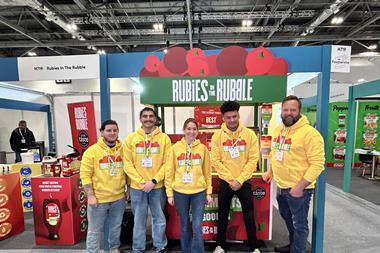
A “mind-boggling” amount of food in the UK is wasted, with less than 1% of excess, perfectly edible food redistributed, says Dan Byam Shaw, policy lead at The Felix Project. And with 11% of Brits living with food insecurity, it’s fair to say we “haven’t quite nailed it”.
Retailers have been reducing the amount of food they waste – after all, it makes good business sense to – and redistributing what’s left. For charities and redistribution organisations, “it feels like we’re getting to the end of what’s available in retail, which has traditionally made up the lion’s share,” Byam Shaw said.
There are times when retailers still struggle to redistribute excess food. Abigail Mines, food waste and communities manager at Ocado, revealed that despite all the forecasting for Christmas, the ability for customers to make late edits to their deliveries, “means we can be left with some excess stock”. This comes at a time when many charities are most busy or closed – “ironically, that’s when the need is most”.
But to achieve greater redistribution of edible food, the UK needs to look higher up the food chain.
“At a farmgate level there’s more surplus to go after,” Mines said. “But it’s hard for farmers – it’s so expensive to redistribute food. There does need to be a subsidy or mechanism of support.”
Policy intervention is needed to incentivise redistribution, the panel agreed. Perhaps tax credits to farmers to redistribute rather than bin their excess, as per the US. But in the meantime, the industry can – and is – making a difference.
“There is no competitive advantage for us having this surplus food,” says Sarah Thomas, chief people officer at Mindful Chef.
“There’s growing attention to collective action. I really hope the industry is going to lean into that challenge more, because everyone wins if we solve this together.”


No comments yet