



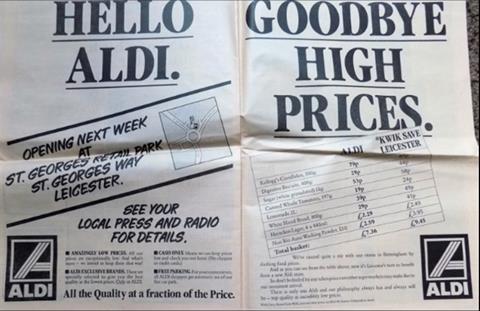
Aldi has come a long way since opening its first UK store in Stechford, Birmingham, in 1990, selling about 600 basic grocery lines.
Back then, strip lights illuminated a warehouse-style arrangement of products stacked on top of each other in pallets, with handwritten signs on bright yellow cards, leaflets printed in black and white, and store managers dressed (inexplicably) in white coats.
Beyond that, if it wasn’t holding the ceiling up, the store didn’t need it, just in case shoppers thought they were paying for something beyond the absolute minimum. Checkout staff didn’t even get scanners until 2001, instead having to memorise prices.
By 2008, Aldi’s UK market share was still only 1.3%, its range was still only 1,000 products, mostly ambient, and the few people who did shop there were supplementing their shopping elsewhere.
Its dramatic transformation since then was laid out this summer, in a Competition & Markets Authority report which concluded both Aldi and Lidl are now large grocery retailers rather than limited-assortment discounters, and should be bound by the same rules on land deals as other supermarkets.
There’s a reason this happened when it did. When the global financial crisis hit in 2008, Aldi and Lidl market shares grew rapidly and they saw the opportunity in offering more, expanding their offer in fresh fruit & veg, chilled and frozen, and even better wines, to win the full weekly shop.
It’s why Aldi launched its Project Fresh store refurbishment and modernisation programme in 2017. It’s also why the two discounters now have a combined market share of 19%. They have simply gone where the growth is, evolving their offers into what UK shoppers expect.
‘Discount principles’
So it is a gamble, to say the least, for Aldi to now turn the clock back and begin trialling reducing the number of products it sells in some UK stores. It follows a similar move elsewhere in Europe, including Germany and Switzerland.
Marc Houppermans, partner at Düsseldorf-based Discount Retail Consulting, puts the reduction at about 200-250 products, mostly affecting brands but also some slower-moving own-label lines. It is, he says, about “getting back to the discount principles”.
An Aldi spokesperson says the reduction is “small”, and aimed at offering a better, more focused selection, but not less choice. “As a discounter, we’ve always kept things simple so that we can deliver what matters most to our customers – award-winning quality at everyday low prices.”
Playing catch-up
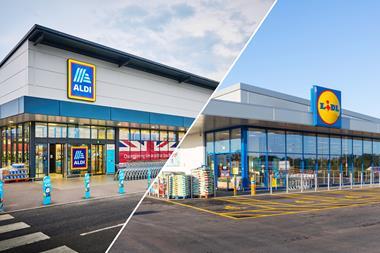
Since May 2025, Aldi’s market share has slipped from 11.1% to 10.4%, while Lidl’s has grown from 8.1% to 8.6%.
Aldi maintains its focus is growing sales in volume, not value. It boasts of being the only UK supermarket whose average unit prices have fallen over the past year – by 0.4% – having invested £340m in price reductions during 2026. Its volume sales are up by 1.7% year on year – much faster than its 0.4% value sales growth over the same period [Worldpanel 4 w/e 1 November 2026], and its volume share has held steady at 12.1% over 12 months.
But Lidl is growing rapidly in both value and volume sales. If anything, its more rapid rise over the past three years has shown the opportunity in offering more choice, not less. And its loyalty scheme has given shoppers reasons to come back and try new products and categories, even if it does amount to a bit of extra operational complexity. Lidl GB chief customer officer Louise Weise told The Grocer in May that about half its growth in its latest full financial year had come through “increased loyalty”.
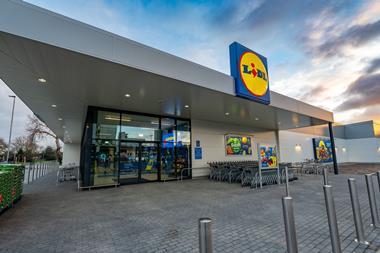
Lidl also already sells more products than Aldi – about 2,300 permanent core grocery lines versus around 2,000. It has more brands too – between 80% and 90% of its range is own label, versus 90%-plus at Aldi. Those extra lines will already be influencing the decision on where to shop for some.
‘Strategic dilemma’
Julian Grindey, MD of Turnpoint Advisory, who spent 10 years working for Aldi UK including as a group buying director, says much of Aldi’s success over the years has come from “becoming more relevant to the mainstream shopper and blurring the lines between itself and the traditional supermarkets”.
But, he says, this latest move presents a strategic dilemma.
“At what point does becoming more like your competitors start to undermine the very things that made you different in the first place?”
Writing on LinkedIn, Grindey adds: “I, for one, think Aldi is absolutely right to trial reducing its range and challenge some of the complexity that naturally creeps into a business as it grows. It’s not about going backwards. It’s about moving forward without forgetting what got you there.”
Houppermans couldn’t disagree more. “This works well in less competitive markets such as the US, Australia and China, but not in highly competitive markets where Lidl is also a large player,” he says.
“The customer gets better choice at Lidl, and Lidl can follow [Aldi] prices, and with its larger assortment optimise margins in its mix.”
Aldi Nord, the company that split off from Aldi Süd in the 1960s and operates in non-overlapping territories, including in Europe, made a similar “mistake” about 10 years ago, says Houppermans. “The result was a big loss.”
Aldi must do something. It lost £23.6m in net spend directly to Lidl over the 12 weeks to 1 November, according to Worldpanel by Numerator data.
It will be betting that a leaner range will help it build a price gap to start winning consumer spend back. But history shows the UK shopper values the right kind of complexity in a supermarket, and Lidl is ready to exploit any gaps Aldi leaves behind.
Cutting back could make Aldi stronger. It just needs to be careful it doesn’t cut the branch it is sitting on.






No comments yet