



As Lidl revamps its loyalty scheme, chief customer officer Louise Weise explains why getting the basics right is key to the discounter’s stellar growth
Three years ago, the Retail Sector Council confidently predicted the discounters would open 1,000 stores in five years, to continue their “relentless growth”.
Awkwardly, since that August 2023 prediction, the growth of the discount sector has slowed. Aldi’s market share has slipped from 10.9% to 10.6% [Worldpanel by Numerator 12 w/e 19 April 2026]. B&M and Poundland have suffered falling like-for-like sales since 2024. The latter has closed about 150 stores.
In fact, the growth of the discount sector has become almost exclusively the growth of one retailer: Lidl. This month is its 34th on the trot as the UK’s fastest-growing bricks & mortar supermarket, in which time its market share has grown by just over a percentage point to 8.4% – level with Morrisons as the UK’s joint-fifth biggest supermarket.
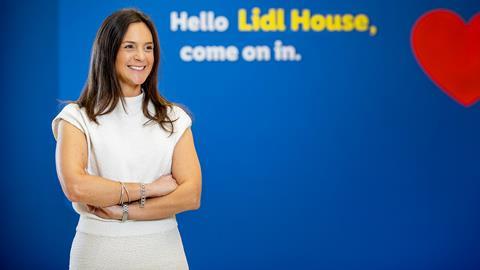
As the discounter’s chief customer officer, Louise Weise understands better than most what it’s doing differently.
“Since we launched Lidl Plus five years ago, in September 2020, we’ve taken in excess of two points of market share,” she says. “More than half our growth in the last financial year has come through increased loyalty.”
The app has been a powerful differentiator just as Tesco and Sainsbury’s have got sharper with Aldi Price Match and loyalty pricing, making it tougher to rely on value perception alone. And the growth delivered isn’t just new sign-ups. “It’s people buying into new categories, new products, switching to a main shop mission with Lidl,” says Weise.
What do points win?
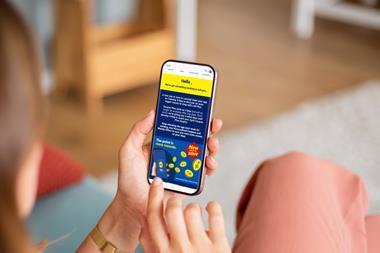
Lidl has continually innovated with it, adding new features such as ‘click, reserve & collect’ last year for middle aisle purchases, but the biggest change to date came this week with a new rewards mechanism: Points.
Lidl Plus users now earn one point for every £1 spent. Points can be redeemed as discount coupons for products or as money off a whole shop, any time within two years of earning the points. The new system replaces Coupon Plus, which gave users set, time-limited rewards for reaching monthly spending thresholds, such as a free sweet bakery treat after spending £10 or 10% off the next shop after spending £250.
Personalised coupons, a core feature of the app, redeemable as discounts on a weekly-changing selection of products, remain unchanged. So do Lidl Plus Offers – non-personalised loyalty discounts that can be signposted on shelf.
Anyone who looked forward to their free sweet bakery treat after £10 spend each month may feel short-changed when they realise it will now cost them 40-90 points depending on the item, requiring £40-£90 spend at the standard rate of one point per £1. But Weise insists users will get more than one point per pound in practice, thanks to campaigns such as double or triple points on select products. To kick things off, Lidl is giving all users 100 points for free, and double points for any fruit purchased up until 22 May.
Name: Louise Weise
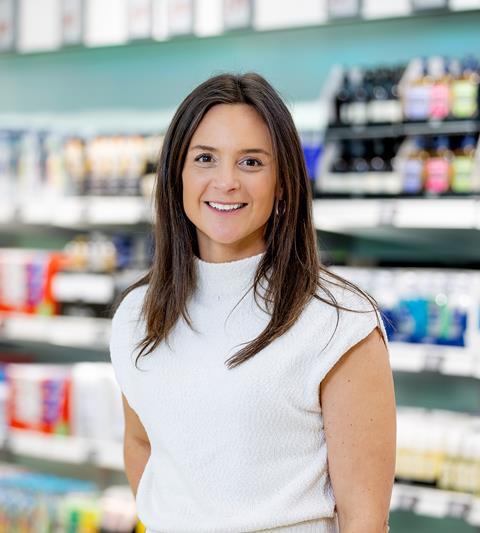
Place of birth: Preston
Lives: Guildford
Age: 39
Family: Husband and two children (five and seven)
Potted CV: Studied in Newcastle and Leipzig; two years in financial recruitment; Lidl’s graduate scheme and then various roles at Lidl
Best advice received: If you can’t find a way, make a way
Business motto: Understand the ‘why’
Book currently reading: I always have a few on the go. At the moment I’m re-reading Harry Potter with my kids and finally getting round to To Kill a Mockingbird
Item you couldn’t live without: A notebook and pen
Hobbies: Swimming, indoors and outdoors
Best Lidl Plus reward: I won my shopping free
Last meal you cooked using only Lidl ingredients? I’m the most loyal Lidl shopper in the country, so it’s easier to say the last meal I cooked not using only Lidl ingredients: I picked some wild garlic and made pesto
Lidl already has a good idea how consumers will respond, having steadily rolled out Points internationally since 2024. In Ireland, where they were added last June, Lidl’s share has grown by 0.3ppts to 14.3% [Worldpanel 12 w/e 22 March 2026].
But the loyalty app alone doesn’t explain Lidl’s growth. “Alone it can do nothing,” says Weise. “Real loyalty is about doing the basics really well, making sure we have the right range in the right quantities at the right time. It’s about delivering that consistent shopping experience, quality and price… It’s about understanding our customers.”
This is where the app provides a virtuous circle of customer information, especially when they have more choice over their rewards. “We’re giving people freedom to choose how they actually spend their rewards. That will look very different for different people.”
Weise is excited about the potential for further personalisation. A “huge amount of innovation and investment is going into the app, particularly in personalisation”.
Also in the offing is the ability for app users to scan items as they pick them up, to save time at the checkout. A ‘friends and family’ beta pilot running since September went live with the public this week in seven stores, “with a view to moving towards a staggered rollout”, says Weise.
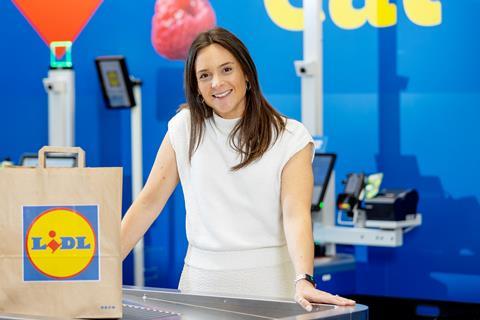
Listening to customers
Lidl paved the way for scan and shop with the introduction of an in-app payment feature in October and scan-to-exit barriers at self-checkouts in 2024. For Weise, it all underlines how much has changed since she started at Lidl, though it was only 15 years ago, in 2011.
She worked for two years in financial recruitment, where she “waited out the credit-crunch years”, before “I recruited myself on to Lidl’s graduate scheme”.
“Lidl was one of my clients. I didn’t take a commission for it. Perhaps I should have. I lived in Wimbledon at the time, but I’d always had this itch because I’d studied German and my now husband is German, so I had an ability to speak a language that I wasn’t really speaking.”
Having studied and lived in Leipzig, “a big draw was that I was very familiar with the Lidl brand. I started in the buying function, in promotional activity. I’ve been fortunate to work in a lot of different roles, and I’ve really found my niche.”
That niche is the chief customer officer role, first created in 2024, a function intertwined with loyalty, which Weise took over in January this year. It exists thanks to “a global restructure and vision to bring the customer’s voice into the boardroom, because it’s one thing to listen to the customer and another to act on it”.
Besides the loyalty app, Lidl’s flash TikTok sales of Dubai chocolate and high-protein products last year were “a really good example of understanding where our customer is [and] the best way to talk to them about a specific activity or product range”.
“I don’t feel that old, and I don’t feel like I’ve been here that long, but the world is changing at pace,” says Weise. “I’d say the business has transformed at a pace that matches or outstrips that pace of societal change.”
Can the pace be sustained, as Lidl laps year after year of tough growth comparatives? “We’ve got more cards left to play. We’ve got more irons in the fire. And the excitement, the thing that keeps me up at night – in a good way – is which order to play them. It doesn’t worry me that we can keep it going.”



No comments yet