






Simon Mellin founded Modern Milkman with a battered old milk float in a Lancashire town. Now he is taking its ‘waste not, want not’ mission to the US
Simon Mellin has a simple belief: that doing the right thing should be easy. It’s why he bought a battered old milk float in 2018 and started delivering milk door to door in his hometown of Colne, Lancashire. And it’s why Modern Milkman – the business he built from that idea – now completes more than 300,000 deliveries a week and is focused on the US as its next frontier.
Mellin grew up in a household where waste was frowned upon and spent his formative years working in his dad’s butcher’s shop. As a man whose upbringing “was all about using everything”, it’s no surprise to hear him lament how “consumerism drives different behaviours”.
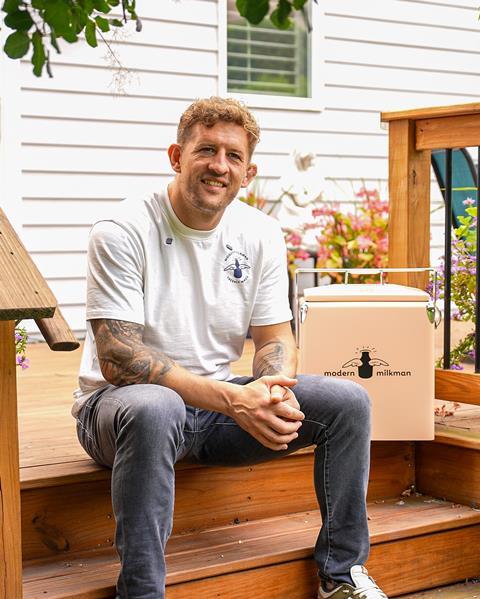
Name: Simon Mellin
Place of birth: Burnley, Lancashire
Lives: Boston, Massachusetts
Age: 39
Family: Wife, three daughters and a dog
Potted CV: Worked in my dad’s butchers shop; left school at 14 with no qualifications; worked as a race engineer for six years; came back to the UK to build companies with a focus on reconnecting people with food
Business icon: Jeremy Clarkson
Item you couldn’t live without: Cheese
Hobbies: Brazilian jiu-jitsu, I’m currently a brown belt
Favourite album: Whatever People Say I Am, That’s What I’m Not by Arctic Monkeys
Favourite product from Modern Milkman: Protein milk
Life in the US or UK: UK for pubs and banter; US for access to so many things (sports, water, etc)
“Through the evolution of the supermarket, we’ve created a tonne of waste with that journey,” he says. “We’ve had to elongate supply chains, wrap food in plastic and extend shelf life.”
The inspiration, he thought, was hiding in plain sight – the milk round. “It was a long way ahead of its time in the use of returnable packaging and delivering fresh product direct to doorsteps,” he says. “What happened?”
While the milk round was ubiquitous for much of the 20th century, it’s now much less common. Although delivery box companies like Abel & Cole and Riverford operate in a similar space, Modern Milkman has only one main competitor in the UK market – Milk & More, which was bought by dairy supplier Freshways in 2023 and has since seen a massive remerchandising effort.
Mellin quickly realised that while the old model for the milk round could still work, it needed updating for the 21st century. “Leaving a couple of quid on the doorstep and putting a note in a milk bottle no longer works,” he explains with a smile.
Modern Milkman has focused on two main technologies: a two-sided marketplace that connects suppliers with customers, and a routing engine to enable the routes to be created and managed efficiently. Its offering has also expanded well beyond milk – taking in everything from sausages to chocolate bars – and even beyond grocery. It now offers collection bags for the disposal of toys, clothes and electricals in addition to its glass bottles of milk.
That expansion is paying off. Its most recent accounts to 29 December 2024 showed turnover up by 13% from £46.2m to £52m, largely thanks to growth following its expansion into the US in 2024. While the company continues to struggle to turn a profit – operating losses were at £6m – it is making progress. These losses are half what they were the year before, and Mellin predicts Modern Milkman will break even across the group this year.
The business also continues to attract investors, most recently receiving a £10m boost from UK-based Salica Investments in January to support the expansion and evolution of its doorstep delivery model. “It’s about enabling people to do the right thing and making that easy,” Mellin says. “Everyone in the world wants to do the right thing.”
Barriers to progress
Crucial to that is removing barriers for consumers, which is where Mellin thinks others have failed. Concepts like returnable packaging work, he argues, but charging a deposit or requiring customers to return packaging to supermarkets act as barriers.
“Where we see success is because we’re trying to remove those barriers and make it simple,” he adds. “Being able to put things on the doorstep or pick things up off the doorstep – there’s nothing easier than that.”
The business recently launched a membership option, which “enables us to plan better and then pass the savings on to the customer”, Mellin explains.
Those savings are likely to be welcome. Given its focus on premium products, “the headline price might look more expensive”, Mellin admits, but the business is “very focused on giving value to our customers”.
That includes a sometimes daring approach to ranging. Modern Milkman recently took the decision to stock almost-raw milk on its website with the launch of Mossgiel Organic Farm Brewed Milk last month, driven by significant consumer demand.
Despite raw milk currently being legal to sell only in England, Wales and Northern Ireland under specific conditions – and not legal at all in Scotland – it was “far and away the most requested product” from its customers. “We launched it to try and give our consumers what they’re asking for in a safe way,” Mellin says.
Mellin believes the launch is crucial in supporting innovation in the liquid milk market, which has been “commoditised to a point where we’ve removed all value from it”, and clearly taps into the wider trend towards more natural, less-processed food choices.
Nowhere is this trend more prevalent than the US, where earlier this year health secretary Robert F Kennedy Jr unveiled new dietary guidelines and called on Americans to “eat real food”.
Modern Milkman is in an ideal position to benefit, Mellin thinks. After all, the brand has “always been very focused on whole-ingredient, simple foods”.
Taking on America
The brand launched into the US in 2024 after acquiring a milk delivery business there also called Modern Milkman, based in Connecticut. The similarities extended beyond the name. “We had the same beliefs, the same values, we were trying to achieve the same things,” Mellin says. “There’s a huge lack of trust in food in America, and it’s quite difficult to understand what’s good quality. So, taking a product from [dairy] farmers and putting it down on the doorstep is massive for American consumers – and that’s what’s enabling a lot of our [US] growth,” he explains.
Those consumers are also typically more affluent, and convenience is much more valued. “There’s a bigger willingness to pay for quality and a product you trust,” Mellin says.

To help Modern Milkman gain a foothold, Mellin and his family are now based in Boston, where he can “better learn the market, better understand it, and enable us to grow here”.
“There are a lot of differences between America and England, and I think the common language gives you a false sense of security around each other,” he adds.
Thanks to these learnings, the business anticipates it will be as big in the US as it is in the UK by the end of 2026. What started out in one state is now in five, with plans to expand to a further two in the next year.
Mellin aims to hit £75m total revenue by the end of the year, but will not compromise on the principles at the heart of the business. “I always remember my nana saying to me ‘waste not, want not’. We’re very focused on staying true to who we are and that builds a loyal following of customers who want to be part of that.”


No comments yet