



With elections in Scotland and Wales on 7 May, what do the main political parties have planned for the food & drink industry?
Scotland
The grocery sector has been weaponised in the upcoming Scottish elections, in SNP proposals that could also herald a new independence battle.
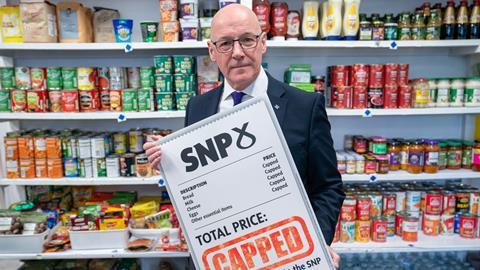
Suppliers and retailers alike were stunned by proposals last month to cap the price of everyday essentials, amid what first minister and SNP leader John Swinney claimed was “moral outrage” at the soaring cost of living.
So is it just a “potty gimmick”, as some have claimed, or a Trojan horse for the seond independece referendum also promised by the SNP? And what other manifesto pledges are concerning food and drink companies?
The SNP manifesto promises to cap the cost of between 20 and 50 essential items “that make up a decent diet”, such as bread, milk, cheese, eggs and rice in large supermarkets.
UK government sources have slammed the plans as “unworkable” and suggested they could be subject to a legal challenges from retailers.
The plans also look certain to fall foul of the UK Internal Market Act, designed to ensure smooth trade between the four nations, which also put paid to previous SNP proposal’s for a deposit return scheme.

That may be just what Swinney has in mind. Industry sources suggest a fight with the UK government over protecting shoppers form “greedy” retailers is exactly the fodder that could help him launch a new independence campaign, one which will be all systems go if the party hits the magic number of 65 MPs in the election on May 7, which would give it an overall majority at Holyrood.
“Price capping in itself is a stupid idea which if it went ahead would lead to months of consultation and disputes with supermarkets, adding a huge heap of red tape,” says one source.
“But politically this would be the SNP saying to voters, ‘look, we are trying to help protect you from the cost of living and the British government isn’t letting us’.”
And with the realistic prospect of blood on the carpet for Labour at the elections, the SNP could before long find itself in a strong bargaining position over securing a new ballot on its big prize-independence.
“If Labour get crushed, how sustainable is their position on independence?” asks a source.
“It is not hard to guess what the SNP’s price cap is for.”
“The SNP clearly has no qualms about being seen to be fighting the big supermarkets and that is going to be a potentially very rocky road for both sides,” adds another source.
Mercifully, the SNP’s manifesto otherwise contains fewer of the radical food policies it has been associated with in the past, with Swinney seemingly picking his battles carefully. There are no formal proposals on obesity or alcohol.
All the parties want to put more conditions on the sale of vapes, and the SNP has committed to banning them from display, in the same way that tobacco products are treated, covering advertising, promotion and retail visibility of both vapes and nicotine pouches.
Scottish Labour plans to whack online distribution centres with a new ‘Amazon tax’ to raise money for town centres.
Leader Anas Sarwar says it is “not fair” for retail businesses to pay “30% to 40%” of their turnover on business rates when online distribution centres pay only “two or three per cent”.
It is not clear how this would be delivered any better than the UK Labour Party’s 2024 manifesto pledge to level the playing field between the high street and online giants, which became a higher tax rate simply based on rental value.
Labour would also abolish the current business rates system, replacing it with a new local business levy.
Other Labour plans include the rollout of breakfast clubs in every school and an expansion of the apprenticeships programme in Scotland.
But it is Reform that stands to finish second, based on YouGov polling earlier this month, with 20 seats againts SNP’s 67 and Labour’s 15.
At just over 20 pages, Reform’s is shortest of all party manifestos, with an emphasis on proposed of tax cuts and a rowback on what it claims are unnecessary and crippling net zero policies.
Reform claims it will save £1bn by rowing back on “ideological net zero projects” and a further “bloated £6.5bn” spent on “unaccountable quangos”.
It proposes a gradual phasing out of business rates in favour of a “fairer” annual property tax, details of which are scant.
The Scottish Conservatives’ manifesto also focuses on reducing costs for business, pledging permanent business rates reform, a moratorium on new regulatory divergence from the rest of the UK, and opposition to restrictions on food and drink marketing.
Like Reform it pledges a move away from unaffordable net zero policies.
Iain Baxter, CEO of Scotland Food & Drink, says the food and drink sector will be hugely affected by the outcome of the result, whichever way it goes.
“Whatever your politics, the issues that dominate every manifesto in this year’s Holyrood elections – jobs, trade, net zero, skills, rural communities – will directly impact Scotland’s food and drink industry.
“We’re a £19 billion sector employing 123,000 people in every local authority in the country, so it’s right that the policies that impact our sector are at the heart of every party’s manifesto.
“We are asking all parties to recognise that they cannot credibly set Scotland up for a prosperous economic future without putting food and drink at the centre of their plans.”
Wales
Wales’ Senedd vote is brewing up to be the most competitive – and consequential – since the advent of devolution to what was then called the Welsh Assembly, back in 1999.
And after 27 years in power in Cardiff Bay, and more than a century as the dominant political force in Wales, the once hegemonic Labour Party is bracing for an unprecedented rout.
Opinion polls in Wales, as across the rest of the UK, have for more than a year pointed to a slump in Labour support and a parallel rise in backing for Nigel Farage’s Reform UK. But Wales is different in one crucial respect: support for Welsh nationalists Plaid Cymru has also climbed by a similarly sharp amount.
In a battle both parties have proclaimed a “two-horse race”, the pair have traded opinion poll leads since last summer.

The most recent survey, published by YouGov and ITV Wales last week, projected Reform would win 37 seats in the expanded parliament, with Plaid on 36, Labour on 12, the Greens on seven, the Conservatives on just three and Lib Dems with one seat.
If this result were to be replicated on 7 May, experts, including YouGov, suggest Plaid would have the best chance of leading a government, either as a minority administration or as part of a coalition with other left-leaning parties.
As far as specific food sector policies go, Plaid says it will create a new, business-led National Development Agency for Wales, which would aim to “help Welsh businesses to secure investment, trade and innovate”, and provide tailored business support for agriculture, food and drink – “promoting innovation and business growth in the sector and supporting succession processes that keep businesses Welsh-owned”.
The food and agriculture sectors have “been overlooked, and failed by Brexit – with farmers and rural communities dealing with rising costs, uncertain funding, complicated rules and too little investment”, it adds.
The party, led by ex-BBC journalist Rhun ap Iorwerth, wants to develop a distinct National Food Strategy for Wales. Part of that includes a pledge to increase from 23% to at least 50% the amount of Welsh food and drink procured by the public sector – an issue that gained national attention in February when it emerged most Welsh schools sourced chicken from countries as far away as China and Thailand.
Plaid also wants to create new, official ‘Made in Wales’ branding “that provides consumers with clear information on product sourcing and the carbon-cost savings of buying local”.
It has said it will “work with major retailers to ensure that every supermarket has a dedicated Welsh produce section”, while also promising to establish a multi-year funding cycle for Labour’s much-derided (and later reformed) Sustainable Farming Scheme (SFS), “giving farmers long-term stability and certainty”.
The party also wants to commission an independent review of the bureaucratic burden on family farms in Wales, protect agricultural land from being lost to large-scale corporate carbon offsetting plantations or excessive solar developments.
On Wales’ deposit return scheme, Plaid wants to “include glass when this becomes practically feasible, and with relevant exemptions to prevent added costs for small businesses”.
As far as Reform goes, the Welsh party is led by ex-London Tory councillor Dan Thomas, but Farage (who is not standing in the election) looms large across all its official promotional material. The party has focused a lot of its energy on promises to tackle immigration – despite the Senedd being powerless on the issue.
But on DRS, it wants to ensure any scheme “operates on a UK-wide basis”, which would mean the exclusion of glass, to avoid putting “unnecessary costs and complexity on hospitality businesses, particularly those operating near the English border”.
On farming, Reform says Wales has “for too long”, had an agricultural policy “driven by ideological targets, excessive regulation, and schemes designed in offices rather than on farms”.
It takes particular aim at the SFS, whose initial proposals included a reduction in farming area – which led to widespread farm protests last year. A Reform government would “progressively end the current SFS” and move towards a “reconfigured system with increased choice for farmers”.
The party wants to instead establish a new system to increase livestock production payments and replace the SFS with a voluntary environmental scheme “allowing farmers the right to decide for themselves whether to take it up”.
Reform has, like Plaid pledged to create a new food strategy for Wales, alongside farmers and farm unions to grow domestic food production. But only if it represents “value for money” and won’t mandate a specific public procurement target.
It has also made an unspecified pledge to “support small and mobile abattoirs by reducing regulatory pressures threatening local facilities”.
For Labour, key, food industry-related manifesto highlights include a pledge to press ahead with its reformed SFS to “boost sustainable food production and increase support for farmers to tackle the climate and nature emergencies”.
But in a section of its document titled ‘A Greener Wales’, it carries far less food-specific policies, mirroring the scant attention given to the sector in its 2024 UK general election manifesto.
Other relevant pledges include work to ban more single-use plastics “to tackle the scourge of littering”, alongside its “UK-leading bottle return scheme” and the introduction of new “statutory reuse targets for local authorities”.
Labour, like Plaid, also want to “encourage more people to grow, shop and eat local”, with an aim to increase the amount of Welsh public sector spend on food of Welsh origin “by at least 50% by 2030” – which would take levels to around the 34.5% mark.
The party additionally wants to “explore action to create healthier food environments, including using local planning rules to limit hot takeaways around schools and playgrounds”.
Elsewhere, the Tories want to develop a “Growth Strategy for Welsh Agriculture” and boost the farming budget by additional £100m over the next Senedd term, while also axing the SFS and replace it with a new food security first scheme.
Meanwhile, the Greens want to introduce “legal biodiversity targets”, which could anger the farming sector, and are aiming to publish a National Rewilding Strategy “to support ecosystem restoration”.
However, it also insists it will “put farmers first” by simplifying agricultural legislation and will introduce a National Horticulture Strategy “to expand domestic production of fruit, vegetables and pulses”.
With just under a week until the electorate goes to the polls, this Senedd election looks likely to have a seismic impact on Welsh democracy, and its food sector – whoever wins.


No comments yet