





Farmers have expressed consternation after the government made only marginal changes to much-criticised amendments to Inheritance Tax liabilities.
Chancellor Rachel Reeves announced the £1m threshold for IHT liabilities would now be transferable between spouses and civil partners in her budget on Wednesday, bringing it into line with wider Inheritance Tax policies.
It means that should a married farmer die they can leave £1m-worth of assets to their spouse, who will then be able to use the deceased’s £1m in addition to their own tax-free allowance when handing a business down to their children on their death.
But despite intense lobbying from the farming sector and major supermarkets, the minor tweak to spousal benefits remained the only concession on the issue by Reeves, who stopped short of further amendments to the controversial policy, dubbed the ‘Family Farm Tax, in this week’s budget announcement.
The NFU said the change would only “help a handful of farmers but it is not enough to change the devastating impact for the majority”.
“Today the government accepted its changes to Inheritance Tax are flawed; which we welcome,” said NFU president Tom Bradshaw. “But this step does not do nearly enough to reduce the damage to the British farming community.
“The acute and cruel impact on the elderly remains. We keep fighting.”
He added that it was also a “huge smack in the face to the Labour MPs who have been working so hard to find a way through this” and called on the government to “look at the multiple solutions that have been put forward”.
The continued calls to bring about further changes were echoed by the Country Land and Business Association. It’s president Gavin Lane said “this concession is the first public signal that the Chancellor knows her inheritance tax reforms have been a disaster”.
“Across the country, family businesses have been reducing their investment, at an enormous cost to the economy and the British public,” Lane added. “It is not too late for her to scrap the entire policy, and finally recognise the enormous value family owned businesses bring to the UK.”
Campaign group Fairer Family Farming reiterated calls on the government to listen to CenTax recommendations which would remove relief for passive investors in farmland and other business assets, funding an extension of 100% relief for farmers and other business owners to £5m per estate.
“Time is running out as we get closer to April, when British farmers will be treated as millionaires, despite the majority of them earning the equivalent income to the average household,” said campaign founder, David Passmore.
Another farmer Liz Webster who was a leader in the farming protests last year said the update was a “minor technical adjustment” and was equivalent to “no concessions”.
”Once farms are forced into sale or consolidation, you don’t get them back,” said Webster. “The government is prioritising short-term revenue over long-term food security and that is a strategic mistake.”
Read more: Supermarkets and the NFU are united in calling for family farm tax u-turn
Changes to IHT liabilities for farm businesses were announced in last year’s budget. Due to come into force next April, they will slash business property relief and agricultural property relief to 50% on businesses valued above £1m.
The policy prompted a collapse in support from the farming sector for the government when it was announced last year and led to protests and campaigns for change.
‘Blood on her hands’
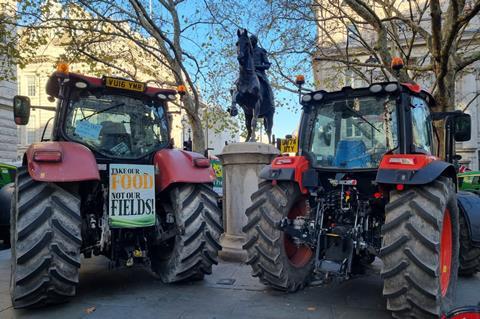
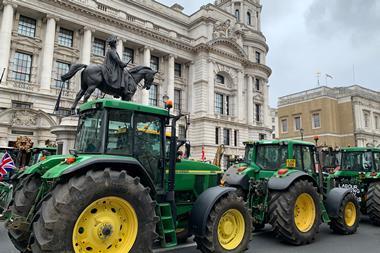
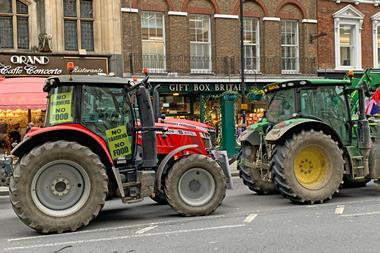
Despite the Met Police banning tractors from central London on Wednesday, farmers still protested at Parliament, with one telling The Grocer the Chancellor had “blood on her hands”.
The Suffolk cereals farmer, who did not want to be named, went on: “The industry has offered many alternatives, some of which increase the tax take and it’s a great shame that the Chancellor has not listened.
“It leaves us in a very difficult position,” he added.
Their comments were echoed by Nicola Beer, a Devon dairy, beef and sheep farmer, who told The Grocer that it “makes what we do even harder because we have no security over the future”.
“All small farmers like ours are asset-rich and cash-poor,” she added. “All we want to do is provide high-quality food for the nation and we want to be able to do that without losing everything.”
Another dairy farmer, David Shepherd from Cheshire, said that the government was “killing good, viable business”.
He added that there would be knock-on effects on businesses, such as tractor suppliers, that would be affected if farmers don’t invest in their farms.
“This government playing student politics and they need to live in the real world,” he said. “This is affecting lives and livelihoods.”








No comments yet