






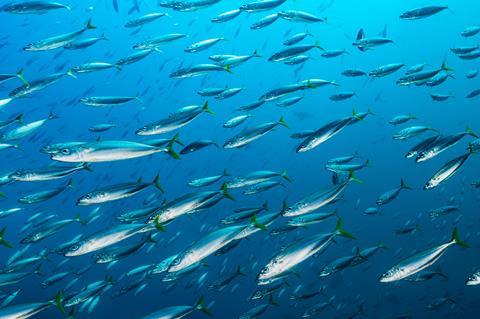
Coastal states have taken measures to prevent the Russian Federation from exploiting the north east Atlantic’s embattled mackerel stock.
According to an EU Commission communique, members of the North-East Atlantic Fisheries Commission voted to restrict Russia’s mackerel catch after it unilaterally decided to raise its quota to 67,548 tonnes – around 23% of the 299,010t Total Agreeable Catch agreed by the UK, Norway, Iceland and the Faroe Islands in December.
NEAFC members, including the EU, UK, Denmark (which also represented Greenland and the Faroe Islands), Norway and Iceland, agreed to limit Russian catches of mackerel in international waters to 1,495 tonnes, and frustrate its fishing fleet by prohibiting transshipment and withholding refuelling services to Russian vessels that exceed the figure.
The Commission further stated that the EU, UK and Iceland had decided to apply the restrictions within their own jurisdictions, as well as to ban Russian ships carrying mackerel quantities above the catch limit from entering their ports. The measures are expected to come into force on 18 August, despite Russia’s objection.
The Commission also urged all NEAFC partners to apply the measures within their own waters, consider further action against Russian overfishing, and ban transhipments at sea in NEAFC area in general.
“These NEAFC measures are an important step towards curbing unsustainable practices in the North-East Atlantic, but they are not sufficient to stop them,” the Commission said.
It added: “The EU underlines the importance of a comprehensive stock-sharing arrangement and co-ordinated management measures among coastal states to facilitate the recovery of the mackerel stock.”
Despite the Commission’s hard-talking statement, the Scottish Pelagic Sustainability Group, which represents Scotland’s pelagic sector, doubted whether the restrictions could be enforced.
“Unfortunately, the NEAFC measure will probably have no impact as Russia has objected to the recommendations, which are non-binding,” SPSG chairman Ian Gatt said. “The Scottish fishing industry remains committed to the sustainable management of north east Atlantic mackerel and will continue to fish the stock responsibly, regardless of Russia’s actions.”
But the North Atlantic Pelagic Advocacy Group, a collective of retailers and supply-chain businesses committed to sourcing sustainable seafood said “all efforts to reduce fishing pressure on mackerel are welcome”.
“Without meaningful action from all parties, we risk further declines in this crucial stock and further economic consequences for the businesses and communities that rely on it,” NAPA executive chair Aoife Martin said.
“We have been clear from the start that only a comprehensive catch sharing agreement, signed by all parties, will truly answer the challenges facing this fishery,” she continued. “Progress has been made in recent years, but it hasn’t come far enough.”
Martin added: “At this point any decision to unilaterally increase fishing pressure on a stock that is below safe limits is unconscionable.”
Maritime sustainability NGO Oceana UK agreed, arguing “it is not Russia alone that is threatening mackerel populations”. Oceana UK executive director Hugo Tagholm said collective allowable catches for north east Atlantic mackerel had been set “higher than is sustainable” for 18 years.
“Negotiations have stalled and what is almost a free-for-all has ensued, putting an entire fish stock and industry at risk,” Tagholm continued. “That has led to a situation where scientific advice recommended slashing mackerel catch limits by a stark 70% last year.”
He added: “If we continue to disregard the science, we will endanger our fishing communities and marine wildlife. We must stand up for our seas.”










No comments yet