





Malaysia has cut forest loss by 57% and achieved 92% smallholder certification coverage, yet marketing products as ‘palm-oil free’ persists despite it being one of the most land-efficient vegetable oils available, says Belvinder Sron, the chief executive of the Malaysian Palm Oil Council.
Palm oil’s reputation problem hasn’t matched reality for over a decade now. While consumers still picture cleared rainforests, Malaysia’s palm oil sector has quietly transformed itself. But most grocery brands haven’t told shoppers about it.
“Malaysia cut primary forest loss by 57% between 2015-2017 and 2020-2022, with another 13% drop in 2024 versus 2023,” reveals Belvinder Sron, CEO of the Malaysian Palm Oil Council. “Forest cover sits at 18.9 million hectares – 57% of total land area – exceeding the country’s Rio Earth Summit pledge to keep at least half the nation forested.”
That progress in Malaysia comes with policy teeth: plantation expansion into forest and High Conservation Value lands has been banned since 2020; a 100 million tree planting campaign beat its targets; and the Central Forest Spine initiative is reconnecting fragmented landscapes.
Behind it all sits market-driven certification. The Malaysian Sustainable Palm Oil scheme (MSPO) is mandatory, independently audited and covers environmental management, biodiversity, agricultural practices and social responsibility. It was updated on 1 January 2025 with stricter sustainability, traceability and ethical requirements.
By August 2024, 92% of independent smallholder areas had MSPO certification – beating the government’s end-2025 target of 90%. The UK government recognised the scheme in 2024, while the EU has acknowledged MSPO certification for EUDR compliance.
The land efficiency problem
But here’s the commercial catch. As certification coverage expands, ‘palm oil-free’ marketing proliferates – missing the environmental point entirely.
Palm oil supplies 35-40% of global vegetable oil demand, using just 6% of land dedicated to oil crops. As such, it is the world’s most land-efficient option. WWF analysis shows that getting equivalent volumes from soybeans, coconut, or sunflower seeds would require four to 10 times more land.
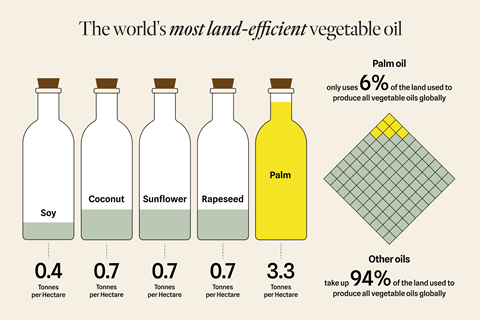
“Brands ditching palm oil aren’t eliminating environmental impact – they’re displacing it, potentially triggering deforestation elsewhere while removing market incentive for sustainable production,” notes Malaysian Palm Oil Council’s Sron. “Research shows 93% of palm oil imported into Europe now carries sustainable certification, but progress depends on continued demand.”
Consumer research suggests shoppers want transparency. Some 58% of UK consumers will pay more for sustainably sourced palm oil, while another 77% think companies should disclose sourcing practices [Malaysian Palm Oil Council internal research]. Brands communicating certification credentials could educate shoppers about real environmental trade-offs instead of reinforcing outdated assumptions, maintains Sron.
Nutritional advantages
“Beyond sustainability, palm oil offers nutritional benefits often missed in formulation decisions,” she explains. “It naturally contains vitamin E tocotrienols – powerful antioxidants more effective than common tocopherols. And research points to potential benefits for cardiovascular health, cognitive function and liver health, particularly in reducing harmful cholesterol.”
Palm oil also provides provitamin A carotenoids – valuable, given that vitamin A deficiency remains a public health issue. Its balanced fatty acid profile and natural stability deliver manufacturing advantages alongside nutritional value.
Meanwhile, the sector’s carbon footprint sits at just 0.81-1.11% of global CO₂ emissions despite meeting over half of worldwide edible oil demand – land efficiency translating into a climate advantage.
The commercial opportunity
Malaysia’s certification progress shows what sustained buyer commitment achieves, adds Sron. “Maintaining this requires grocery brands communicating confidently about sustainable sourcing rather than defaulting to ‘palm oil-free’ positioning that contradicts environmental evidence,” she says.
“When major retailers and manufacturers talk up certification credentials, they establish evidence-based transparency as a category standard. That creates competitive pressure, rewards environmental progress, and educates consumers about land-use efficiency.
“Malaysian palm oil is sustainable by design and sustainable by law. UK grocery recognition of this transformation would maintain market incentives for continued improvement – and position brands as sustainability leaders grounded in agricultural reality rather than consumer misconception.”
Visit Malaysian Palm Oil Council’s website for palm oil market intelligence and sustainability information.