



Annual events such as Mother’s Day put a huge expectation on grocery retailers to curate the perfect gifting inventory – whether bought in-store or, increasingly, online. So, how can they respond in a way that will secure not just that day’s purchase, but longer-term consumer loyalty.
While Mother’s Day should be all about family time, the shifting date each year means it’s often defined by a stressful dash to the shops as Brits lose track of time or simply forget completely. But the script has changed. Today’s customers aren’t just turning to on-demand orders in a moment of panic; they are choosing it as a deliberate strategy to reclaim their weekend with a calm tap on their phone.
That shift represents a massive opportunity for grocery retailers to connect with new customers. While Christmas and Valentine’s Day can take centre stage in the seasonal calendar, new Uber Eats data proves that Mother’s Day is another vital point of need. Indeed, data shows how important Mother’s Day has become in the annual calendar, hitting an estimated £1.67m in spend in 2025, up 5.3% year-on-year. According to Mintel, while in-store shopping plays a key role (54%), online shopping grew significantly, increasing from 38% to 44% of shoppers in 2025 and retailers “can leverage a growing cohort of confident and savvy online shoppers with AI tools and technology to further streamline gift shopping”.
Consumer expectations on Mother’s Day
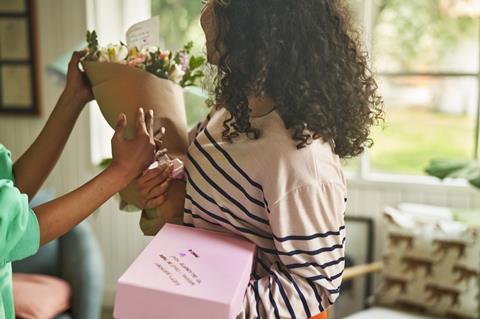
So, as the nation prepares to treat the matriarchs in their lives on 15th March, rapid delivery is set to be a defining feature of the celebrations.
“Today’s customers aren’t just turning to on-demand orders in a moment of crisis; they are choosing it as a deliberate strategy”
Katie Hunter, General Manager of Grocery & Retail, Uber Eats UK
When a modern customer realises, at 10am on Mother’s Day, that a card is missing or a brunch ingredient has been forgotten, they aren’t looking for a delivery window on Tuesday – they expect a solution in 30 minutes. And as the boundaries between digital discovery and physical fulfilment blur, on-demand delivery has transformed into a strategic necessity for retailers looking to capture every nuance of those seasonal peaks.
“We are seeing a clear evolution in consumer behaviour,” says Katie Hunter, general manager of grocery & retail at Uber Eats UK. “With Uber Eats covering 90% of the UK population, we know today’s customers aren’t just turning to on-demand orders in a moment of crisis; they are choosing it as a deliberate strategy to reclaim their weekend. It’s about both confidence and convenience.”
Already this year Valentine’s Day trading has also showcased such seasonal moments as an international opportunity, as customers overseas leveraged rapid delivery to say ‘I love you’ in the UK – with flower orders being placed by Uber Eats users from Poland to the US.
This shift presents a massive opportunity for retailers to connect with time-poor shoppers, as the grocery and retail segment now accounts for over 40% of global Uber Eats orders. Acting as a digital storefront for major stores like Waitrose, Sainsbury’s, Co-op, Boots, Morrisons and Asda, the platform allows partners to remain competitive in the current environment, where speed is of the essence.
The challenge for retailers, however, is converting a one-off shopper into a long-term customer. As such, the rapid response required for Mother’s Day will act as a high-intent touchpoint where partners can prove their reliability.
Hunter elaborates that the integration of traditional loyalty schemes into the on-demand experience is a game-changer. “Our partnership with Waitrose is a prime example. By linking ‘myWaitrose’ accounts directly within the app, customers don’t have to choose between the speed of delivery and specific loyalty benefits. This builds a deeper connection and provides retailers with insights that drive return business long after the event has passed.”
Online searches ramp up

New Uber Eats data highlights the specific points of need set to define this weekend. In the lead-up to Mother’s Day 2025, search surges [Uber Eats] revealed a nation focused on gifting and treats to mark the occasion:
● Cinnamon buns: up 187%
● Daffodils: up 145%
● Potted plants: up 132%
● Boxes of chocolates: up 122%
● Clotted cream: up 74%
Solving traditional pain points
To meet this demand, the underlying tech must solve traditional pain points. New Uber Eats tech features such as Live Order Editing allow for the addition of last-minute items up until checkout, while AI-Powered Replacements ensure that if a specific bouquet is out of stock, a smart alternative is suggested – preventing the customer from walking away empty-handed. Meanwhile, operational efficiencies like Batch Picking are allowing in-store staff to manage multiple orders simultaneously, drastically reducing the click-to-door time during these critical windows.

“We aren’t just changing how people shop, we’re changing how retailers can grow”
Katie Hunter, General Manager of Grocery & Retail, Uber Eats UK
The perception of value today goes deeper than just discounts; it’s about a unified experience. An Uber One member who saves on their evening plans and weekend excursions via Uber rides is far more likely to turn to Uber Eats for their weekly shop or a last-minute gift. This has a ripple effect where loyalty across the platform brings a consistent audience to retail partners.
“We aren’t just changing how people shop; we’re changing how retailers can grow,” concludes Hunter. “By removing the perceived ‘convenience tax’ through integrated loyalty programmes and Uber One membership, and providing the tools to handle logistical mountains, we’re helping our partners move beyond surviving these peaks to truly mastering them.”
As we look toward the remainder of 2026, the message to the sector is clear: the retailers who win Mother’s Day will be those who provide a seamless experience that gives customers back the one thing they value most - time with their loved ones.
Explore more on Uber Eats here: Uber Eats Grocery & Retail