


From Oxo’s 1908 marathon deal to Coca-Cola’s Panini sticker tie-up, food and drink’s love affair with sport has never been more sophisticated – or more lucrative. As a packed summer of global events approaches, we explore how brands are turning sponsorship into full-scale marketing platforms, and what that means for retailers.
It’s only a few weeks until kick-off at the FIFA World Cup 2026.
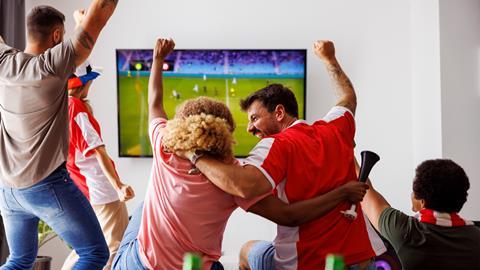
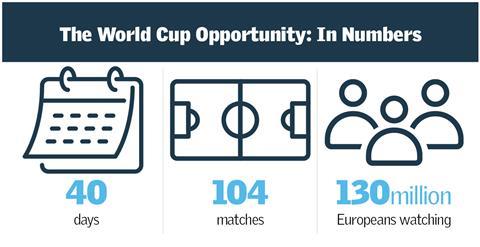
When the whistle blows on 11 June, tens of thousands will gather in the stands of Mexico City’s Estadio Azteca, while more than 130 million European fans tune in from afar, all bracing themselves for 40 days of high-stakes sporting drama spanning 48 teams, 104 matches and – for the first time – three host countries.
And joining them in anxious anticipation will be those brands and retailers that have spent months tirelessly mapping out how best to become a part of that global excitement.
Because if, at one time, sports partnerships meant little more than a pitch-side ad or sponsored kit, today’s tie-ups span immersive social-first campaigns, bespoke giveaways and limited-edition launches, as brands seek to capitalise on today’s multichannel, multi-layered sports ecosystem.
So, why do sports remain such a compelling proposition? How exactly have partnerships evolved, and why? And what does success look like in 2026, both on and off the pitch?
Playing for passion points
Food and drink has a long and storied history when it comes to sports.
The first recorded brand deal was struck by food manufacturer Oxo all the way back in 1908, with marathon runners handed branded Oxo drinks as they competed in the first Olympic Games to be held in London.
By 1928, heavyweights like Coca-Cola had signed up, a branded freighter carrying the US Olympics team and 1,000 cases of the soft drink to that year’s host Amsterdam, in a move seen as instrumental in Coca-Cola breaking into the European market.
“Sports are a huge part of Coca-Cola’s history,” says Paul Hiskens, head of partnerships at Coca-Cola Europacific Partners (CCEP). “The FIFA World Cup, for example, which we’ve been a partner of for many years, is a cultural moment. It drives reach and relevance to most of the consumers in our target market. However people feel about football, it reaches 80% of the population, and it’s a number one passion point for our consumers.”
It isn’t only football either. In what looks set to be “a very, very busy summer ahead,” CCEP’s Schweppes brand is also working with the Lawn Tennis Association and Royal Ascot, and at the Glasgow 2026 Commonwealth Games, its Coca-Cola Zero Sugar, Powerade and Smartwater brands will be the Official Soft Drink, Sports Drink and Water providers, respectively.
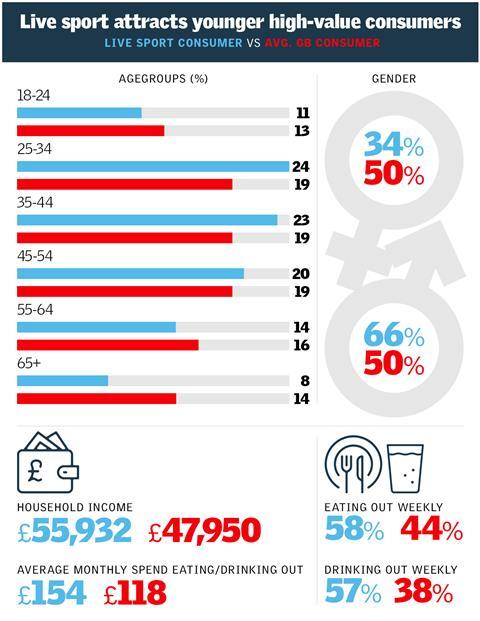
This level of activity is because “sports partnerships allow brands like ours to connect with the consumers at these passion points,” adds Hiskens. They create emotional engagement, he explains, while capitalising on a commercial uplift for the company’s brands off the back of the social and sharing moments linked to sports. Live sport, in particular, attracts a younger, more affluent consumer, willing to spend money on food and drink to supplement their experience.
“The addressable market around sport now stretches far beyond teams and leagues into media, retail, gaming and experiential, creating a global ecosystem worth trillions”
– Andy Milnes, Nielsen market lead for sports in the UK & Ireland
At Unilever, too, an official sponsor for this year’s FIFA World Cup alongside myriad other sporting tie-ups, Chris Barron, general manager for personal care, for UK & Ireland, says: “When our brands show up in sport, we see excitement turn into action. On match day, marathon day and everything in between, we’re not just paying to be visible, we’re creating experiences that people actually want to be part of. That might be in the stadium, around it, or far beyond it.
“Done well, sports partnerships drive awareness, sales and loyalty because fans are deeply engaged and tend to be great shoppers too.”
That rings true for George Phillips, owner of TJ’s Lateshop. “These events help build consumer demand well before shoppers even enter the store, meaning a large proportion of the awareness and intent-building is already in place from a retailer perspective,” he says.
Phillips actively seeks to drum up anticipation in his local community ahead of major events, “reinforcing that TJ’s is more than just a store. By creating an engaging, event-led environment, the store becomes part of the overall experience rather than simply a place to shop.”
More diversity, more data
Crucially, the scale of this opportunity has only increased over recent decades, as changes in sports viewing and consumption habits, coupled with greater digitisation and data, have unlocked new ways for brands and retailers to align themselves with major sporting events.
“The addressable market around sport now stretches far beyond teams and leagues into media, retail, gaming and experiential, creating a global ecosystem worth trillions,” agrees Andy Milnes, Nielsen market lead for sports in the UK & Ireland.
First off, “media fragmentation means audiences are no longer concentrated around linear broadcast – they’re spread across platforms and devices,” he explains. Streaming alone now accounts for over 40% of ad-supported viewing time in markets like the US, for instance, “fundamentally changing how brands reach fans”.
Added to this is “the diversification of sports properties themselves”, notes Milnes. “Rights holders are no longer just media vehicles, they are sophisticated commercial platforms, monetising fan attention through data, content and direct-to-consumer channels.”
Combined, this means “sporting partnerships have evolved from being largely visibility plays into full marketing platforms,” observes Sarah Dawson, executive vice president and managing director at The Team, formerly Wasserman. “Historically, many brands were buying reach – a logo on a shirt, boards around a pitch, or a hospitality package. That still has value, but it is no longer enough on its own.
“Fans today have a far deeper experience of sport that goes well beyond the stadium and linear broadcast,” she says. “They follow it across social, streaming, retail, gaming, creator channels, communities and live experiences. That has transformed partnerships from a media asset into something much broader – a platform that can influence brand fame, shopper behaviour, product relevance and cultural credibility.”
“Measurement is now full-funnel. Brands can track impact across favourability, consideration, purchase intent and actual sales lift”
– Paul Hiskens, head of partnerships at Coca-Cola European Partners (CCEP)
It’s a shift that CCEP’s Hiskens has seen first-hand. “It’s changed hugely just in my time,” he says. “If you think of the basics of where sponsorship started with pitch visibility, which was a big deal then, now it’s gone to a different level given the digital ecosystem.” CCEP’s approach is underpinned by a ‘Sofa to Stadium’ mindset to reflect this change, ensuring each touchpoint is covered, be it digital, social or retail.
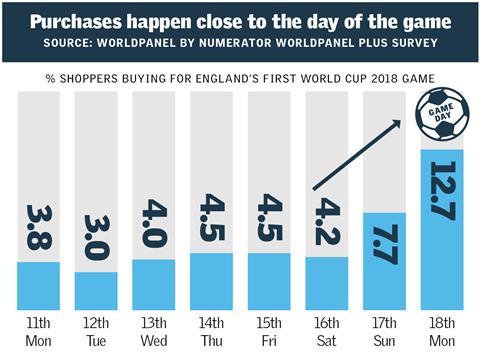
As well as behavioural and media shifts, brands and retailers also now have access to all sorts of datapoints that can help them adjust and adapt their plans, from the impact of weather or the timing of a match on spending habits, to the average Brits’ viewing habits. A survey by Numerator Worldpanel during the 2018 FIFA World Cup, for example, found that most consumers stocked up on alcoholic drinks for a match in the 24 hours beforehand, at 12.7% compared to 3.8% a week prior, highlighting how retailers need to adapt availability ahead of big games.
“Crucially, measurement is now full-funnel,” says Milnes. “It’s no longer just about awareness; brands can track impact across favourability, consideration, purchase intent and actual sales lift. That’s particularly important at a time when marketers are under pressure to do more with less, with over half planning to reduce ad spend in 2025.”
At CCEP, “data has transformed how we operate”, says Hiskens. “We’re now able to understand purchasing behaviour, so it’s not just a blanket approach. Instead, you have to think about, say, what retail environments you’re going to promote in, at what time based on what big moment is coming up next.”
All which has, put simply, changed the game.
“The opportunity is significantly bigger than it was 20 years ago, but so is the expectation and the volume of brand partnerships in sport,” says Dawson. “A great sports partnership today is not simply about being seen. It is about creating something consumers want to engage with, talk about and buy into.”
A 360-degree solution
It is both more challenging and more rewarding, agrees Hiskens.
CCEP tackles this “by making sure we have a 360-degree activation plan that ensures we can maximise engagement throughout”, planned meticulously for months in advance and spanning every touchpoint, both physical and digital.
Ahead of the FIFA World Cup 2026, for example, it has teamed up with Panini, the event’s exclusive partner for official stickers and trading cards, to roll out a collectible sticker experience embedded directly within the Coca-Cola bottle label. Shoppers can peel back the label to reveal one of 12 exclusive stickers, featuring star players from 10 countries, and designed to be added to a dedicated Coca-Cola page in the Official FIFA World Cup 2026 Sticker Album.
“It’s a great collectible mechanic and it gives consumers a clear reason to keep purchasing repeatedly as they build their collection, which in turn drives frequency and hopefully basket spend for our retail partners,” says Hiskens. “It also taps into nostalgia and social behaviour as consumers share, trade and discuss their collections, extending the reach of the activation beyond the point of purchase.”
This sits alongside exclusive new product development (NPD), such as the reveal of two new limited-edition Powerade flavours, styled around an ‘attack’ and ‘defend’ concept, and created to “add some colour and interest to fixtures”.
And in March, the brand even unveiled a new anthem for the tournament, released via its own label, Real Thing Records, and featuring acclaimed Colombian artist J Balvin.
“We’re thinking well beyond just the stadium, creating experiences in, at, around and away from it – because what happens off the pitch is just as important as what happens on it”
– Chris Barron, general manager for personal care, UK & Ireland, Unilever
At Unilever, meanwhile, the team is also prioritising a multi-pronged approach. Alongside limited-edition packs, it has also put in place creator partnerships, ‘fan zones’, gaming and in-store theatre activations across its personal care brands, says Barron.
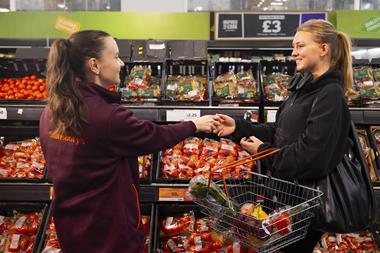
Phillips works closely with brand partners to bring this in-store theatre to life, with free merch handouts and branded activations. This is complemented by photos and videos captured and shared across social media which “amplifies the impact beyond the store walls.”
For some brands, tapping into sports culture even extends into the UK’s vibrant grassroots sports scene. Last year, for instance, saw the return of Kellogg’s kids football camps during school holidays, an initiative made possible by its partnership with clubs across the country and positioned as an antidote for busy parents unsure how to occupy kids post-breakfast.
“It works because it connects brand, product and behaviour,” says Dawson. “Breakfast becomes the starting point for an active day, not just a moment in isolation. And, crucially, it translates into retail through strong promotional mechanics that drive value for shoppers, retailers and the brand. It’s simple, but that’s the power of it.”
Creating engagement and excitement
For those brands eyeing up this potential in sports – but unsure of their first move given the complexity – Dawson recommends starting with the right question. “Too many brands begin with ‘Which sport should we sponsor?’ rather than ‘What are we trying to achieve, who are we trying to reach, and why will sport help us do it better?’”
Next, think of the partnership as a platform, rather than an asset purchase, she advises. This means the “value does not sit only in the rights, nor is it a media buy. It sits in how effectively you activate them across the entire business – marketing, retail, ecommerce, social, PR, internal engagement, customer experience and trade.”
Milnes agrees. “Industry best practice is clear: for every £1 spent on rights, brands should be investing at least £1–£2 in activation,” he says. “Without that, you are buying an asset and leaving it in the warehouse.”
Don’t miss out on measurement, he adds. “Failing to define key performance indicators (KPIs) from the outset and tracking performance is a missed opportunity particularly when the tools to do so are readily available. If you don’t know what success looks like on day 1, you cannot optimise for it on day 100.”
All of which echoes the learnings that Hiskens and his team at CCEP have built up over their years – and years – of carving out a leading role in sports partnerships.
The bottom line is “ensure you’re thinking about both your customer and your consumer,” he says. “That means you have to ensure you understand who the consumer is and then give them a reason to get engaged and get excited.
“It’s not just about watching matches, it is about the opportunity to have a conversation, to spend time with family and friends.”
And, hopefully, to tuck into plenty of food and drink too.
How can retailers drum up in-store excitement?
For retailers, by making a few smart, strategic choices around merchandising, promotions and even a little in-store theatre, they can unlock far more excitement (and spend) from sports fans.
“Retail is one of the most powerful, and often underutilised, extensions of a sports partnership,” believes Nielsen’s Milnes. “The key is to turn passive shoppers into active participants in the fandom.”
This first comes via relevance. “Product storytelling needs to connect directly to the partnership, whether that’s through themed ranges, limited editions or contextual merchandising. From there, it’s about experience,” he adds. “The most effective retailers create immersive touchpoints such as in-store offers or activities, competitions, sampling or digital integrations that bring the partnership to life at the point of purchase.”
Ensure this activity is carefully aligned with occasions that drive demand too, recommends Hiskens. “Think about when the matches are and work out if you have stocked up in the right way to ensure you’ve got the right products available in the right pack for the right occasion.
“Make sure you’ve got strong availability, clear visibility and secondary displays to make the most of these moments.”
Consider cross-category merchandising too, he advises. For example, pair soft drinks and snacks to nudge up incremental basket spend. And work with brand partners to help deliver some in-store theatre around their own activations, such as Coca-Cola’s Panini tie-up.
Most importantly, don’t miss out urges Phillips. “Brands invest millions in advertising these moments for a reason – they create excitement, awareness, and real demand. It’s our job, for the benefit of our own businesses, to tap into that investment and turn it into sales.”