


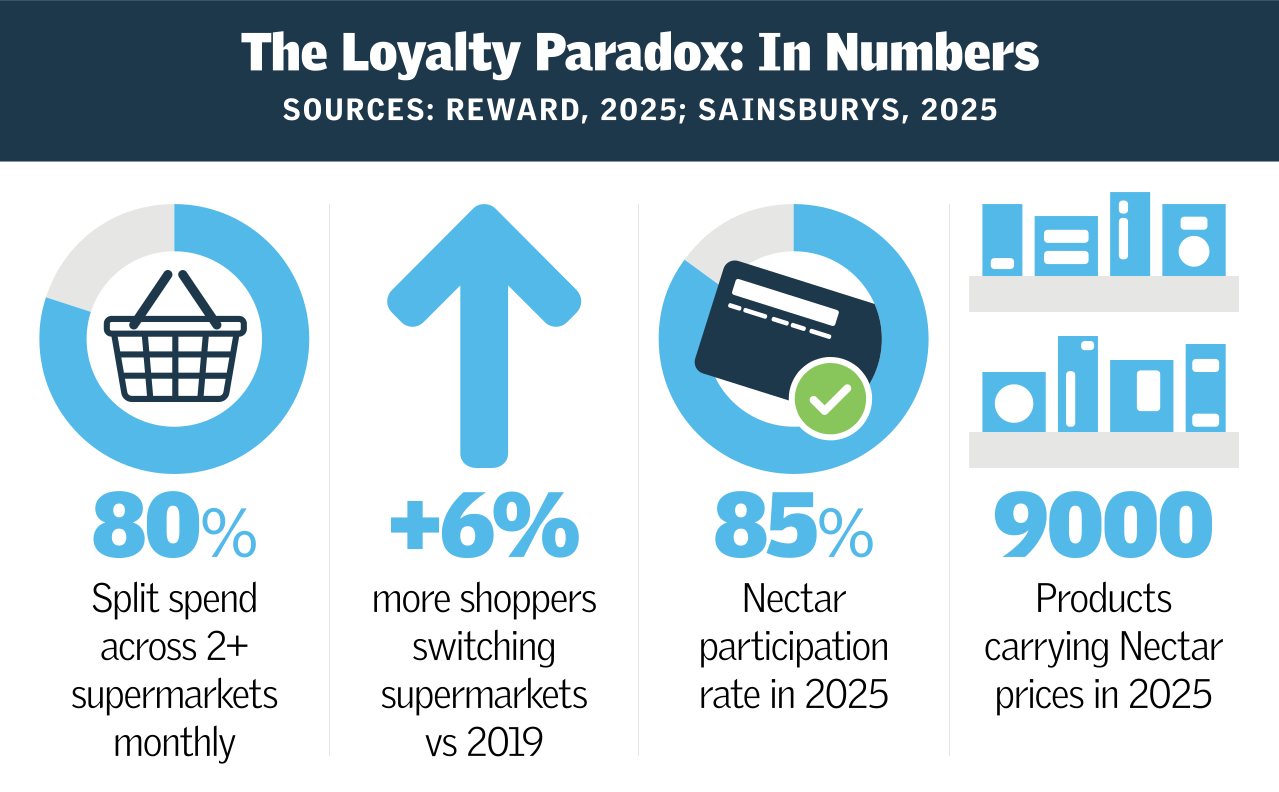
British shoppers are among Europe’s most prolific in signing up to retailer loyalty schemes yet 80% split their grocery spend across multiple supermarkets every month. As the cost-of-living hangover lingers and choice proliferates, retailers and payment providers are being forced to rethink what loyalty actually means.
On paper, loyalty schemes at the UK’s major supermarkets are booming.
As of 2026, roughly 83% of UK households had a Tesco Clubcard [Tesco]; 24 million Brits are carrying a Sainsbury’s Nectar card into stores [Sainsburys]; and even the Co-op is targeting 10 million active members by the end of the decade [Co-op].
In fact, the UK shopper is more drawn to loyalty schemes than in many other European countries [Mando], with the average consumer a card-carrying member of no less than three schemes, according to 2024 analysis by the Competition & Markets Authority [CMA].
The trouble is… participation doesn’t equate to loyalty.
Eighty per cent of these consumers now split their grocery budgets across at least two supermarkets per month, the highest proportion since 2023, according to a 2025 poll by Reward. Overall, the total proportion of shoppers switching had increased by 6% since 2019.
In other words, loyalty schemes might have the scale, but they aren’t creating enough of a differentiator to stop shoppers from straying elsewhere when the price is right.
So, how can retailers level up loyalty schemes to really cut through in the current climate?
What’s fuelling fragile loyalty?
The current economic and retail landscape isn’t exactly conducive to loyalty. Not only has ongoing inflation and geopolitical uncertainty meant consumers are prioritising price or value over metrics like brand recognition or familiarity, but they’re also faced with unprecedented levels of choice, spanning social commerce, online behemoths like Amazon, discount platforms and, of course, traditional supermarkets.
“Loyalty has become maybe more fragile because of the cost-of-living crisis and the ongoing impact [of that] on how consumers focus on value; they’re just voting with their wallets,” says Richard Lim, founder and CEO of Retail Economics. “Value has become king because of how people’s discretionary incomes have been put under so much pressure.” As a result, behaviour has been driven by “whether or not people can get a better price at a different supermarket”.
To some extent, this behaviour can be amplified by the proliferation of loyalty schemes, points out Dave Jones, head of UK consumer at PayPal. “Consumers increasingly have a wide range of choices with multiple providers in most segments, many of which are turning to loyalty schemes to try to create a point of differentiation,” he says. “That increased prevalence of schemes correlates with consumers being less loyal.”
That’s particularly evident in grocery since the introduction of membership pricing models, kickstarted by Tesco in 2020 and now the backbone of loyalty schemes at nearly all the major grocers. In 2025, Nectar prices were expanded to some 9,000 products, says Sainsbury’s, with participation reaching 85% across the year, and even higher at seasonal shopping spikes such as Christmas.
However, effective though these membership pricing models can be as a short-term lever, when the primary incentive that underpins a loyalty scheme is price, retention is only ever as strong as the next deal.
“Loyalty programmes have become almost universal, but many still operate as transactional mechanics rather than decision-shaping systems,” says Ben Snowman, global head of loyalty and personalisation at dunnhumby. “Shoppers sign up because it’s sensible but that doesn’t mean those programmes meaningfully influence where they shop on a given trip.”
Differentiation beyond price
Faced with this quandary, retailers may need to rethink their focus, says Jones.
“People want to feel rewarded when they transact – so there is a definite space for loyalty programmes to win and appeal to consumers,” he says. But “if you’re rewarding on an individual transaction basis, it’s nearly always a race to the bottom and it’s going to be difficult to substantiate that approach over time. Where the interesting innovation lies for loyalty providers is: how do you create points of differentiation and a clear focus?”
Some retailers are already cottoning onto this, with relaunched or expanded schemes offering greater flexibility and freedom or drilling down into greater levels of personalisation.
In early 2026, for example, Holland & Barrett relaunched its loyalty programme, rebranding from Rewards for Life to H&B&Me. The scheme is now fully app-based, with points accrued available instantly to be spent in-store coupled with other bonus gifts, such as birthday vouchers.
“Simplicity was a key focus for us,” says chief marketing officer Mark Singleton. “We know customers are looking for clear, accessible ways to support their wellbeing, so we’ve designed H&B&Me to remove friction and deliver immediate value. Features such as instant points redemption, birthday rewards, seamless app integration and points that don’t expire – alongside core benefits like member pricing – mean customers can see and feel the benefit straight away.” Early feedback has been “very positive”, he adds, and forms “the start of a broader move towards integrating wellness and loyalty in a more relevant and motivating way”.
Sainsbury’s has also steadily added to its roster of 500 brand partners, allowing Nectar points to be spent interchangeably rather than solely in-store. In April, it added Uber and Uber Eats, as part of its ongoing efforts to “give people more ways to enjoy the value they get from Nectar”, according to chief technology, marketing and data officer Mark Given.
Also in April, M&S unveiled what it says is a “transformed” Sparks loyalty programme, utilising AI and machine learning to deliver more personalised offers and rewards, an experience it says will improve incrementally the more it’s used by shoppers.
“Extra injection of reward”
For Jones, it’s all about delivering a broader, interactive experience for loyalty scheme users. “You’re wanting to form established, deep-rooted habits with the consumer that deepen and broaden your relationship with them,” he says. “That’s what everyone’s goal is. So how do you gamify that in a personalised way, whether that’s through product-specific placements or through offers and opportunities at certain points in the consumer life-cycle, when they’re likely to become disengaged?”
This is why – in developing and launching its own loyalty programme, PayPal+, in November 2025 – Jones and the team zeroed in on creating “that extra injection of reward” for a value-driven user base. For example, attention-grabbing headline offers, such as a partnership with festival organiser Live Nation UK, were paired with high levels of flexibility. As Jones puts it: “Whether you transact at checkout, use our credit card, pay later or you’re making a cross-border payment, we’re willing to give you rewards. It’s being received well too, we’ve had 3 million enrolments in the first few months which is a good indication that consumers are seeing the value.”
These rewards augment existing retailer schemes too, by allowing users to benefit from both. “We’re [also] putting a lot of effort into trying to convert consumers who transact occasionally or infrequently with PayPal to transact habitually,” he adds, via elements such as gamified milestones on transactions.
Yes, value matters – especially now – but trust, recognition and ease matter too. Programmes that combine intelligent personalisation, compelling value, and a sense that the retailer genuinely ‘gets’ the shopper, are the ones that break the ‘apparent’ paradox.
“The best programmes recognise that loyalty isn’t just economic,” says Snowman. “These retailers don’t try to force loyalty – through continuous, relevant engagement, they make loyalty the most rational and rewarding choice.”
To find out more about PayPal, click here.