


With UK grocers under increasing pressure to deliver against a backdrop of numerous compliance challenges and consumer trends, Northern Ireland is showing how some of its award-winning products are measuring up to the specific problems retailers face in 2026.
UK retailers are navigating a challenging moment. Consumer demand for health, sustainability and provenance is intensifying, while cost pressures, allergen compliance and supply chain resilience remain constant preoccupations for buyers. Against that backdrop, Northern Ireland’s food and drink sector – worth £8.4bn and supporting 113,000 jobs – is making a compelling case for itself.
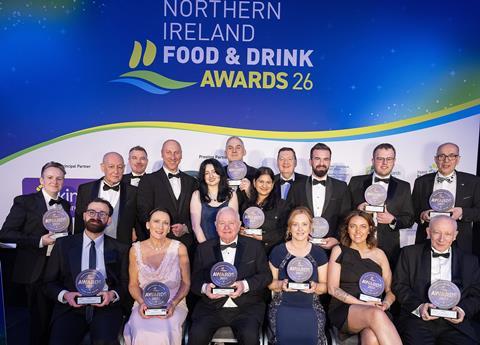
What makes Northern Ireland so competitive? From export-ready innovation to advanced manufacturing, leadership on sustainability, and retailer-aligned product development, the winning companies featured in its recent 2026 Northern Ireland Food and Drink Awards, held in partnership with Kinecx Energy, highlight the commercial strengths of the region and offer insight into how NI processors continue to outperform in UK and global markets, says Michael Bell, executive director of the NI Food and Drink Association.
“These awards are unique in our industry in that buyers from Asda, Lidl, Marks & Spencer and Tesco are on the judging panel,” he says. “So, for Northern Ireland firms it’s not just about celebrating our industry at a gala dinner, but showcasing innovations in product, people and process to key customers. We want to see quality, ingenuity and commerciality - three areas where the industry locally really excels.”
That commercial lens matters. The awards are not a celebration of regional pride alone. They are, in effect, a curated pitch to the retail trade.
Provenance that earns its place on shelf

The most commercially resonant products here are not trading on origin alone. Clean label, plant-based and with a story that writes itself, Crawford’s Rock Dilisk Sprinkles is the kind of product that gives category buyers something to talk about. Winner of the best new product award in the micro company category, it showcases the local heritage and flavour of Irish dulse, hand-harvested along the Mourne coast and air-dried to preserve its natural nutrients. The result is a single-ingredient seasoning with a savoury, smoky umami the company calls ‘bacon of the sea’. Provenance, here, is not a sticker on the pack. It is the product itself.
Gilfresh Produce’s Warty Goblin pumpkin makes a similar point. Winner of the Invest NI best product launch outside Northern Ireland award, it delivered a seasonal exclusive to a major retailer in the Republic of Ireland this Halloween – a distinctive, story-rich SKU with genuine footfall potential. Local producers, these winners suggest, are thinking like brand marketers.
Functional innovation with real retail utility
The strongest trend across this year’s winners is the ability to translate health credentials into genuine consumer appeal, rather than simply badge a product with functional claims.
For buyers looking to trade customers up within chilled, Big Pot Co’s Bone Broth Vegetable Soup – winner in the best new product (small company) category – is evidence that comfort and function are no longer competing priorities, as it brings collagen-rich broth into a convenient chilled format. Meanwhile, Simply Fruit’s Sparkling Pink Lady Apple Juice, which uses cores left over from the company’s fresh-cut line, shows how waste can become value, and sustainability can be turned into a selling point rather than a cost, achieving something neatly elegant.
And, as a direct response to retailer reformulation targets without sacrificing consumer appeal, Fibre UP’s sparkling soft drink achieves sugar reduction alongside functional fibre.
These are not products chasing trends. They are products built around what buyers actually need on-shelf in 2026.
A similar blend of insight and execution underpins Deli Lites’ Salt ’n’ Chilli Chicken Goujon Wrap, Best New Product in the large company category, which has become a standout onboard choice for Aer Lingus. Built around one of Ireland’s most popular flavour profiles and informed by consumer data, it shows how NI processors can deliver premium, travel‑friendly food‑to‑go options that meet foodservice and retail needs alike.
Supply chain strength that buyers can rely on
Product innovation is only part of the story, however. What gives Northern Ireland its commercial edge is the operational sophistication sitting behind the products.
Wilson’s Country illustrates this on two fronts. Its gluten-free, crunchy-crumb potato croquettes address the high-volume banqueting sector’s twin pressures of labour shortages and consistency – a product with genuine utility for operators demanding speed, repeatability and allergen control. In addition, the company’s on-site anaerobic digestion system, which stabilises energy costs and reduces exposure to market volatility, secured it the Ortus Energy Sustainability Energy Leadership Award. For retailers assessing the resilience of their supply base, that kind of investment is increasingly significant.
Moreover, at a time when Scope 3 emissions are under growing scrutiny, the ability to hand buyers verifiable sustainability data is a meaningful commercial differentiator.
As an example, Dale Farm’s Future Strong framework, which supports 1,300 dairy farmers to reduce on-farm emissions while improving processing efficiencies, enables the cooperative to provide a milk pool-wide carbon footprint for its customers.

Other significant structural investments that make suppliers easier to work with include: WG Buchanan & Son’s physical segregation of nut and non-nut storage, using engineering controls, which directly tackles allergen risk; and McColgan’s ‘Journey to World Class’ digital transformation, which shows how automation and data analytics can lift OEE and cut waste, delivering the price competitiveness and availability that buyers require.
The talent to sustain it
Underpinning all of this is a workforce with the ambition to match. Northern Ireland’s food and drink sector attracts and develops serious talent. Few UK regions can point to an industry that feeds 10 million people from a population of two million. Fewer still can do so while consistently outperforming on innovation, sustainability and manufacturing quality, as exemplified by the Vickerstock Rising Star award, given to Samuel Turner, sustainability executive at Finnebrogue.
Bell’s message to retailers is direct: “Let the functional benefits do the talking. Sustainability needs to translate into supply resilience and cost stability. And innovation isn’t just about the end product – the ingenuity of a talented workforce unlocks process improvements, new product development and fresh thinking on-shelf.”
Northern Ireland’s award winners are not asking retailers to take a chance on regional provenance. They are offering something more useful: products that solve real problems, processes that reduce real risks, and a supply base built for the demands of modern retail. That, in 2026, is a serious commercial proposition.
For more information on the Northern Ireland Food and Drink Awards, visit nifda.co.uk/awards