





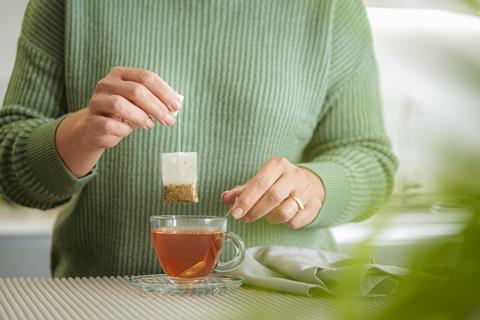
Picture this: a consumer stands in a supermarket aisle, choosing from the array of teabags on offer. With household budgets under pressure, value is paramount. As they survey the range of branded and own-label options, a fundamental question emerges: how much will each cup of tea actually cost me?
It’s a straightforward question that, surprisingly, lacks a straightforward answer.
Currently, the prevailing method of pricing – £x per 100g – makes it inordinately difficult for consumers to genuinely compare prices and identify the best-value option. While ‘price per 100g’ offers a metric, it fails to reveal the ultimate cost of a single, brewed cup, or indeed the cost of an individual teabag.
A weighty issue
A significant part of this problem lies in the enormous variation of tea content per bag across the market, as bag weights can range from as low as 1g to over 3g. This disparity profoundly skews how affordable products appear to be on a per 100g basis, because some standard black teabags weigh considerably more than others, depending on the teas used and the desired brew at the end.
This wide variation means comparing solely on a per 100g basis is fundamentally misleading. Introduce green tea or other fruit and herbal infusions into the equation – where some highly concentrated herbal teas can appear astronomically expensive on a per 100g basis yet offer a perfectly affordable per cup cost – and the picture becomes even more opaque.
It is time for the tea category to come together and address this. As concerns about making ends meet persist for many UK consumers, we in the industry have a clear responsibility to be as transparent as possible and empower shoppers with the tools they need to make informed purchasing decisions.
We believe the most effective way to achieve this is by clearly signposting cost per use – effectively, cost per bag – at the fixture. Shelf-edge labels across the category should consistently display not only the price per 100g but also the price per bag (or per cup).
Cost per cup
This is not a radical proposition; other household categories have long adopted similar, more intuitive approaches. Shoppers buying laundry detergent are shown the number of washes they can expect per pack. Coffee pods are universally sold by the ‘serve’ or ‘pod’, multipacks of biscuits are priced per individual biscuit, and multipacks of crisps clearly show a price per individual bag.
Encouragingly, Ocado has already begun displaying a ‘cost per bag’ model for tea, recognising its importance for consumer clarity. However, most major retailers are yet to follow suit, leaving a gap that, in our view, does not serve consumers well.
Our own research strongly supports this shift, with shoppers telling us they like the idea of knowing the cost per cup because it’s simple, intuitive and immediately comparable. In fact, ‘cost per cup’ ranked sixth in the in-store decision-making hierarchy. Expecting shoppers to undertake the mental gymnastics of comparing the value of a 40-bag pack from one brand against a 240-bag pack from another simply adds unnecessary complexity to an already busy aisle.
Concerns and clarity
Uniting the tea category around a ‘per bag’ or ‘per cup’ metric will, naturally, present challenges. Some brands might argue their bags are strong enough to make more than one cup of tea. Others may fear the metric could inadvertently trigger a move towards lower bag weights in a bid to appear more affordable.
These are valid commercial concerns. However, such considerations should not ultimately supersede our responsibility to consumers. True transparency, even when it requires confronting existing commercial models, fosters trust and long-term category health. Providing clear ‘cost per bag’ information for different tea types and brands would immediately offer consumers transparent and comparable value of what each ‘cuppa’ costs.
Beyond the immediate benefits, there are also some unexpected advantages. Tea is an inherently healthy, delicious, and affordable drink, but its true value isn’t always immediately apparent to consumers. Introducing a ‘cost per use’ metric would vividly highlight just how economical tea truly is. Looking to the future, increased transparency around ‘cost per use’ could also pave the way for broader conversations around ensuring fair prices for tea farmers – prompting us to ask if, for example, a sub-2p teabag can truly allow for a sustainable supply chain.
If the tea industry is serious about supporting shoppers through continued financial pressure, then we must adopt clearer, more intuitive pricing. ‘Cost per cup’ is not a radical overhaul – it’s a common‑sense step that aligns tea with the rest of grocery retail. It’s time for the category to unite, take responsibility and give consumers the clarity they’ve been missing.
Jonny Briscoe is MD UK&I at Lipton Teas & Infusions






No comments yet