





The government has outlined further details of its highly anticipated animal welfare strategy, including proposals for tougher rules on how animals are reared in the UK and slaughtered.
The wide-ranging strategy, first announced over the weekend, covers all aspects of animal welfare, with its farmed animal section aiming to ensure livestock “experience not just a life worth living but a good life throughout all life stages”.
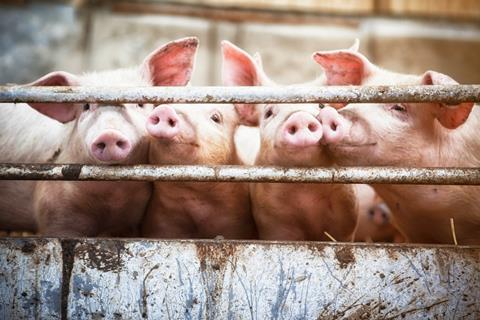
Standout commitments published yesterday afternoon include proposals to ban the use of CO2 gas for the pre-slaughter stunning of pigs, subject to a consultation.
Defra said there was a “pressing need to address the welfare issues” associated with the practice, with a shift towards other “commercially feasible” and higher-welfare alternatives such as argon gas and automated electrical stunning required in as short a time as possible.
However, the National Pig Association warned such alternatives were not yet ready for market. “As yet, there are no viable alternatives, despite research into some options including use of inert gases, electrical stunning, low atmospheric pressure stunning and nitrogen foam,” said NPA chief policy advisor Katie Jarvis.
She added that research programmes were investigating new methods but ”none are yet at the stage where they can be commercially adopted”.
These concerns were echoed by British Meat Processors Association CEO Nick Allen, who added that the structural changes that would be needed “will be difficult to achieve in that timeframe and would likely not yield the desired animal welfare improvements”.
Allen also said that the changes to Co2 would also mark the ”UK out as a single outlier in the world - no other country has gone down this route”.
“Moving away from Co2 would slow down operations to such an extent that it would render processors completely un-competitive,” he added. ”It would decimate the domestic pigmeat industry and be a severe blow to UK food security.”
Concerns that these changes could cause issues with international trade have been repeated by the NFU and British Egg Industry Council.
NPA CEO Lizzie Wilson also echoed the concerns over importing produce that does not meet the same animal welfare requirements.
Read more
-
Meat: government urged to tackle labelling misinformation
-
Animal welfare reforms welcomed but farmers raise concerns
“Implementing core standards will prevent UK farmers’ animal welfare and sustainability efforts from being undermined and ensure that the UK does not simply offshore food production to countries with cheaper, less sustainable systems and lower animal welfare standards,” Wilson said. “Allowing goods into the UK produced to standards that would not be legal for our producers, would represent a betrayal to British farmers.”
The government said it would “consider whether overseas produce has an unfair advantage and be prepared to use the full range of powers at our disposal to protect our most sensitive sectors”.
The government has also said it would end the “practice of killing day-old chicks”, due to the development of new in-ovo sexing technologies, although the Vegetarian Society’s chief executive, Richard McIlwain, asserted it needs to go further to ensure change.
“While the strategy includes some promising measures for animal welfare, it unfortunately stops short of committing to an imminent ban on male chick culling,” McIlwain said. “Without a clear and time-bound commitment, this deeply cruel and avoidable practice will continue on a vast scale.
“Public support for ending male chick culling is overwhelming, and politicians and public figures have repeatedly called for decisive action.”
In further moves that will have a significant impact on the pork and egg sectors, the government strategy said it would consult on phasing out caged systems, such as enriched colony systems for hens, and farrowing crates for sows.
“Removing the use of intensive confinement systems is an essential component of the government’s plan to ensure all farmed animals have a life worth living,” Defra said.
On the back of concerns over the use of fast-growing poultry breeds from animal welfare NGOs, the government added it had commissioned the Animal Welfare Committee to provide a “sound, up-to-date evidence base on livestock breeding and animal welfare”.
And it added that while the poultry sector had made progress on transitioning to lower stocking densities, it pointed to potential regulatory moves to push further progress on the issue, and to encourage the wider uptake of the Better Chicken Commitment – which also mandates the use of slower-growing breeds.
“It is vital that this work is supported by proportionate, transparent and robust enforcement systems,” the strategy urged.
The government will also introduce humane slaughter requirements for farmed fish into legislation, subject to consultation, and will improve animal welfare at production.








No comments yet