




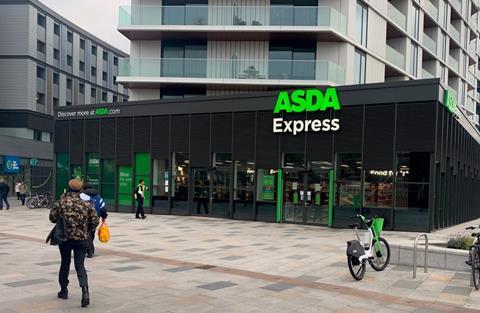
Asda has harmonised more prices between Express and main stores, and reduced how much more convenience shoppers pay in most categories. However the absence of some of its deepest rollbacks from smaller formats means that the overall mark-up at Express stores has increased.
Data shared with The Grocer by Ipsos examined a basket of 112 everyday products across six fresh food categories in February and June.
Of those items, the proportion that cost the same or less at Asda Express jumped from 14.3% to 23% as the retailer aligned the price of more high-volume lines with its full size stores. A two-pack of avocados commanded an 18% premium while a five-pack of oranges cost 26.7% more in February. Asda lowered the price of both SKUs to match main store prices in June.
For most categories, the mark-up for convenience categories reduced. In milk the gap narrowed to 9.7% from 16.6% and fruit to 14.1% from 20.1%.
However the convenience premium for cheese increased from 6.5% to 13.8% and meat from 9.7% to 14.1% as Asda’s rollback promotions were not always replicated in its smaller local stores.
Amongst the widest price gaps, Philadelphia Original Soft Cheese 165g became cheaper at Asda’s main stores as its rollback promo deepened from £1.25 to £1. At Asda Express, however, the same item cost £1 in February but £2.60 in June. Similarly its 300g lamb leg steaks cost £4.92 on a rollback promotion at Asda’s main stores, down from £5.74 in February. In its Express fascias the price increased from £6.12 to £6.30.
That meant the overall convenience premium across all 112 products edged up slightly to 13% compared with 12.7% in February.
In November convenience boss David Lepley told The Grocer that value was a “key part of growth” as it opened more Express convenience stores. At that time Asda matched 14 essential products and would run different promotional strategies across its formats.
Ipsos data confirmed that Asda ran more multibuys in its Express format. It ran 30 multibuy and two price cut promos across the 112-strong basket. In main stores it was a more balanced 17 multibuys and 16 price cuts.
All supermarkets charge a mark-up in convenience stores. Ipsos said the average premium across retailers is 10-13%.
Steve Fullard, client manager, Ipsos Channel Performance said: “Retailers routinely apply different convenience premiums by category, reflecting varying commercial strategies, customer missions and competitive dynamics.
“Against that benchmark, Asda’s results suggest that while category-level pricing has evolved over the first half of 2026, there hasn’t been a big shift in strategy. The narrowing of category variation is interesting in itself, but it has not translated into a lower overall convenience premium.”
Asda Express has been a strong performer for the group as it battles declining market share. It opened its 500th store earlier this year and reported its seventh quarter of consecutive growth in the three months to 31 March 2026.
An Asda spokesman said: “Asda committed to ensuring that the products that customers buy the most in our Express stores would be matched to the prices in our larger sites. This research shows that more than a quarter of the products featured were priced the same or lower, including everyday essentials such as milk, bread, cheese, fresh fruit and vegetables.”




No comments yet