




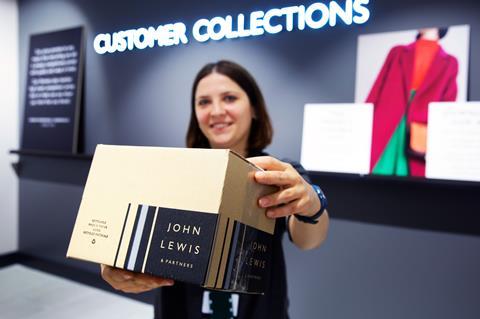
The owner of Brent Cross shopping centre is suing John Lewis for a share of its click & collect sales, despite the lease terms predating e-commerce.
Brent Cross owner Hammerson and former owner Standard Life Investment argue click & collect sales fall within the terms of a turnover lease that was agreed in 1979, The Financial Times reported.
John Lewis is liable under the lease to pay 0.75% of the branch’s gross receipts for annual sales above a threshold of £4m, rising to 1% of turnover above £10m.
Hammerson and Standard Life argue click & collect sales should be covered by the contract wording, which stipulates that “mail, telephone or similar orders received or filled at or from the demised premises or directed thereto” contribute to gross receipts. They argue a £2.95 John Lewis collection charge, which applies to orders below £40, should be included, and are seeking backdated payment.
John Lewis argues a click & collect transaction takes place when the order is dispatched from the distribution centre, rather that at the store the customer collects it from, and that it therefore does not fall within the terms of the lease.
“The dispute centres on the commercial tension built into turnover rent clauses, with landlords seeking to maximise what counts towards turnover and tenants seeking to limit it,” said Kristine Ng, partner at law firm Morr & Co.
“The question before the court is whether wording agreed decades ago, long before online retail and click & collect existed, can fairly be applied to today’s trading models.
“This is not about creating new rules on turnover rent. It is about how a historic lease should be interpreted.
“The court will look at whether the language used, judged by the standards and commercial context of the time, can legitimately extend to modern retail practices such as click & collect, or whether that pushes the wording further than it was ever intended to go.”
Landlords have long sought ways to claim a portion of retailers’ online sales, with efforts intensifying in the wake of the pandemic.
Retail data firm CACI developed a new lease model in 2020 which considered online sales within a store’s catchment area in arriving at a rent ‘top-up’. However, the model struggled to gain traction, with landlords yet to implement it by 2022.









No comments yet