



Selling fresh and chilled products online isn’t as straightforward as replicating offline retail. However, with more than a decade of testing and learning under its belt, one dairy giant says it has now turned ecommerce into its strongest area of strategic growth. To do so, it has had to rethink everything from logistics to packaging to price.
Arla has always aimed to be “on the front foot” when it comes to ecommerce, says the company’s sales account director Matt Davis.
When many fresh and chilled brand owners still held back, hesitant around the logistical challenges of selling safely and sustainably online, the UK’s biggest dairy co-operative leaned into the opportunity, listing its range on Amazon as far back as 2015 to offer its broad portfolio of milk, yoghurts, butter, cheese and dairy drinks on the online store.
By 2021, after Covid accelerated growth, Arla fast-tracked its plans, announcing an ambitious target to double sales via online stores to €600m across Europe by 2025, further investing in infrastructure and expanding its dedicated ecommerce team.
In recent years, the company has experimented in quick commerce too, again working with Amazon to offer its range via both the retailer’s same-day delivery service and – from the start of this year – its new Amazon Now service, which offers groceries in 30 minutes or less to select UK cities, including London and Manchester.
The dairy cooperative has always been crystal clear on the commercial opportunity says Davis. “For the best part of 15 years, online has been identified as an important channel for success within FMCG, both from a growth perspective but also strategically, in terms of how we develop our go-to-market brands. It has always been incredibly important to us.”
“Amazon provided us with the opportunity to test and trial how fresh produce would convert into revenue, growth and visibility for our brands”
– Matt Davis, Sales Account Director, Arla
Test and trial
There’s no doubt that a portfolio dominated by fresh and chilled products can throw up challenges or learning curves when it comes to optimising ecommerce – particularly in areas like fresh milk, with high volumes but short shelf-life, admits Davis.
Take, for example, something as seemingly simple as how milk bottles are packaged and transported. Typically, Arla has used ‘tets’, specialised milk trolleys designed to streamline the movement of milk containers and maximise efficiency by reducing the need for box packers on its production line. But, as the business expanded beyond traditional supermarkets and into ecommerce networks, it became clear that not all were set up to accommodate ‘tets’, requiring Arla to adapt its handling processes for different distribution models. “That has been a continual journey of understanding,” says Davis.
Arla’s response, though, has always been to iterate, trying different approaches and building up its knowledge on how online shoppers behave, what they reach for and their expectations around speed, he adds.
Amazon has played an invaluable role on that journey from day one. “They provided us with the opportunity to test and trial how fresh produce would convert into revenue, growth and visibility for our brands. At the start we learned a lot – about how shoppers bought same-day items, their preferences for brands versus own label, as well as different shopper profiles.”
The team quickly got to grips with the advocacy of online search, for example, and the importance of appearing on an ecommerce flywheel, as well as customising areas such as price pack architecture for online rather than physical retail.
“It has enabled us to tailor our plans by channel and clearly start to compare what works well, and what might not ‘lift and shift’,” he explains.
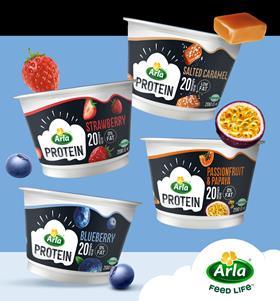
That growing presence online has also helped Arla champion its core messaging on health and nutrition, and zero in on associated value-add growth areas, like yoghurt, dairy drinks and cottage cheese. Eighteen months ago, the supplier even worked with Amazon to create a dedicated ‘protein’ landing page, reveals Davis, showcasing not only Arla’s own range but those of its competitors to provide consumers with a “full complement of their protein needs in a day”. The project went from idea to execution in weeks rather than months, he adds, thanks to the pace at which the retailer can operate.
This is supported by Amazon’s suite of branding tools, where it is constantly testing and learning new merchandising opportunities to surface selection to customers and optimise for how they shop. Amazon is also a member of the Dairy Roadmap’s Value Chain Forum, providing feedback on drafts of the pathways report to support its effectiveness for stakeholders across retail.
Convenience is king

That history is why, when Amazon expanded its same-day grocery service and later announced its Amazon Now service at the start of 2026, Arla was well-positioned to be part of the range from the outset, admits Davis.
Arla has dabbled in rapid delivery before, but it has remained a small part of the business, in large part because the industry has struggled to nail down a commercially sustainable approach, he says. But, having seen Amazon’s trials in the US, “we could clearly see that this could be the future of commerce, particularly in conurbations and big cities. We really believe that same-day [and rapid delivery] could hold really high value in the long-term. Convenience is king. And while tackling quick commerce across the industry has been a challenge, who better to test and trial it than Amazon?”
It’s early days on Amazon Now, but within the range, essentials like milk are proving popular for quick-commerce shops, while impulse categories like dairy drinks have also got the potential to be “really successful”, believes Davis.
As from the start, Arla’s approach is to test, learn and lean into the opportunity. “We’re prepared to continually learn, and test and trial new things because the landscape is always changing. We’ve got a clear view of where the growth engines within dairy will come from over the next five to 10 years, and therefore it’s about how we engage with Amazon over the longer-term.”
Future growth
Arla’s early embrace of Amazon’s latest delivery innovations shows how perishable brands are moving fast to meet changing shopping habits, and the online grocery opportunity is only growing. “Arla saw the opportunity early, and we’re always looking for ways to support brands that can add value to the customer experience,” says Peter Masters, director of EU grocery & everyday essentials at Amazon. “We’re constantly innovating to help brands grow on Amazon, and we’re excited about what’s ahead.”
After all, a little more than a decade after Arla took the ecommerce plunge, the commercial advantages couldn’t be clearer.
“Our broader ecommerce business is a significant part of what we do now, it’s growing and it’s a channel that we need to compete in because the share within our total business is of a scale now to ensure that, more importantly, you can’t afford to lose .” Particularly when you factor in the “ever-evolving world of retail media and the implications that will have on what was the traditional marketing funnel”.
As a result, the dairy supplier is continually adding to its dedicated team of specialists, tools and infrastructure, drawing on international lessons from Europe and further afield to see what could be coming next around the ecommerce corner.
“It will continue to be the fastest-growing channel for us going into our next strategy period,” says Davis – proof that being prepared to test, learn and adapt early can pay off.