


Ut eu turpis placerat, vehicula diam sit amet, viverra felis. Sed nec volutpat leo. Ut eu turpis placerat, vehicula diam sit amet, viverra felis. Sed nec volutpat leo.
1. More than one in 10 consumers drink tea at least six times a day
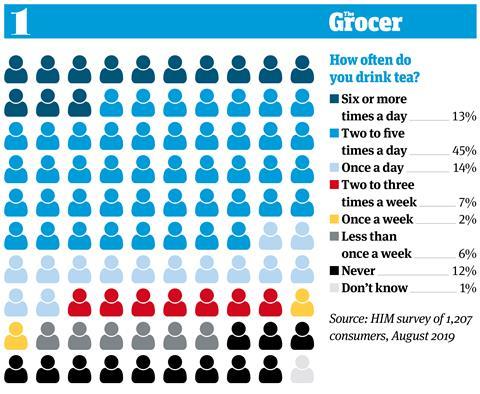
So much for Brits dumping tea in favour of coffee. Britain remains a nation of loyal tea drinkers, according to our research. Three quarters of consumers drink a cuppa at least once a day. And a sizeable 13% drink at least six cups daily.
PG Tips owner Unilever can confirm tea isn’t going anywhere. “Tea remains an iconic part of British culture, with 50 billion cups drunk a year on average,” says Hazel Detsiny, VP of marketing at Unilever UK & Ireland.
Consumption is highest among 35 to 44-year-olds, of whom 17% drink a daily minimum of six cuppas. That figure falls to just 5% among 18 to 24-year-olds.
2. Black tea is most frequently drunk across all age groups
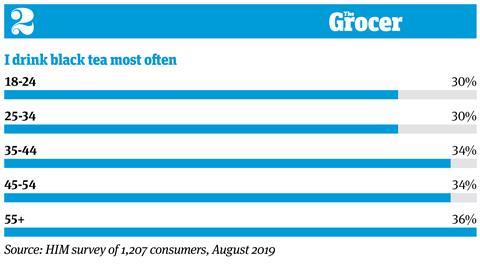
Fruity, herbal and decaf brews may be driving growth in the tea market, but traditional black tea is still Britain’s go-to cuppa. A third of consumers say they consume black tea more often than any other type.
Herbal tea pales by comparison, named by only 9% of consumers as their most frequent brew. “Black tea currently accounts for 85% of the total tea category, and we believe the opportunity in the sector is huge,” says Unilever’s Detsiny.
However, there is some variation across the generations. Black tea is the most regular brew among 30% of the youngest age group, compared with 36% of the oldest. That’s partly because younger consumers more adventurous in their tea choices.
Among the 18 to 24-year-old age group, 39% drink herbal tea and 26% drink fruity brews. Those figures fall dramatically among the 65-plus age group, of which just 14% have a herbal cuppa and 10% drink fruity infusions.
3. There is a gender split in fruity tea consumption
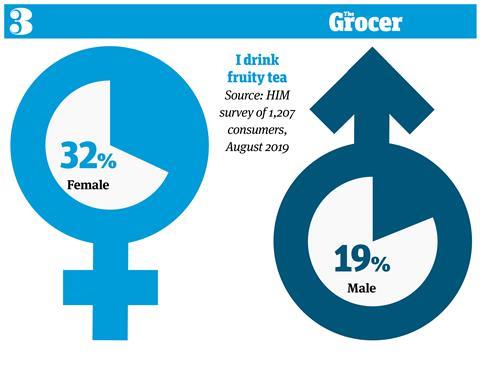
It may not come as a surprise that fruity tea appeals most to women. In terms of packaging and marketing, these blends lean towards the female market. It appears to be paying off. Roughly a third of female shoppers buy into fruity tea, compared with less than a fifth of men.
It’s not just fruity tea that has a gender split, though. Women tend to drink a wider array of tea as a whole. Herbal tea reaches 35% of women, compared with 25% of men. Similarly, 19% of women drink decaf tea, a figure that falls to 15% of men.
And female respondents are also slightly more likely to drink iced tea. However, black tea reigns across both genders. It is the most frequently consumed type of tea among 35% of women and 32% of men.
4. Breakfast is the most popular black tea blend
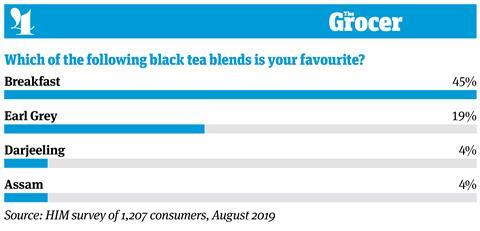
When it comes to black tea choices, consumers are a pretty traditional bunch. Breakfast is by far the most popular blend going, favoured by 45% of consumers. That number falls sharply to 19% for Earl Grey, and further still to just 4% for Darjeeling and Assam blends.
The love for breakfast tea is pretty universal across the demographics. In terms of regions, breakfast has its strongest foothold in the East Midlands and Yorkshire, where 53% of consumers name it their favourite black tea blend.
Londoners tend to be a bit more experimental in their tea choices. Breakfast is still the leading brew – favoured by 42% of consumers in the capital – but other blends also have a strong following. Just over a quarter of Londoners named Earl Grey as their preferred black tea blend, and 8% came out in favour of Darjeeling.