



With the cost of living squeezing shoppers ever harder, you’d expect value ranges to be expanding – but the opposite is true. What’s going on?
Jackie Stott is a smart shopper. The 32-year-old mum of four from Doncaster knows that at Lidl “you get 15 cheese slices for 83p” and “700g of minced beef for the same price as 500g elsewhere”. If she wants pepperoni, “I go to the Co-op, believe it or not, because it’s actually cheaper”.
“I’m really aware of prices and weights and what you get for your money. Because I’ve had to be. Tesco budget stuff tastes the best out of all of them. If you add some milk and butter into those beans, they taste like Heinz,” she says. “A good budget range does matter to where I shop, because without those low-value items we probably wouldn’t be able to go the whole month. The budget ranges are super-important to my family.”
That’s why Stott was exasperated when Tesco cut some of her kids’ favourites from its Stockwell & Co budget range last year. The retailer might have brought back the blue and white stripes made famous by its Value range earlier this year, but only to highlight its ‘Low Everyday Prices’ on – usually pricier – branded products. For shoppers like Stott who rely on supermarkets’ own-label budget ranges, there has been no such respite.
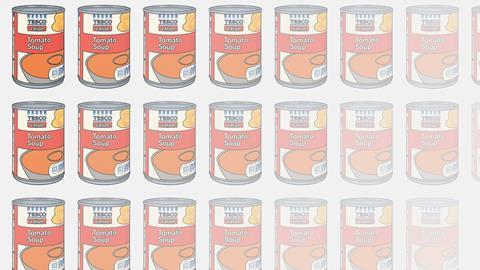
Analysis by The Grocer shows that across the traditional big four supermarkets plus the two discounters, budget ranges have shrunk by 5% over the past year – with four of the six cutting budget SKUs.
“That’s on top of the price rises. I worry every time I go to the shops about whether the prices have gone up again,” says Stott. “I used to buy 15 tins of carrots to last us the month, now I can only buy eight. My kids miss ravioli, but they can’t have it any more. It’s ridiculous that they’re cutting back the budget ranges.”
So, which supermarkets have done the most to develop their budget ranges, and which have quietly shelved them – and why? How will cutting them affect shoppers? And what does the future hold for ranges that include Stockwell & Co, Asda Just Essentials and Lidl Simply?
The paring back of SKUs and therefore choice for those on a budget is a recent phenomenon. Apart from Tesco, ranges are larger than five years ago. But four of the six supermarkets analysed by The Grocer have cut back in the past year. Only Asda and Lidl added to their Just Essentials and Simply ranges.
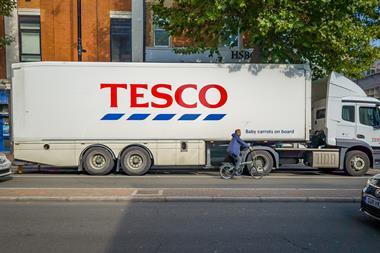
Tesco has reduced its budget range – which now consists of a slew of ‘exclusively at Tesco’ brands, including Rosedene Farms and Stockwell & Co – the most, cutting a whopping 18.7% of SKUs. Morrisons, Sainsbury’s and Aldi also cut their value ranges in the past year, by 14.7%, 7.6% and 7% respectively. Aldi says it does not recognise The Grocer’s figures – but declined to provide a list of budget SKUs for verification purposes.
“Our approach to Everyday Essentials hasn’t changed. It’s an important part of our core range,” Julie Ashfield, chief commercial officer at Aldi UK, tells The Grocer. “These products are sold at our lowest price points but still offer the Aldi quality our customers expect. Across our entire range, Aldi is still the undisputed leader on low prices, which is why we’ve been named the Which? cheapest supermarket five years running.”
Tesco and Morrisons declined to comment. Sainsbury’s does not dispute The Grocer’s research. A spokesperson says that since rebranding its value range as Stamford Street Co in 2023, “while the number of products has varied as we’ve adapted to changing customer preferences and market trends, it remains largely unchanged. Over this same period, we’ve more than doubled the number of products in our Aldi Price Match offer and are laser-focused on providing great value on the essentials our customers buy most often.”
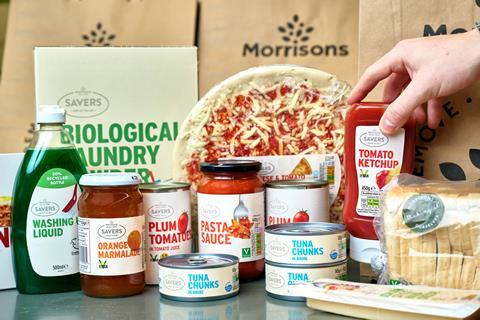
Lidl (19%) and Asda (14.6%) both posted double-digit increases in their budget lines in the past year. Rachel Eyre, chief customer officer at Asda, tells The Grocer that “value is an inherent part of Asda’s DNA, so we work hard to help our customers save money, whether through significant investment in price – via Rollback, Asda Price – or our own-brand ranges.
“With household finances still under significant pressure, we’re continuing to invest in lowering prices across our entire range. This includes products in the Just Essentials range, further ensuring hard-working families receive the value they expect when they shop with Asda.”
Establishing value credentials
There are multiple reasons why four out of six supermarkets have quietly cut their budget ranges. For starters, Brits have been spending less on the own-label value tier for each of the past two years, and that decline has accelerated. Sales fell by 4.8% in the year to 24 March 2025 and a steeper 8.2% in the year to 22 March 2026. Shoppers bought 775 million fewer budget products in the year to 22 March 2026 than two years previously. Volume decline reached double digits last year, dropping 10.8%.
This creates something of a dichotomy: many people are struggling and feeling worse off, yet shoppers generally are buying less from budget own-label ranges. According to Valentins Kirillovs, head of grocery at CACI, shoppers are becoming “far more selective”.
“After several years of sustained cost pressure, shoppers are managing budgets by stripping baskets back to essentials and cutting out ‘marginal’ items altogether,” he explains.
“This is being reinforced by fewer choices on shelf as retailers rationalise ranges, and by a growing intolerance for products perceived as poor quality or a false economy (shrinkflation). In that context, ultra-basic own-label lines are often the first to be dropped – if an item feels risky, or dispensable, it simply doesn’t make it into the basket.”
That is a point that Richard Harrow, partner at private-label consultancy IPLC UK, reiterates: “Fewer [budget] SKUs will result in less sales. We can also see there’s been quite a lot of inflation into the tier. The problem is that cost price increases have a bigger impact on value tiers, because it’s a higher percentage of the total cost.
“A lot of budget products do not make a huge amount of money, and they will be diluting in terms of cash margin and in terms of percentage. I can only assume that in each category review, they’ve gone: ‘Hold on a minute, I’ve got a premium product I can pull in here.’”
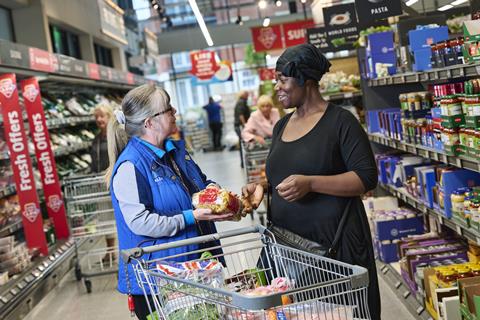
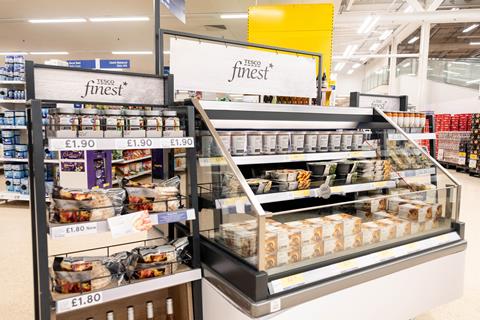
The decline in budget ranges has certainly gone hand in hand with the rise of premium own label, where Brits’ spending increased by 13.4% in the year to 22 March 2026 and by a similar amount the previous year. With the cost of eating out skyrocketing and more shoppers treating themselves to a nice meal at home, retailers “have got a choice to make”, says Harrow. “They don’t have elastic shelves. And if you’re a category manager, with the option to put in two value lines or two premium lines, you’re going to go for the premium lines, by and large.”
Budget lines may also be disappearing from supermarket shelves simply because they are no longer the key means by which retailers establish their value credentials. These days, retailers such as Tesco and Sainsbury’s rely on a combination of Aldi price match, price freezes on some KVI lines and loyalty card discounts. This results in a much more nuanced offer in terms of what constitutes value, rather than a focus on budget ranges.
“It’s not only about making it cheap, it’s about making it really good quality at a fair price,” says Harrow. “After all, if price was the only thing consumers looked at, Asda’s recovery would be stronger than it is.”
Differentiation also poses a problem for budget ranges – in that it’s pretty much impossible. Recipes across retailers are very similar, and there’s little opportunity to build a story around budget ranges. So, has any retailer made an effort to develop its budget range? Not according to Ged Futter, director at consultancy The Retail Mind and a former senior buyer at Asda.
“Developing the lowest-tier range is not something any retailer puts a huge amount of effort into,” he says. “The basic tier is quite often matched to their competitors, which makes it difficult. Whereas the premium tiers, they’re not matched at all. Add in significant amounts of inflation, and sometimes those products are just not economically viable any more.”
A double blow for budgets
When The Grocer’s findings on budget ranges being pared back over the past year were put to Stott in Doncaster, her first reaction was: “Oh no, don’t do that.”
It’s a double blow for those on limited budgets, for whom the cost of groceries has gone through the roof in recent years. “The kids don’t really get treats any more. chocolate used to be £1 and now it’s £2. It’s gone up so much,” says Stott. “The supermarkets are expensive. If I didn’t have loyalty cards for them I’d be in trouble. That does help, but I still rely on the budget ranges.”
Food charity Bags of Taste teaches cooking and budgeting skills to some of the most vulnerable people in society. According to founder Alicia Weston, every time its shopping guide goes out, “the budget ranges go up in price”.
According to her team, she adds, it’s also common for supermarkets to withdraw budget SKUs for a short period, only for them to return at a higher price or become mid-tier only. The effect this can have on struggling consumers should not be underestimated, says Weston: “We observe this feeling of scarcity causes a sense of panic in people – especially if it’s something they know their kids will eat and that they’re comfortable cooking.”
Retailers can also make it trickier to shop in the budget tier. “They do put some little barriers in place,” says Harrow. His local Morrisons, he explains, stocks products in its budget Savers range he cannot find online. The same goes for smaller-format and convenience stores, which many on low incomes rely on but which are renowned for rarely stocking value lines because the economics don’t stack up for the retailers.
According to Kirillovs, the prolonged financial strain faced by many UK shoppers is creating “behavioural fatigue” – which also explains why people are spending less on budget SKUs despite cost of living pressures.
“Shoppers want shopping to be simpler, quicker and lower risk – not a continual optimisation exercise,” he explains. “That pushes behaviour in two directions: towards discounters that are trusted to deliver the lowest prices across a whole shop, or towards mid-tier own label that feels like a safer balance of price and quality.”
The complexity of value
Even for savvy shoppers like Stott, where someone shops usually comes down to a combination of price, perceived value and geography. “People have really complex strategies,” says Megan Blake, an expert in food security and food justice at the University of Sheffield. “They shop for deals. And yes, people who are struggling still shop in Sainsbury’s or Tesco if it’s near where they live and getting to other shops via taxi or public transport costs more than they see in savings.
“Food is usually one of the most flexible budget lines within a household, and that food budget includes the transport (and time) cost. There are trade-offs people make. It’s a kind of spatial entrapment.”
It’s a situation Stott recognises. She says where she shops depends on the deals available at the time, and she goes to different stores for different products. But location also plays its part.
“Take mince. Asda is probably the cheapest, but I go to Lidl because it’s near me and Asda isn’t. I have a Tesco about an hour’s walk away. It’s quicker on the bus, but they only come once an hour. I go to Tesco for tinned stuff, because it’s the cheapest for the quality of the product,” she says.
“We had a Tesco nearby, but it closed and changed to a pound shop. It is a pain, going here for this and there for that. But you have to.”
Weston adds that Bags of Taste’s mentees “absolutely” still shop in the traditional supermarkets rather than just at the discounters, mainly because the latter don’t always carry a full range.
Asda customers are the most hard-up of the traditional big four and discounters. According to CACI, 42.1% of Asda shoppers are in the ‘stretched society’ or ‘low-income living’ demographics, versus 29.3% of Tesco shoppers and 34.5% at Aldi.

That’s part of the reason why, Eyre says, Asda made its “entire value proposition” simple, by making “our lowest prices available to all Asda customers” without the need for a loyalty card.
She’s proud of how the Just Essentials range has kept its budget credentials overt rather than heading down the tertiary brand route. It “offers choice and clarity for our most price-sensitive customers at a time when they need it most”.
Asda Just Essentials’ bold yellow branding is “unapologetically visible”, according to Eyre, as opposed to traditional value Packaging, which “often blends into the background or uses muted, generic cues”. Tesco’s multitude of tertiary brands, for example, play their budget credentials closer to their chest, but Harrow still picks that range as a top budget performer.
“If you look at Tesco’s farm brands, and Sainsbury’s with Stamford Street, and then you look at their performance over the past three or four years, I think it’s been outstanding,” he says. “They found a great combination of a value tier together with Aldi price match and loyalty card pricing. It’s certainly slowed Aldi down.”
Despite budget ranges’ role in that overall value proposition, most experts agree they’re destined to remain relatively unloved at most supermarkets.
“What do I expect in the future? Not a great deal of change,” says Futter. “It’s something they’ll continue to do, but it won’t massively increase or decrease. Innovation in that area is not something you put any money into.”
Harrow, though, thinks that if food price inflation picks back up again in the way the FDF has been suggesting recently, perhaps hitting level as high 9% to 10% by the end of the year, some retailers might start “reversing the trend, and there could be a bit of a resurgence of the budget tier – especially if the retailers start to lose volumes. After all, the value tier is a good volume builder.”
In the end, though, it “really depends how strongly premium remains in growth”, he adds. “I come back to my point earlier that the shelves are not elastic. So, if they’re going to expand their budget offering, they’re going to have to take something out. And if we’re still seeing premium growing, it’s going to be a hard call for retailers to expand the budget tier.”







No comments yet