





Unless you’ve been living under a rock – or, perhaps more pertinently, under a fatberg – for the past couple of days, you’ll have been assaulted with the news that plastic wet wipes are done. Finished. An excrement-smeared thing of the past. Or at least they will be once the government’s new law banning the sale of wet wipes containing plastic comes into force in England in spring 2027.
It joins the Welsh government, which has already passed legislation to ban them from December 2026, with the Northern Ireland executive and Scottish government expected to legislate by the end of the year.
Announcing the news on Tuesday, the government hailed “a major step forward in tackling plastic pollution which devastates our waterways”.
We’ve all seen the shocking statistics. According to government figures, 32 billion wet wipes were sold to British consumers in 2023 – enough to cover 2,200 football pitches if they were all laid out flat. And according to Defra Beach Litter Monitoring Data, an average of 20 wet wipes were found littering every 100 metres of beach across the UK.
Meanwhile, water industry research has found that wet wipes contribute to 94% of sewer blockages, which cost water companies around £200m to fix each year – a cost that’s ultimately passed on to households through their water bills.
The ban was lauded by environment secretary Emma Reynolds, who said: “This will put an end to plastic wet wipes which choke our sewers, litter our beaches and poison wildlife. It’s another example of the government taking strong, decisive action to clean up our rivers, lakes and seas.”
Charities were also lining up to praise the new law, with Chris Coode, CEO of environmental charity Thames21, saying the organisation “welcomes this fantastic news. This vital move is a crucial step towards protecting the health of our rivers, as it will reduce the introduction of microplastics into the environment.”
To flush, or not to flush
Signing the ban into law is, of course, a positive move. But it’s not really news. The government had announced that wet wipes containing plastic would be banned across the UK back in April 2024, and many retailers (to their credit) have long been adhering to the rules ahead of the legislation.
Tesco and Sainsbury’s, to name just two, do not sell wet wipes containing plastic, while Steve Ager, chief customer and commercial officer at Boots, said the retailer was “proud to be one of the first retailers to remove all wipes containing plastic from sale in stores and online” back in 2023.
So, will the new law change much? It would be remiss of us not to point out that, plastic aside, manufacturers are still promoting flushability, with both branded and own label products marketed as “flushable toilet tissue wipes” or similar.
Despite what manufacturers say, there is broad consensus that these wipes are not in fact ‘fine to flush’ (to borrow the name of a short-lived wet wipe certification quashed in March 2024 over fears it was causing confusion among consumers).
As Randa Kachef, an urban waste and sustainability expert at Birkbeck, University of London, told me last month as part of a feature on wet wipes in The Grocer’s annual Green Issue: “Technically, when a wet wipe company says their product is biodegradable and flushable, they’re not actually lying – a wipe is technically flushable in the same sense that you could flush a goldfish that died or, really, anything. But they’re also not being transparent or responsible in their messaging.”
She added that no materials with “a more robust structure than traditional toilet roll” should go into the toilet. This is because even natural polymers, such as cellulose, that wet wipe brands like to trumpet as part of their flushable solution, are hydrophobic, meaning they repel water and so “don’t lose their strength in water the same way toilet roll does”.
The government seems equally clear that this is the case. When announcing the new law this week, it stated that “the public can take action now by ensuring that any wet wipes, even if they are labelled as flushable, are put in the bin rather than flushed away, to reduce costly blockages and safeguard nature”.
This is the area where new legislation is really needed. Manufacturers differentiating between wet wipes that are supposedly ‘flushable’ and those that aren’t seems at best problematic and at worst openly misleading – and it’s our waterways that bear the brunt.
Mixed messaging
Apparently, water minister Emma Hardy has written to manufacturers urging that wet wipe packaging reflects the government’s message. But does that include ‘moist toilet tissue’ and the like? And as we all know, it’s legislation, not letters to manufacturers, that really gets industry in line.
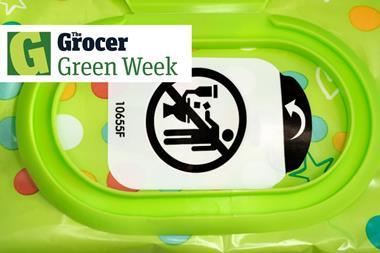
Wet wipe manufacturers do include logos on products they deem not safe to flush, encouraging consumers to bin them, but they can be small and easily lost among all manner of other messaging. Consumers are already bombarded with statements like “99% water” on gentle pastel blue or pastel green packaging; small pictures of hands holding our planet in a loving embrace alongside “plastic-free wipes” messaging; leaves, trees and drops of water abound.
It’s almost like manufacturers want consumers to believe their wipes are better for the planet than they actually are…
While messaging like this remains on the table, the move to plastic-free wipes could very well have unintended consequences. Even Nice-Pak International, which describes itself as the largest sustainable wipes manufacturer in the UK and Europe, admitted that with “the large-scale switch to plastic-free wipes, there may be some confusion around whether they can be flushed”.
Given Hardy’s letter to manufacturers, it appears the government knows this. So, with the wind in its sails following the immensely popular new law – 95% of respondents to the government’s consultation agreed with the proposals – it needs to double down and rein in manufacturers’ claims over flushability and misleading on-pack messaging.
Our rivers, lakes, beaches and sewers desperately need this. The Grocer’s message is: act now – before the wet wipes really hit the fan.

1 Readers' comment