



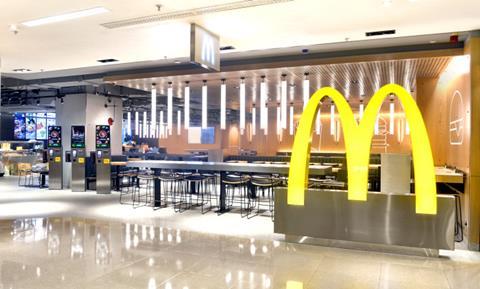
Fast food giant McDonald’s today became the latest operator to have its advertising cleared under the government’s controversial new junk food ad restrictions.
The decision by the Advertising Standards Authority comes in the week that Andy Burnham, who as shadow health minister more than a decade ago was one of the original proponents of the ban, came into power. Health groups have called for him to tighten the ban.
It also comes after the watchdog earlier this month cleared other fast food companies including Burger King, Domino’s, KFC and Uber Eats, of accusations that they had breached the terms of the ban.
The latest case concerned a TV ad for McDonald’s McDelivery, which aired in January, weeks after the ban came into force.
It featured a woman sitting in a living room, looking at her phone, turning to a man and saying, “McDelivery? You in?” On-screen text then stated “Delivery fee from 99p. Only on the McDonald’s app” as the man replied, “I’m in.” The ad then showed another adult at the top of some stairs who shouted “I’m in. McNuggets for me, medium meal.” A man was seen looking in a fridge as he said “Yeah, I’m in,” before a woman walked through the door and said “I’m in. McCrispy”. The ad then showed a crane on the top of a block of flats with workers shouting “We’re in” and “McDelivery, McChicken sandwich I’m in.”
The ad was passed by TV advertising clearance body Clearcast, which decided that it did not include a product high in fat, salt or sugar (HFSS), and so did not fall under the restrictions for ‘less healthy’ foods.
McDonald’s said the ad did not feature any images of food or drink products but that some McDonald’s products were expressly named by the characters in the ad. They confirmed those products were Chicken McNuggets, a McCrispy, and the McChicken Sandwich. The character who asked for McNuggets asked for a McNuggets Medium Meal.
McDonald’s said that McNuggets, McCrispy and McChicken Sandwich were not products HFSS and were therefore not “less healthy” foods. It provided nutrient profile calculations for those products, and said those three products were readily distinguishable from other menu items it sold.
“We considered the references to the McDelivery service, and by extension the full range of McDonald’s products, related to the overall McDonald’s brand and therefore depicted the brand of a range of products rather than any specific “less healthy” product,” The ASA said in this week’s ruling. “However, because the ad also named three specific menu items, it depicted specific food products. We therefore assessed whether those items were ‘less healthy’ foods.”
“We understood that the McChicken Sandwich and the McCrispy were not HFSS foods. Ads for those two menu items were therefore not restricted by the ‘less healthy’ food rule.”
Katrina Anderson, a partner at law firm Mills & Reeve LLP, said the ASA’s decision was more good news for fast food firms and delivery platforms, although not without its downsides.
“This is another example of the extensive reformulation work carried out by brands,” she said. The premise of the complaint was that the nuggets were HFSS, but they had in fact been reformulated and were compliant.
She said the ruling also showed that an ad for a food delivery service could a benefit from the brand exemption.
“This will be good news for Deliveroo and similar platforms and, by extension, should provide greater comfort to the hospitality sector that a service can be advertised without breaching the rules.”
“The meal deal advertisement was considered compliant despite including a small number of HFSS drinks, which were not specifically named. This provides a useful template for how to advertise meal deals that contain a mix of HFSS and non-HFSS products in a compliant manner.”
However, Anderson added: “McDonald’s succeeded because the products were not HFSS. However, this is a less favourable aspect of the decision, as advertisers may have hoped this would be treated in the same way as decisions involving incidental product imagery. It is therefore not such good news for brands.”
Meanwhile, one of those companies cleared in this month’s earlier ruling has had a complaint against it upheld.
A TV, video on demand and YouTube ad for Domino’s Cheeky Little Pizza offer was aired at 7.45 on 6 January and included a a close-up shot of a meat pizza with a slice being lifted away, before a second pizza with vegetable toppings was shown. The voice-over stated, “Domino’s for just four quid? Yep, cheeky little pizzas at a cheeky little price.” Large on-screen text stated “Just £4”, and then “cheeky little pizzas” and “under 600kcal”.
Domino’s said it had relied on a third party to provide them with a nutrient profile for each pizza, which mistakenly led it to include the sausage and bacon pizza in the ad. However, since being contacted by the ASA, it said it had realised that the figure for energy used in that calculation was incorrect and it was an HFSS product.
As soon as they were made aware of the complaints, Domino’s withdrew all advertising that included the Sausage and Bacon “Cheeky Little Pizza”.
The company said it was committed to ensuring compliance with the “less healthy” food and drink rules and had reviewed its nutritional assessment processes to ensure the validity of the data in nutrient profile calculations.
Anderson said: “The Domino’s decision largely concerns an error in the HFSS calculation. Once the mistake was identified, the outcome was inevitable. That said, it illustrates that the ASA is not currently offering informal resolution to advertisers in relation to HFSS matters.”





No comments yet