





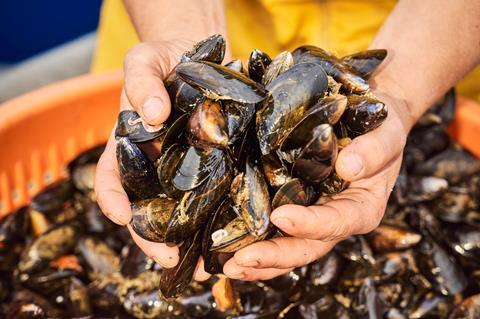
Scottish mussel production has hit record heights, according to Scottish government data, thanks to surging exports to the European Union.
The Scottish Shellfish Farm Production Survey 2025 found a record 12,303 tonnes of common mussels were produced for the table market last year, representing a 5.2% increase year on year and a rise of 59.1% on 2016’s total.
In production value terms, this amounted to £13.3m – a year-on-year rise of 5.3% – with Shetland accounting for 85% of all mussels farmed.
Other more minor Scottish shellfish farming subsectors, including king scallop and pacific oysters, saw production increase 4% and 5% respectively, although native oyster production declined 7%.
Industry voices said European countries, whose domestic industries had been impacted by climate change, were the chief source of the growth, with demand from the UK static.
“Elevated seawater temperatures in Greece and Spain have seen outputs falling and, overall, within Europe, the demand for mussels and oysters greatly outstrips home produced supplies,” said Association of Scottish Shellfish Growers CEO Dr Nick Lake. “Even in other major exporter countries such as Chile, the production levels are falling based on environmental challenges.
“Scotland is in an advantageous position regarding the water quality we have managed to maintain with all our mussels produced in Class A waters,” he continued. “This allows direct export to the European Union without the requirement to depurate [cleanse impurities]”.
Musseling in
Mussel exports surged 38% to £8.3m in 2025, according to Seafish, far outpacing the overall growth rate of all British seafood exports (1.3%). Unlike the latter, however, the EU continues to be a source of growth, with overall British shellfish exports to the bloc increasing 8% to £417.9m.
Sam Laurenson, a mussel farmer at Shetland-based mussel producer Blueshell Mussels, said countries including the Netherlands, Belgium, Spain and France were important markets for his family’s business.
“The export market has allowed for the increase in production,” he continued, saying businesses like his had been forced to take “a hit on the price” to establish themselves through volume sales.
“We have had to start exporting to keep up with the growth of the business,” Laurenson added. “If we are able to sell more domestically and there was more appetite for domestic production, it would be more beneficial for more people.”
Scottish mussels have been widely recognised as an environmentally sustainable source of animal protein, with rope-grown mussels requiring no feed, fertilisers or freshwater inputs during production. They can also support marine biodiversity and naturally filter seawater as shellfish grow.
They are also a nutritional powerhouse, according to professor of nutrition Baukje de Roos, who said they and oysters contained “high-quality protein, omega-3 fatty acids, vitamin B12, iodine, and zinc”.
“Regular consumption may improve cardiovascular health and nutrient status, while their low environmental impact makes them a highly sustainable dietary choice for both people and the planet,” de Roos continued.
With growing demand for sustainable, nutrient-dense food, Scottish Shellfish ambassador Kelly Wright said, “mussels are well positioned to meet this demand”.
“Mussel consumption in the UK remains comparatively low, while seafood sales continue to be dominated by the ‘big five’ species,” she continued.
The UK is a poor consumer of its own seafood, with around 80% of the seafood produced in the UK exported to international markets and imports accounting for 80% of the seafood consumed in the country.
In the case of mussels, however, Sue MacKenzie, National Federation of Fishmongers president and owner of Camberley-based The Fish Shop, said confidence was a key hurdle.
“People think they’re more of a faff than they really are,” she said, adding that many shoppers think they will “take your family out with food poisoning”.
“Because we have lost touch with cooking from scratch, I think,” MacKenzie added. “On the continent, that’s how they’re brought up and they continue to eat that way.”
She added: “It’s a hard gig to get a nation to change their eating habits.”
Despite this history, MacKenzie said she had seen more customers, particularly younger ones, interested in cooking from scratch and knowing the provenance, as well as the nutritional value of their food.
“There are an awful lot of people who are not interested in that and that will take a long time to change,” she added. “But our growth this year has also been unbelievable.”









No comments yet