



Asda is on the war path when it comes to price, having last month announced cuts to 956 ‘family favourite products’.
It was the latest salvo in a price war waged by Asda since the start of the year, when it relaunched its Rollback campaign and chairman Allan Leighton vowed to undercut full-range rivals by 5%-10% by the end of 2026.
But those rivals were never going to take it lying down. So, how have they been responding to its recent round of cuts? Who is dropping the most prices, and who is going the deepest?
Tesco CEO Ken Murphy told analysts in October it had seen “an increase in pricing intensity” at the start of the year, which had “stepped up”.
“We see that continuing into the second half,” he added. “We don’t see any relaxation or moderation in the competitive environment.”
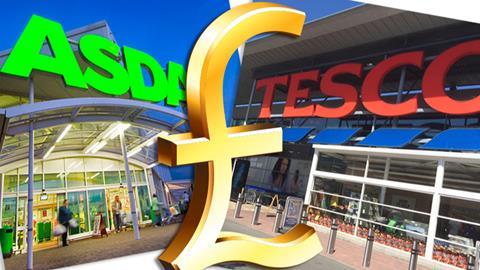
Tesco and Asda have since been jockeying for the position of cheapest retailer in the Grocer 33 weekly pricing survey. Tesco ended a consistent run of Asda victories by triumphing on 31 October, and then repeated the performance on 7 November. Asda was cheapest again in last week’s shop, but by nowhere near the 5-10% it wants to achieve by the year end.
New analysis of Assosia data by The Grocer delves deeper into the battle.
It shows that in the four weeks to 3 November, Tesco cut prices on 3,352 SKUs – 19.5% of a total 17,156 SKUs analysed – by an average of 20.6%.
However, during the same period, Tesco increased prices of 3,558 SKUs, by an average of 30.9%. It means Tesco prices were up by an average of 2.4% over the four weeks.
In the same period, Asda reduced the price of 2,814 SKUs – 19.1% of 14,722 SKUs analysed – by an average of 17.6%. Prices rose on 2,135 SKUs, by an average of 26.5%. It means Asda prices rose by an average 0.5%, much slower than Tesco’s.
Heating up
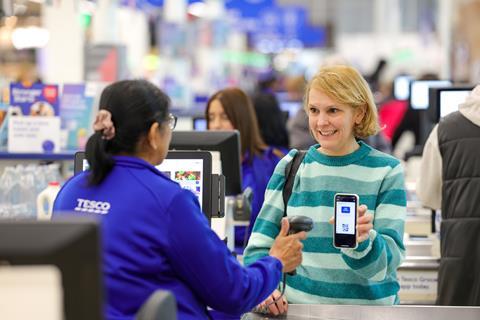
Things really intensified in the week to 3 November, as more supermarkets marched to the beat of Asda’s drum.
Sainsbury’s made 3,529 price cuts, Waitrose 1,805, Tesco 1,764 and Morrisons 1,203. Asda, having cut prices earlier, lowered another 276.
Retail Economics chief executive Richard Lim says: “Some of these guys are playing catch-up to Asda and discounting quite fast and broad across lots of different product categories.
“Tesco are not going to relinquish their market share without a fight, that’s for sure.”
Still, Asda is ahead of its rivals on the widest number of SKUs. In analysis of 7,664 food lines sold by Grocer 33 regulars Asda, Morrisons, Tesco, Sainsbury’s and Waitrose on 3 November, Asda was cheapest or joint cheapest for 3,611 and exclusively for 2,681 of those.
But when rivals do undercut Asda, they go deeper with cuts. On the occasions where Morrisons was cheapest there was 20.9% gap between its price and that of the nearest competitor, whereas when Asda wins it is 10.7% cheaper than rivals.
“Asda are competitively priced across such a large range of products,” says Lim. “They’ve obviously taken quite significant measures to reduce prices across the board and turn the boat around after the decline in market share that they’ve experienced over the last few months.”
Enter the discounters
And then there are the discounters. Little more than a market share rounding error during Allan Leighton’s first stint at Asda, Aldi and Lidl between them now have 18.8% of the grocery market.
Asda shelved Aldi price match in January, just 12 months after it launched. On a sample of comparable SKUs (438 at Aldi and 928 at Lidl), Asda was beaten by Aldi on 77% of lines and by Lidl on 67%.
Asda argues a comparison with the discounters is “not a relevant one given we offer a much more comprehensive selection of products including the household brands that shoppers buy week in and week out”.
A spokesperson adds: “We are making a significant long-term investment to lower prices across the entire store and establish a gap of at least 5% over other full-range supermarkets by the end of 2026.
“We are pleased with the progress we have made so far, with more than half of all products reduced to a new lower ‘Asda Price’. The results can be seen in independent price comparison surveys, such as the Grocer 33, which consistently show that Asda’s prices are lower than competitor base and loyalty card prices.”
Read more
-
Asda wins cheapest supermarket but Tesco gives it run for its money
-
Spending ‘subdued’ as shoppers prioritise saving amid budget worries
-
Food prices fall at fastest rate in five years, says BRC
-
Tesco CEO Ken Murphy hits out at rivals’ irrational price cuts
Tesco UK MD for food and commercial operations Gordon Gafa says: “The UK grocery sector is very competitive, and we work hard to provide great value for our customers, delivering quality food and drink at competitive prices.
“Shoppers know good value when they see it, which is why we have seen more consumers choosing to shop with us. However, there is no room for complacency, and we remain focused on delivering great value to Tesco shoppers.”
A Sainsbury’s spokesman says: “We’ve fundamentally reset our value position over the past five years, investing over £1bn and improving our value perception with customers year on year – the only grocer to do so. This includes focused and effective investment to ease cost of living pressures, keeping our price inflation below the wider market and investing where it matters most for customers.”
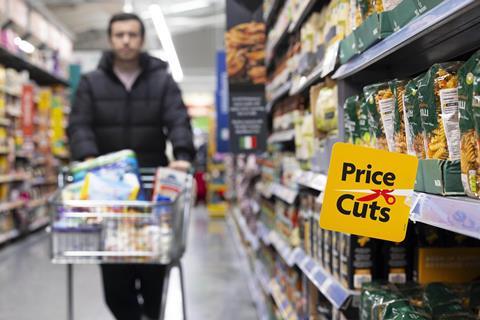
A Morrisons spokesman says: “The numbers include promotional moves and the volume of promotional price changes is not necessarily reflective of the value our customers are seeing in their basket. We’re determined to keep prices low on the products that matter most to Morrisons customers.”
An Aldi spokesman says: “Our promise to customers is that they will always make significant savings every time they shop with us, without needing to join a club or show a loyalty card. We do that by offering simple, consistent everyday low prices.
“That’s why we’ve been named as the cheapest supermarket each time we’re included in the Super Grocer 33 over the past year.”
Lidl was approached for comment.
The ongoing price wars will be playing into inflation figures. Worldpanel data this week had grocery price inflation slowing to 4.7% [4 w/e 2 November 2025], down from 5.2% a month earlier. Sales were growing more slowly, by 3.2%. Spending on promotions hit its highest level since April, at 29.4%.
Delivering volume growth
As for Asda, its sales were down 3.9% year on year, while its share had slipped by a full percentage point to 11.6% [12 w/e 2 November 2025]. The latest dip follows four consecutive months in which its share had stabilised at 11.8%.
Ratings agency Fitch warned in April that Asda’s “updated strategy to accelerate sales volume growth could lead it to breach its negative leverage sensitivity” in relation to its corporate debt.
But it viewed the plan to “invest in enhancing the pricing competitiveness of its branded product offerings as an appropriate part of its new strategy to regain lost market share”, adding “successful implementation will deliver volume growth”.
Entering the final stretch of the year, Asda will likely be wondering how much longer it must wait for the strategy to start delivering.


No comments yet