




Charities and campaigners are holding more influence than ever. The Grocer’s Charity Power List charts the people reshaping what responsibility really means in food and drink today
At one time, doing good was largely an optional extra in UK food and drink. Yes, there were the oversized cheques handed to community groups by smiling store managers. The plastic charity buckets rattling around with loose change on supermarket tills. And perhaps even a high-profile pledge or two to national causes.
But these were often little more than a box-ticking exercise, overseen by small corporate social responsibility teams given only fleeting attention by the higher-ups.
Those working in charities, social impact or activism therefore had limited influence on the decisions being made by the industry’s heavy hitters, much to their chagrin.
But in 2026, that dynamic couldn’t be more different. Nowadays, doing good is a commercial and reputational imperative – and those pulling the strings at the UK’s biggest trusts, charities and advocacy groups are far more powerful than they once were, as a result.
Research by Deloitte found 57% of consumers are more loyal to brands that commit to addressing social inequities, such as food poverty – with a direct correlation between revenue growth and a c-suite level focus on CSR. As a result, doing good has risen strategically up the corporate agenda.
Far more than that though, discussions around doing good – and what that even means – are also far more expansive and all-encompassing than they once were.
Today, the concept extends way beyond straightforward cash donations (though that’s still absolutely crucial) to take into account debates on wider systemic issues like food poverty and security, the industry’s role in shaping healthier diets, the ethics of marketing junk food, reducing environmental impact and the working conditions retailers and manufacturers create for employees.
As reflected in The Grocer’s Charity Power List, this change has elevated the views and voices of those working across the UK’s social impact sector.
The ways in which they affect change is far more varied, the topics they speak to far more diverse and the regard in which they’re held that much higher. In fact, many partner directly with industry heavyweights to advise on major decisions, scale up charitable initiatives, and help organisations comply with a growing laundry list of regulatory obligations on areas like ESG.
Take surplus food. When The Grocer kicked off its Waste Not Want Not campaign 10 years ago, there were a few fledgling partnerships in place between redistribution networks like FareShare and the leading grocers, but they were often limited in scale and scope.
Today, partnerships are extensive and deeply embedded in the day-to-day operations of nearly all leading food and drink businesses. They’re responsible for diverting tens of thousands of tonnes of food to organisations that need it and slashing significant quantities of carbon from supply chains, putting those at the helm of redistribution charities like Felix FareShare (as it’s now called) on a more equal footing with industry counterparts.
In advocacy, too, the profile and politicisation of issues like food poverty, retail crime and health means outspoken campaigners can now wield significant influence on policymaking decisions, affect the day-to-day decisions of industry bosses and be offered a seat at the table at the highest levels, including the new Food Strategy Advisory Board.
From charity bosses to passionate campaigners on a personal mission, trade body CEOs and grant-making trusts with billions to dispense to worthy causes, The Grocer’s Charity Power List can only capture a snapshot of this changing face of ‘good’ in the UK food and drink sector – but be in no doubt: the way they are wielding their ‘power’ is making the world a better place.
Anna Taylor, Executive director, Food Foundation
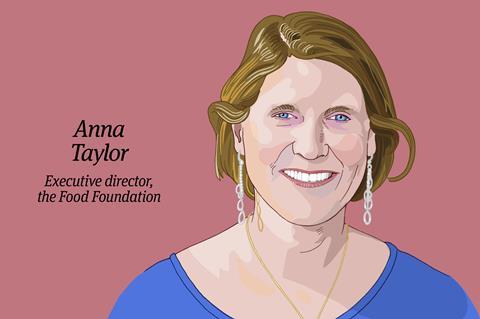
There are few more pressing topics for UK food and drink than improving access to affordable, healthy food – and few more influential voices on how to do it than Anna Taylor, executive director at the Food Foundation.
Taylor joined the organisation, set up as an independent think tank by former MP Laura Sandys, as its first executive director in 2014, after five years as senior nutrition advisor at the Department for International Development and 10 as head of hunger reduction at Save the Children UK. Suffice to say, she brought to the then fledgling organisation buckets of knowledge and credibility, which she’s used in the years since to steadily build its profile, its relationships and its influence.
Taylor has pushed for a ban on forms of junk food advertising to children as well as an extension to the soft drinks levy. She also spearheaded calls to widen the provision of free school meals to all those on universal credit – a goal finally achieved in 2025.
Taylor was also selected as part of the government’s Food Strategy Advisory Board, after three years working alongside Henry Dimbleby on the 2021 National Food Strategy. Though its composition has met with some consternation, for Taylor the board represents “a unique opportunity to help establish the foundations for long-term change”.
Charlotte Hill, CEO, Felix FareShare

The merger of the UK’s two biggest food redistributors, FareShare UK and The Felix Project, combines a well-established and much-loved industry charity with a London-focused passion project. And if the partnership seems culturally unlikely, there’s a strong belief that by joining forces, a simpler, singular organisation can drive surplus redistribution in the UK from 1% to 5% over the next decade.
That’s the vision. And there’s compelling reasons to think it’s achievable. First there’s the complementary skills and capabilities: combining The Felix Project’s City fundraising skills and London dominance, with the reach of FareShare into every postcode of the UK. Then there’s the combined scale: the two organisations redistributed 150 million meals worth of food to 1.5 million people last year.
But the other factor is CEO Charlotte Hill, who brings 15 years of experience in social impact leadership positions, as CEO of youth charity Step up to Serve and executive director for children and young people at Children in Need before moving to Felix, where her expertise and energy has delivered significant innovation, opening Felix Bakes and the Felix Food Factory.
Hill is now central to bringing together the food industry, funders, the charity sector and crucially government to achieve a step change in food redistribution. Above all she understands impact, using food as a catalyst to change lives, whether helping people into employment, out of addiction or isolation, and improving nutrition.
Nadim and Tanya Ednan-Laperouse, Natasha Allergy Research Foundation
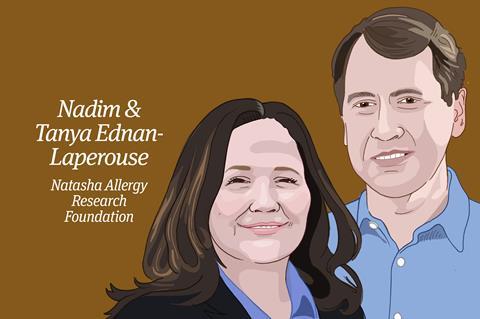
Tragedy first thrust Nadim and Tanya Ednan-Laperouse into the spotlight 10 years ago. The couple’s 15-year-old daughter Natasha died in 2016 after a fatal allergic reaction to sesame seeds baked into the dough of a Pret a Manger baguette that was not listed on the label.
Determined to ensure such a heartbreakingly preventable death wouldn’t happen again, Nadim and Tanya set up the Natasha Allergy Research Foundation (NARF) in 2019, quickly spearheading a landmark change in allergen labelling in the UK.
Natasha’s Law, which came into effect in 2021, now requires all food businesses to provide full ingredient lists, with allergens highlighted on any pre-packed for direct sale food. With some two million allergy sufferers in the UK alone, there is little doubt the change in law alone has directly saved lives.
The foundation hasn’t stopped there however, campaigning tirelessly to ensure allergies remain on commercial and political agendas, spearheading clinical research and educational programmes to raise awareness.
In September, it teamed up with Iceland Foods to highlight the mental health toll of severe allergies. There was also the renewal of its four-year strategy partnership with Bidfood in October, a new three-year partnership with Welsh wholesaler Castell Howell in May, and the backing of Booths for its ‘Make Allergy History’ campaign in 2024.
Sarah Bradbury, CEO, IGD

Having been around since the 1900s, the Institute of Grocery Distribution (IGD) has long gone under the radar in food and drink, a fact that hasn’t been helped by its notoriously cautious approach when sharing views on the food system’s most pressing issues.
But the arrival of Sarah Bradbury as CEO in 2023 has undoubtedly helped shake things up, turning the industry body into a far bolder and more outspoken lobbying voice.
Bradbury’s 25 years in the cut and thrust of retail will no doubt have helped. Prior to joining IGD, she was group quality director at Tesco, where she was responsible for a broad remit that included sustainability, agriculture and regulatory compliance, as well as working collaboratively to drive action across supply chains – all valuable experience.
Though her appointment as co-secretariat to the Food Strategy Advisory Board last year ruffled a few feathers (with many baulking at a pivot ‘from information to influence’) the decision, and Bradbury’s evidence-based contributions to health, sustainability and employment platforms, certainly cements her growing impact on what ‘good’ looks like in UK food and drink.
Bradbury is also part of the Coronation Food Project Advisory Board, under the leadership of His Majesty the King, with IGD partnering with Felix FareShare to drive Alliance Food Sourcing. This new collaboration of the food industry, providing hard-to-reach surplus to charities, is a potential game-changer.
Gary Stott, Executive chairman, Community Shop
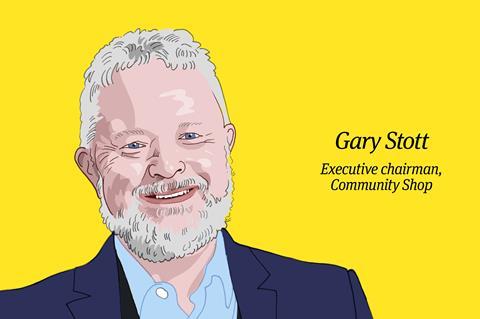
In March 2025, social supermarket Community Shop opened its latest outlet in north Leeds, in partnership with long-standing supporter Asda. The store will provide local users with access to discounted surplus food and household items, as well as affordable hot meals, workshops and guidance.
Its opening brings the Community Shop network to 14, marking a little more than one addition per year since the initiative was founded in 2013 by Company Shop Group (CSG) as a way to redistribute edible surplus food in manufacturing supply chains into the hands of those who need it most.
Gary Stott has been instrumental in that success, brought on board by CSG founder John Marren in 2012 to apply his decades of experience in the social impact field to shape Community Shop’s development. Now executive chairman, Stott has crafted what could have been another short-lived CSR venture into a thriving example for how the food and drink sector can make a meaningful difference.
In fact, since it launched, Community Shop has supported some 73,000 families, delivered more than 218,000 development programmes and fed over 880,000 children for free via its Community Kitchen initiative. As well as Asda it’s also backed by the likes of McCain, Unilever and Aldi. In 2024, it even worked with Ocado Retail to launch its new ‘on the go’ initiative providing six of the most deprived communities in England with access to new pop-up shops.
Hans Rausing, Chair, The Julia Rausing Trust
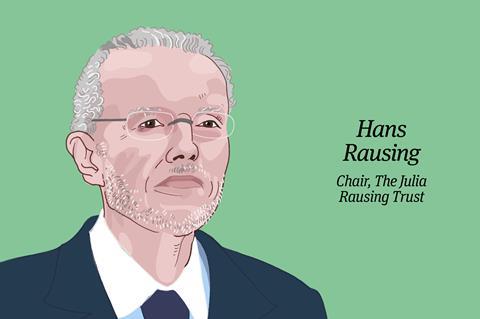
By the time of Julia Rausing’s death in 2024, the 63-year-old – who married Tetra Pak heir Hans Rausing in 2014 – was already established as one of Britain’s leading philanthropists, donating some £335m to charities via the Julia and Hans Rausing Trust. To continue that legacy, Hans unveiled a new trust in her name that same year: The Julia Rausing Trust was conceived with the ambition to distribute £100m to UK charities by the end of its first year alone, with Hans as chair.
Many organisations on the frontline of the UK’s battle against escalating food poverty have been among the first tranche of recipients, including £1.7m to develop Felix FareShare’s soup from surplus range, £250k to expand volunteer networks at The Hygiene Bank, and tens of thousands for free meal services provided by The Wishing Well Projects.
Most notably, in October 2025, the trust confirmed a £3m grant over three years to Trussell, specifically targeted toward helping the food bank network manage rising operational costs and integrate future resilience.
Samir Patel, CEO, Comic Relief

Since 1999, no less than 80 iterations of that iconic Comic Relief Red Nose have appeared in Sainsbury’s stores, emblematic of a longstanding charitable partnership that has raised hundreds of millions for good causes, galvanising shoppers and employees alike.
Sainsbury’s no longer has the monopoly on Comic Relief merch: from 2023, Amazon became ‘the official home’ of the Red Nose. But it continues to work with the UK charity, as do countless food and drink brands. PG Tips licenses brand mascot ‘Monkey’ from the charity, while Maltesers, Babybel and Holland & Barrett are close collaborators.
With ever-fiercer competition for the public’s disposable cash, the past decade has dampened Comic Relief revenues, however. In March 2021, Samir Patel was brought in as CEO to turn around its fortunes. 2024’s Red Nose Day saw the first annual increase in monies raised since 2015 – testament to Patel’s vision and the strength of those long-standing corporate partnerships.
Andria Vidler, CEO, National Lottery operator Allwyn UK
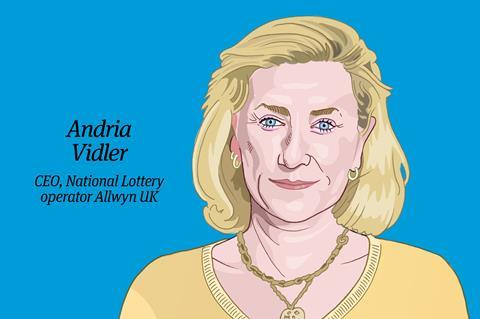
New National Lottery operator Allwyn has promised to double charitable donations from £30m a week currently to £60m over 10 years. Early plans were slowed by litigation. But Vidler’s energetic modernisation and digitisation will make a big difference.
Contribution to good causes increased £60m (or 4%) to £1.7bn in 2025 – the highest increase since the pandemic. But the true impact from her actions – rolling out new PoS last August in over 30,000 grocery outlets, the major upgrade to its website and mobile apps last month, the new partnership with rapid delivery service Gopuff, and the £7m investment into ‘Because of You’ – a media campaign that finally communicates the impact consumers make to sport, arts, community and heritage projects – will take time.
Chris Brook-Carter, CEO, Retail Trust

When Chris Brook-Carter first joined the Retail Trust as CEO in May 2020, at the onset of the Covid pandemic, retail staff were heroes. PM Boris Johnson thanked them again and again for their selflessness and bravery. Waitrose supermarket assistant Anisa Omar even appeared on the cover of Vogue.
It was short lived. Soon shocking statistics unveiled the increasing abuse levelled at store staff. So Brook-Carter and his team have worked tirelessly to raise awareness, improve conditions and give a much-needed voice to the UK’s 2.5 million retail employees.
In November, it kicked off the ‘Let’s Respect Retail’ campaign in a bid to curb abuse in the run-up to Christmas. Drawing on new research that found nearly half (43%) of staff said they are being abused or attacked every week, the campaign urged the public to, well, show a little respect.
It has also campaigned for the law to be changed to make assaulting or abusing a retail worker a specific, standalone criminal offence in England and Wales; launched online training to help shop staff cope with antisocial behaviour; and partnered with numerous retailers to improve conditions.
John-Arne Røttingen, CEO, Wellcome Trust
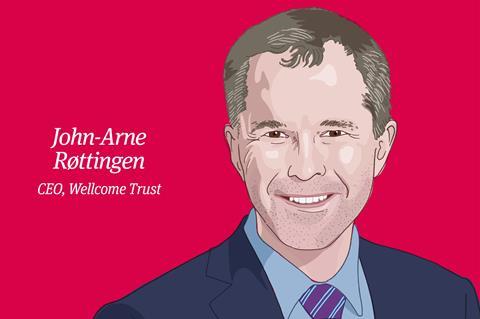
It may be more of a behind-the-scenes player when it comes to philanthropic causes related to food and drink, but the influence of the Wellcome Trust on the UK’s charitable and non-profit sector as a whole is undeniable.
With an endowment of £39.9bn, it is not only the largest independent charitable foundation in the UK, but one of the largest in the world. It made grants of £1.9bn in 2024/25 alone. And though the bulk goes toward scientific research, the outcomes directly inform our understanding of diet and nutrition. Sizeable grants in the past year have gone to projects investigating sustainable diets, child and maternal health, and climate change. In short, what John-Arne Røttingen and his team put their financial clout behind has a direct impact on what and how we eat.





No comments yet