



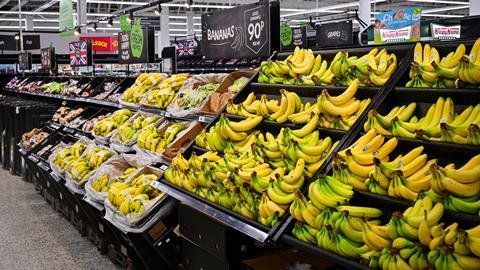
Over two years Asda and Nesta conducted in-store trials to see how shoppers might switch to healthier food.
Here’s the skinny
The much-anticipated results of Asda’s healthy eating ‘nudge’ trials, conducted with influential research foundation Nesta, were announced last week.
The good news: they prove resoundingly that it’s possible to boost sales of healthy options – and grow wider category sales at the same time.
So what did Asda learn? What worked? What didn’t work? And what makes the trial so timely?
What the trials involved
Nesta has an ambition to halve obesity in the UK by 2030 and says this requires only an 8.5% daily calorie reduction for those with excess weight. It is achievable through many small changes made in the food system, the foundation says, particularly in supermarkets, where 80% of calories consumed are sold.
To support the ambition, Asda set a goal to improve its sales of healthy foods year on year through to 2030. It aims to remove about 30 calories a day from customers’ diets, in line with Nesta’s target.
So, from October 2023 to March 2026, Asda and Nesta ran eight proof of concept trials in up to 20 stores across the south east of England.
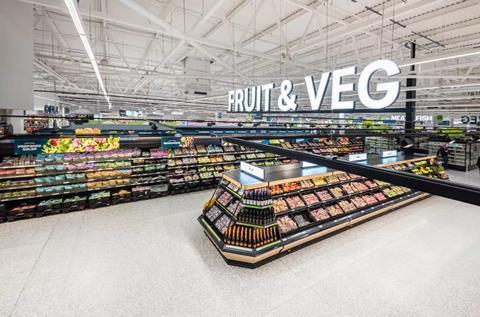
While none of the tests were designed to be of sufficient scale to meet the target, the intention was they would give Asda the necessary evidence and confidence to introduce changes that proved successful more widely.
The trials focused on four key “levers” thought to influence healthier buying habits: positioning of products, merchandising, messaging and incentives.
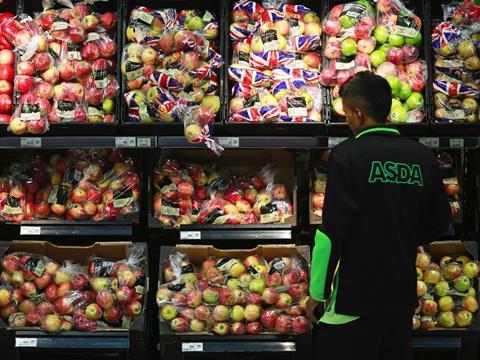
Tests were implemented in frozen, snacks and produce, “as each area plays a distinct role in customer diets”, the report found. The experiment did not go as far as reformulation or any changes to pricing.
What worked best
Of the four levers, positioning had the biggest positive impact. Three changes were tested using the approach: putting healthy options in wire bins around the store, having fruit & nut pots at checkouts, and making healthier product swaps at store checkouts.
“Wire bins showed the strongest health signal, with a 14% increase in healthier snack volume,” says the report. Fruit & nuts at checkouts scored an even bigger increase in healthy volume sales, as measured by Nesta, at 16% (see table, right). But this result was treated with less statistical significance.
In all three positioning trials, “the pattern was the same: customers responded to healthier products when they were placed where impulse purchases naturally happen, and the business saw no commercial downside”.

What was less successful?
It was bad news for healthier pizzas, which were given more visibility and space in chillers, pulling the merchandising lever. It had “no measurable effect on either health outcomes or sales”, says the report.
The change, in one small area in relation to the whole store, was too subtle to influence customer behaviour, the report concluded. The test was also undermined by control stores increasing healthier pizza facings in routine layout updates.
When it came to messaging, the results underlined how important it is to “understand which messages resonate best with customers”.
Two bays were tested – with starkly different outcomes.
“Asda’s analysis showed that product sales increased by approximately 6% when merchandised in a bay with ‘less than 100 calories’ messaging,” says the report. “However, sales decreased by approximately 8% when merchandised in a bay with ‘source of fibre’ messaging.”
The incentive trials produced limited and fleeting results. First, Asda gave pharmacy customers £5 vouchers to spend on fresh produce in five stores. Only about 7% of the vouchers were redeemed and “evidence suggested customers largely used them to pay for produce they would have bought anyway”, according to the report.
In another incentive trial, Asda tested whether making fruit more appealing to children could increase sales. Shoppers could redeem a free lunchbox if they bought five fruit pots. It increased spend on fruit by £1.50 per basket on average when shoppers did partake, but the effect disappeared when the promotion ended. Asda recommended redesigning the trial to focus on different products and reduce the cost. Merchandising was the least effective of the levers.
The conclusions
“When you increase opportunities for healthier eating, customers respond,” says Parita Doshi, director of Nesta’s healthy life mission. Crucially, the findings show this can be done in a commercially sustainable way.
But an Asda spokesman warned “there isn’t a single quick fix. Driving meaningful and sustained change to support customers to make healthier choices at scale will require significant long-term measurement and investment.”
Asda is working to understand how best to scale the successful initiatives to help “make progress” toward its 2030 target. It has not quantified this target but says the overall health score of its food sales improved from 1.83 to 1.77 through 2024. It’s set to publish its 2025 score in its forthcoming ESG report.
The timing
Asda’s progress, like the rest of the industry’s, is based on the 2004 nutrient profiling model (NPM), which the government is planning to replace (amid fierce industry resistance).
Asda and Nesta’s report was published one week before a consultation on moving to a much tougher 2018 NPM, to apply to existing restrictions on promotions and advertising of products high in fat, sugar or salt, closed on 17 June.
The new NPM would also be applied to planned mandatory healthy sales reporting by all large food businesses, which the government is expected to consult on from July to September, and could be in force as soon as 2028.
“As the UK government moves towards mandatory healthy sales reporting and targets, this partnership offers timely evidence that outcome-based targets can drive healthier sales,” says the report.
It takes the opportunity to make a series of recommendations for policymakers, stressing that “changes to the way a business drives healthier sales must be and can be commercially sustainable”.
“Policies that account for operational reality and can fit within business-as-usual are more likely to succeed,” it says.
That includes ensuring the proposed 2018 NPM update is “accompanied by clear timelines and implementation guidance”. It also calls for “consistency across devolved nations” – a prospect that looks less likely this week after the Scottish government ruled out moving the NPM goalposts.
Health groups have also welcomed the findings, while arguing nudges alone are not enough to shift diets at scale.
“Evidence consistently shows that price, in particular, has a significant impact on food choice,” says Teresa Pais, director of partnerships & member engagement at the British Nutrition Foundation. “Nudges should sit alongside structural measures like sustained lower pricing of healthier options and reformulation.”
Asda and Nesta’s trials have shown what nudges can work for healthier sales. The conclusions also provide a timely nudge for policymakers to remember that new rules must work for supermarkets too.




No comments yet