






There’s nothing quite like that first ice-cold sip of a refreshing lager in the holiday sunshine.
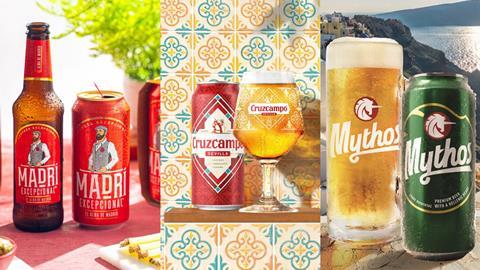
That unbeatable feeling helps explain why the rise of so-called ‘continental lagers’ has been the biggest trend in UK beer in recent years. Led initially by the phenomenally successful Spanish beer brand Madrí, multinational brewers have been queueing up to take advantage of our growing thirst for European lagers. Sales of world beers are up 6.5% on volumes up 6.6% in the past year [Worldpanel by Numerator 52 w/e 28 December 2025], making the segment a rare ray of light in a troubled category.
It’s a crying shame, then, that many of these beers are nothing more than watered-down versions of their continental counterparts, foisted on shoppers in place of the real deal by their multinational owners. In a further insult to UK beer drinkers, they’re also more likely to be brewed in Burton-upon-Trent than Barcelona.
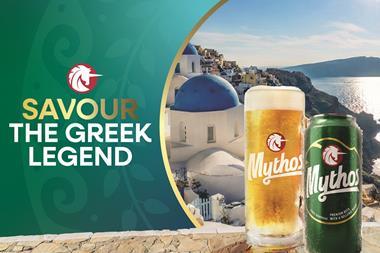
Take Greek beer brand Mythos. This week, owner Carlsberg Britvic announced it was relaunching the lager in the UK to tap “clear momentum in premium, world beers”.
However, unlike the hitherto imported version sold in B&M and specialist retailers on a limited basis, the new “Greek-style” Mythos will be brewed in Northampton and carry a lower 4.6% abv, somewhat short of the 5% abv original.
That makes it about as authentic as Greek-style yoghurt.
‘Beer category norms’
A Carlsberg Britvic spokesperson says the decision to reduce the abv of Mythos was “based on consumer preference and category norms”, while pointing out “many beers in the UK are brewed at a lower abv than those in Europe”.
In other words: “everyone else is doing it, why shouldn’t we?”
The supplier may have a point. Research by The Grocer of 30 branded European lagers on sale in UK supermarkets reveals less than a third (30%) are imported from their country of origin and carry the same abv in the UK as in their domestic market. If other ‘world lagers’ such as Asahi, Corona and Cobra are included, the figure is even lower.
That’s why The Grocer is today publishing its Lager Authenticity Index in a bid to improve transparency and to help consumers find genuine world lagers on their next supermarket shop.
The Lager Authenticity Index has been created based on The Grocer’s own research and will be updated regularly to reflect abv or production location changes, and when new products are launched in the UK.
It reveals that German and Czech beer brands such as Paulaner, Budvar and Pilsner Urqell are among the most authentic available to shoppers. The deep respect for brewing heritage and tradition in these markets – and the fact that a number of the brands remain independently owned – means production of these beers has not yet migrated to the UK.
Meanwhile, there are also a small number of beers that remain brewed overseas, but to a different (usually weaker) recipe for UK drinkers. These are still authentic continental lagers, but created specifically for the UK consumer – and tax regime – in mind.
Take Rosa Blanca, a 4.8% abv lager produced by Damm in Barcelona. The UK version, launched in 2023, is considerably weaker at 3.4% abv, conveniently slotting into the lower tax banding for weaker beers in the UK and saving Damm over 30p in duty on every 33cl can sold.
Conceived abroad, made in the UK
The ‘next best’ category contains products that do exist in other European markets, but are now produced in the UK. Some, such as Stella Artois, Carlsberg, Cruzcampo, Amstel and Tyskie, are also watered-down versions of the overseas originals.
Too often the brand owners of these beers will fall back on flimsy excuses to try and justify why UK shoppers are being short-changed.
“Reducing the abv of Carlsberg Danish Pilsner enables us to invest in innovation and in our portfolio of much-loved lagers and ales – while supporting public health by removing circa 56 million units of alcohol from the UK market,” Carlsberg said after cutting the abv of its flagship namesake pilsner to just 3.4% in 2023. Carlsberg has also long since been brewed for the UK market in Northampton.
Meanwhile, Menabrea has been produced at C&C Group’s Tennent’s brewery in Glasgow since mid-2024 “under the supervision of Birra Menabrea”. The decision was taken as it was “unsustainable to continue importing vast quantities into the UK every few months from Italy”, a spokeswoman for C&C Group told The Grocer at the time.
It’s undeniably true that beer produced and packaged in the UK, rather than shipped over from the continent, is more environmentally friendly. But that’s not an excuse to give drinkers an inferior product that – thanks to our draconian alcohol duty system – also costs UK consumers more.
Fake continental brews
At the bottom of our index sits the aforementioned Madrí Excepcional, made by Molson Coors.
Despite describing itself as “el alma de Madrid (the soul of Madrid)” Madrí Excepcional was dreamt up by Molson marketing executives in 2020 and is almost entirely brewed in Tadcaster, North Yorkshire. It is loosely based on Madri Pilsner, a 5% abv lager launched by Spanish craft brewer La Sagra in 2016 but – until recently* – did not even exist in Spain.
In our view, that makes it the least authentic continental lager available in the UK.
Madrí’s murky origins have fuelled accusations of duplicitousness from rival brewers, with Estrella Galicia going as far as calling out “big British-brewed brands masquerading as Spanish beers” in a 2023 OOH campaign.
Despite this, it has been one of the most successful UK beer launches for over a decade, with annual off-trade sales racing past £130m last year [NIQ 52 w/e 6 September 2025], suggesting many shoppers don’t care all that much about the provenance of what they are drinking.
But surely it’s better to be informed than ignorant?
*After this article was published, Molson Coors contacted The Grocer to state it began brewing Madri Excepcional in Spain for the Spanish market in 2024. It declined to provide annual production volumes for the beer in Spain. This article was amended on 19 March 2026 to reflect that information.




No comments yet