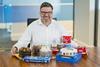
Finsbury Food Group’s CCO has helped ensure strong growth despite ‘constant change’. Now he’s overseeing its biggest-ever growth capital project
Graeme Clark is an ambitious man. Finsbury Food Group’s turnover has rocketed from £70m to £500m in the 18 years he’s been with the Scottish bakery giant, but he’s far from satisfied. “We set out with a target of becoming a billion-pound bakery business and that ambition is still there,” he says.
If the business reaches those heights, it’ll almost certainly be rooted in its buy-and-build strategy. “We’ve always looked to be acquisitive,” admits Clark, who was named chief commercial officer in May 2024. From Finsbury’s 2002 origins as a cash shell with an imminent listing on London’s junior stock market, the business has doggedly pursued such an approach – beginning with the purchase of Memory Lane Cakes.
After the cakes came bread, meringues and more. There’s been “constant change”, according to the Glasgow native. “That’s probably the reason I can still justify being here after 18 years.”
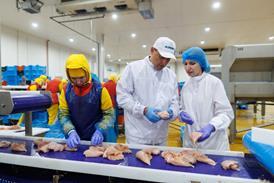
Today he’s just south of the city in Hamilton, where Finsbury makes more than 55 million cakes a year, often under licence from entertainment giants such as Disney and Sony.
This year alone, the business has gained the best part of £50m through acquisitions and is back in organic volume growth overall. Finsbury may be best known for its cakes, but it’s also the UK’s largest private-label sourdough baker and a major supplier of foodservice bakery and DTC cakes.
Five years ago, the business invested “a hell of a lot” to bring together its bread and cake divisions. In doing so, Finsbury united its 10 UK bakeries and one Polish factory under a single operating structure more suited to further acquisitions. The business was ready to ramp up its buy-and-build programme. But there was a problem – one that dated back to the company’s foundation in 2002. In those years, Finsbury shares were traded on AIM, London’s junior market. Not as glamorous as the big dogs on the LSE, the exchange suffers from a smaller pool of traders and general lack of research.
“We were on the public market for a long, long time. We grew and delivered results, but we could never get our market cap value to what we believed was justified by our performance,” Clark says.
The company’s depressed market cap made it harder to borrow for suitable M&A targets, while biannual updates only added cost and workload. The buy-and-build strategy, for the first time in the company’s history, no longer looked sustainable.
The time had come to sell up, and in September 2023 Finsbury was acquired by private equity firm Dbay. The bid was worth £143.4m – a 24% premium on Finsbury’s share price at the time. “The feeling was it’d give us more opportunity for capital and support our buy-and-build programme – alongside helping us grow and improve internally. Our structure gives us freedom to decide how much capital we want to invest.” It was a natural time to “put our foot on the ball” and assess the market, says Clark, especially given the headwinds of a highly inflationary market with spiking cocoa costs. Turnover slipped 1.7% to £445m in the 2025 financial year as Finsbury cut low-margin contracts.
“It was absolutely intentional,” Clark says. “We had an [opportunity] where we didn’t just have to chase topline growth. Once we’d done that, we pulled off a couple of really interesting bits of M&A.”
Name: Graeme Clark

Age: 48
Family: Married with two sons, 20 and 17, one at uni, the other a pro footballer
Potted CV: Marketing degree; sales role in the textile industry; a small Scottish bakery called Enterprise Foods, whose manufacturing division was bought by Finsbury; Finsbury ever since
Leadership icon: I’ve enjoyed Simon Sinek’s book on leadership: Leaders Eat Last
Best advice received: Never be scared to ask the difficult questions
Hobby: Golf, watching football and keeping fit
Favourite album: The Stone Roses’ debut
Favourite Finsbury bakery item: Co-op Irresistible Sourdough
Favourite toast topper: I like a bit of avocado – I’m not a jam man
First, it bought Lola’s Cupcakes – a “brilliant venture” for Finsbury and its first foray into DTC – before picking up specialist meringue maker Flower & White.
Clark says Lola’s has “integrated fantastically” while opening up a new channel. “We like having a broad spread. If one channel’s going really well, we can put the firepower there – or pivot and react,” he adds.
Lola’s is on course for 29% growth this year and Clark wants to double its turnover in three years. That growth has helped make up for a “challenged” cake market in grocery, where volumes have flattened.
‘Heavy’ investment
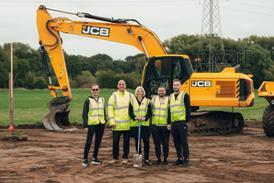
Earlier this year, the business drove an ambitious programme of data-led NPD, supported by a “heavy” investment in NIQ and Kantar data. It has also kicked off its largest-ever growth capital project: a combined £25m investment into two new bakery subcategories, which will be kept under wraps until the autumn.
“We’re taking advantage of opportunities we see in our data – being privately owned has allowed us to invest heavily into our core business,” Clark adds.

The data has also helped the company avoid tough markets and pursue premium goods. “We’ve specifically stayed away from plant bread,” Clark says, revealing how Finsbury instead threw its weight behind subsidiary Nicholas & Harris in 2013, well ahead of the sourdough curve. “Jason’s has done a fantastic job of leading the branded proposition – and we do all of the own brand in that space,” Clark says. “It’s probably the biggest growth percentage we see in the category.”
Other premium products have also performed strongly. “It’s a trend that will continue,” Clark says. “While shoppers are obviously very conscious about how much they spend, if you get the offer right, [premiumisation] will continue right across bakery.”
Change is coming for the “sweet side” of Finsbury’s business, too, given the rapid rise of GLP-1s and changing consumer habits. “Snacking and [different] usage occasions are going to play a big role. People are adapting how they consume cake and sweet products. That’s a trend we’re hoping to capitalise on,” Clark says. “Those trends will continue. There’s no doubt health is a big focus right across food in the UK and the bakery category is doing some good work to try and react.”
Whatever trends reshape bakery, though, Clark insists one thing will never change. “Let’s be honest,” he says. “If someone goes to the bakery category, they have to be delighted with how the product tastes.”


No comments yet