



Amid fresh departures, questions swirl over Co-op’s new strategy and structure, leadership, performance and corporate governance
The revolving door at The Co-op continues to spin. And once again it’s the commercial team bearing the brunt.
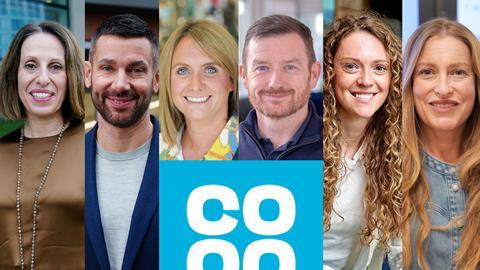
The departures of group commercial and logistics MD Matt Hood, fresh and chilled commercial director Nicole Tallant and strategy and supplier relationships commercial director Tom Bradley follow Sinead Bell (chief commercial officer), Rebecca Oliver-Mooney (commercial director) and Adele Balmforth (propositions director), as well as others who went in the autumn redundancies.
“It’s really worrying the whole of commercial [seems to] have all gone at once,” says Catherine Shuttleworth, CEO of shopper marketing agency Savvy.
“When leadership chooses to walk off the pitch, it’s challenging for those left behind, especially [after] the cyberattack. These people are battered and bruised, and it takes its toll.”
Tweaks to the GCL structure
The Co-op has worked hard to backfill roles, even delaying the announcement of Hood’s departure while tweaks to the structure at the top of the new group commercial and logistics (GCL) division were put in place.
As a result, Hood’s role will be split: current chief procurement officer Imran Rasul will become chief commercial officer; while new supply chain and logistics director Andy Wilmot, who joined in April, will also report directly to the CEO (see below for the new leadership structure).
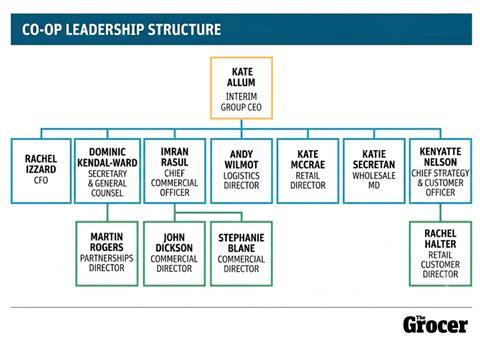
Hood adds that other new recruits “that have come in over the bumpy period [since the autumn], whether from Aldi, M&S or Sainsbury’s, have made such a difference to the strength of the buying group and how successful it will be going forward.
“There is some absolutely brilliant talent coming through at the level below John Dickson and Nicole, which didn’t exist before. That means we’ve got a proper backfill for the future and people who just are energised by buying.”
These are not the only high-profile departures to fill, however. The Co-op is operating with an interim CEO, Kate Allum, a former Co-op non-exec director with no retail experience, following the April departure of Shirine Khoury-Haq; the Food MD role is still vacant after Hood’s role change; and the Co-op also lost quick commerce guru, Chris Conway.
So questions remain over the new structure and strategy, the leadership, the broader performance of the business, and the Co-op’s governance.

The good news is: the Co-op is back in growth. “Last week’s Kantar/NIQ sales data suggests they have bounced back well from last year’s cyberattack,” says City analyst Nick Bubb.
The crisis wiped £285m in sales and plunged the Co-op to a £35m loss in 2025. But in the 4 weeks to 13 June NIQ reported that Co-op grocery sales were +6.0% in terms of grocery sales. And while Worldpanel estimated growth lower at +2.7% “both figures underestimate overall sales growth, as they don’t pick up the Co-op’s ‘pick up’ trade,” adds Bubb.
No one at the Co-op is getting carried away. Hood admits: “It’s tough to read at the moment because obviously our data is lapping catastrophe. Added to that is the weather over the last couple of weeks.
“But I genuinely believe there is an improvement in the base because of the foundations we’ve been putting in place over the last six to nine months. Promotions are better, prices are better, and availability is better.”
All customers are equal
The buying group (the UK’s fourth biggest according to the Co-op) was conceived by Hood with Khoury-Haq as a way to both grow sales and save money – by combining the separate commercial teams for Co-op retail stores with its Co-op wholesale, franchise, Federal Retail Trading Services (FRTS), and Independent Society Members (ISMs).
Hood insists it’s working. “The feedback from [customers] has been incredibly positive. They will say they are now being treated in the way they always should have. It sounds ridiculous when you think about it. These are £1bn+ businesses. But one of the reasons we’re picking up new contracts is because the new structure enables us to really get close to [all our customers].”
Another major initiative given to buyers was to renegotiate terms with suppliers to “move the majority [of trade investment] from back margin into margin,” Hood explains.
“The buying group needed to become agnostic. Back margin was conditional income attached to store activation], even if products weren’t right for the customer. That’s quite a tricky drug to get off.
“But now our proposition team, whether it’s wholesale, franchise, FRTS, or retail, can say: ‘We do what’s right for the customers, and that’s what we then activate, rather than promotions being driven by who pays us the most money.”
However, suppliers The Grocer has spoken to are still finding it difficult to navigate the new structure. “They’ve lost a lot of their senior leadership and there’s also been changes in the junior buying ranks, so speaking as a mid-size supplier, communication has been challenging and has led to confusion about who is making decisions and when. It’s infuriating,” says one.
They’re not the only ones. According to a source with knowledge of the situation, “80% of the board could not explain what [the GCL] is or what the strategy behind it is”.
As well as causing huge upheaval within the commercial teams, the controversial new business unit has also been a considerable source of friction on the board, The Grocer understands.
“I was gobsmacked the way the GCL came about,” says the source. “Something as big as that should have been a strategy for consideration by the board. But these decisions were made with no option to approve or interfere.”
Governance concerns
Concerns over governance have led to tension within the board itself, The Grocer understands.
This came to a head after an incendiary email, said to represent “a significant proportion of the senior leadership population”, was sent to Co-op chair Debbie White in mid January, alleging a “toxic leadership culture” in the wake of the GCL restructure. After several weeks, frustrated at the board’s lack of response, along with previous complaints, the email was leaked to the BBC. The BBC’s story, published on 11 February, resulted in extensive negative publicity.
The Grocer understands an anonymous survey of senior leaders was not carried out until March. And in response to claims that the email was not shared with the CEO until it was contacted by the BBC, the Co-op said “individual directors and colleagues were made aware as and when appropriate”.
In turn, when Khoury-Haq announced her departure in late March, she insisted this was not linked to the allegations.
Uneasiness about the board’s governance have not ended there, with concern raised over the level of control Allum is being given.
“To now hand to the interim CEO full ownership of the structure and strategy, that this is an executive decision and not a board decision, is fundamentally wrong,” says a source familiar with the situation. “Everything is screaming for more oversight.
“If you are in a crisis – and the Co-op is in a crisis – you need all hands on deck. The status quo needs to be challenged. There needs to be more numbers, more control.”
Hood admits it’s “a big transition” after “a tumultuous 12 months”.
”But I’m confident that what Kate is building, and what I’ve been working with her on in terms of future structure will be the right thing, and there will be people who come in with an energy greater than what I had left.”
However, a specialist turnaround expert with knowledge of the Co-op believes it hasn’t been honest about the scale of the problems caused by the cyber-attack. “It was worse than they admit. And there’s a broader trading challenge,” they add.
“The Co-op is nowhere near as resilient as it once was, specifically due to Aldi and Lidl. The discounters have really focused store openings on the Home Counties. As costs go up there’s more and more competition from cheaper and better competitors.”
Savvy’s Shuttleworth also believes price is a problem. The Co-op is in “a really strong place in terms of its offer, locations, beliefs and principes, but it’s a very competitive market, and Co-op have been out on price for a long time, and shoppers have a lot more to choose from. It will only work if you’ve got a strong leadership.
With Khoury-Haq having shored up the Co-op’s finances during her tenure, and CFO Rachel Izzard highly rated, the Co-op’s crisis isn’t financial or existential as it has been with previous crises, adds an ex-Co-op boss.
“It’s much more around governance and the vision, how to compete with world-class retailers like Aldi, Lidl, Tesco and Sainsbury’s. The Co-op’s point of difference isn’t sufficient and it’s not being run well enough to do that right now.”
Amid so much upheaval, the revolving door urgently needs to stop spinning, or at least spin much more slowly. And the appointment of a permanent CEO – with retail experience – cannot come soon enough. Three months on from Khoury-Haq’s departure the search is understood to be going slowly. And whoever it is, says a source familiar with the situation, “without the right governance, it’s difficult to see how it will work”.

1 Readers' comment