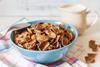
a bowl of bran flakes

Source: Getty Images

Bran Flakes would fall foul of the new NPM

Bran Flakes are about to become junk food. Not because anyone with a working knowledge of nutrition thinks they are, but because a government scoring model that has not been meaningfully updated since 2004 says they are – and in Whitehall, the model wins.

The instrument in question is the nutrient profiling model, the tool Labour intends to use to determine which foods can be advertised, where they can be promoted and how prominently they can be displayed in shops. Under the updated version the government is expected to apply, products like Kellogg’s Bran Flakes will be reclassified as HFSS, sitting in the same regulatory bracket as the kind of ultra-processed snacks the policy was designed to discourage.

The mechanism is technical but the effect is not: tighten the thresholds around free sugars, and suddenly the fibre and protein that give Bran Flakes most of their nutritional value can no longer offset the score. The cereal fails. The algorithm moves on.

None of this would matter much if the NPM were merely a labelling curiosity. It is not. It determines where a product sits on a supermarket shelf, whether it can be promoted on a multibuy and whether it can appear in an advertisement before nine o’clock at night. A bowl of Bran Flakes eaten with semi-skimmed milk by someone trying to manage their cholesterol will, under this framework, carry the same restrictions as a sharing bag of cheese puffs. You would be hard pressed to design a better illustration of what happens when policy is driven by a model rather than by judgment.

The science, for those inclined to consult it, points firmly in one direction. The British Dietetic Association recommends 30g of dietary fibre a day for adults. The average Briton manages 18g, barely 60% of the target. The Scientific Advisory Committee on Nutrition has identified strong evidence linking cereal fibre and wholegrains with lower rates of cardiovascular disease, stroke, type 2 diabetes and colorectal cancer.

A University of Reading review published in Philosophical Transactions of the Royal Society B last year concluded that millions of British adults are raising their chronic disease risk because they cannot get anywhere near the 30g target. Breakfast cereal, according to Food Active, is the single largest source of dietary fibre in the British diet.

The government is therefore proposing to restrict the promotion of one of the few mass-market foods that addresses a nutritional deficiency it is simultaneously trying to reduce. It is the kind of thing that would be funny if the health consequences were not quite so serious.

Now, the cereal industry is not without its own history of overreach, and it would be wrong to ignore it. But Bran Flakes are a different product with a different history. John Harvey Kellogg developed his original flaked cereals at the Battle Creek Sanitarium in Michigan as medical foods for patients with digestive complaints. The bran was not a filler or a disguise, it was the point – and the nutritional case for it has only strengthened in the century since. Criticise the company’s later commercial decisions by all means. Tracing that criticism back to Bran Flakes requires a degree of bad faith the facts do not support.

As Nesta noted in February, the NPM remains a binary instrument. Products pass or fail. There is no room for a cereal that delivers real nutritional value alongside a modest level of added sugar. A public consultation on the updated model is expected this year, which means the thresholds are not yet fixed. There is still time to apply some judgement before the rule book lands on foods that have done nothing to deserve it.

The government is right to take childhood obesity seriously. It is right to restrict the advertising of genuinely poor food. What it needs to avoid is the particular error of trusting a 20-year-old algorithm more than it trusts common sense. When the model says Bran Flakes are junk food, the correct response is to fix the model.


Adam Aljewicz is a director at WeAreSPQR