



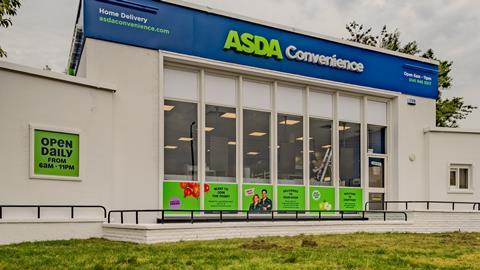
A new player has entered the game, as the battle for the independent convenience market continues to heat up. Last week, Asda announced a new wholesale supply model for independent retailers, after striking a partnership with Scottish retailer One O One to trial its new Asda Convenience fascia in three Glasgow stores.
It’s a bold move for the retailer, while also being a long time coming given Asda’s growing convenience estate – its company-owned Express format now boasts 517 stores. Unsurprisingly, the business has already been “inundated” with enquiries from independent retailers.
That does at least partly explain why Asda hasn’t yet started actively recruiting retailers. For now, the focus is on delivering a successful trial that’s “operationally brilliant and makes retailers keen to join us”, according to Asda Express, fuel & wholesale director Joseph Sutton.
The proposition itself goes big on fresh, own label, and value – all likely to appeal to independents. With that rough blueprint in place, Asda is targeting stores looking to grow their fresh food offer and effectively become “small supermarkets”. Trial stores stock around 3,500 products, including own-label, fresh and chilled groceries, as well as food to go – all sold “at Asda’s well-known value prices”.
But, like anyone looking for a perfect match these days, Asda also has a distinct partner profile in mind.
Yes, size matters
Initially, Asda is targeting retailers that already have 10 sites or more, allowing it to scale up quickly. As Sutton says: “It’s an easier way for us to get into the market and have a meaningful presence.” That’s not to dismiss smaller and single-site operators entirely though – it expects to work with these later down the line.
In the meantime, there’s a medium-term goal of bringing 100 stores under the fascia.
“We want to be really ready before we start taking on anyone at mass,” says Sutton. “Our ambition is significant and we want to be a major player in this market, but the scale of expansion will be dependent on refining our model once we are confident we are ready.”
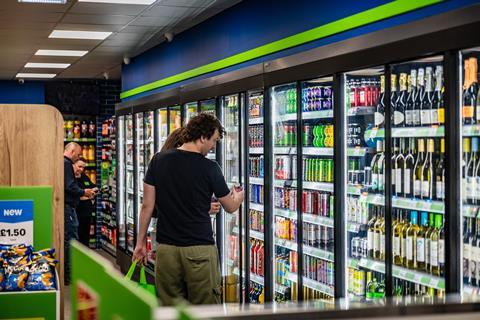
Size matters, too. Sutton admits the format wouldn’t be appropriate for smaller convenience stores spanning up to 600 sq ft. One O One’s smallest store, for example, is 1,900 sq ft.
“If you’ve got a traditional CTN selling mainly impulse products, it’s hard to imagine we’ll be able to outperform the existing players in the market,” says Sutton. ”In slightly larger stores, where there’s more potential to sell these categories, we’re likely to add more value. It’s not that smaller retailers aren’t great, I’m just not sure we’ll be able to offer them something materially different to a Booker or a Bestway.”
It’s also important retailers understand what they’re signing up for. On the sliding scale of symbol group and franchise, Asda’s offer currently sits somewhere in the middle. The initial trial allows One O One to source products outside of Asda’s supply chain for local ranges such as McGhee’s Bakery.
But as Asda Convenience scales, the expectation for future partners will be to source “100%” of their supply from Asda. While the One O One partnership has been built around collaboration, Sutton acknowledges the model will ultimately move closer to a franchise.
That’s Asda Price
So independents should not expect a wholesale model that allows them to buy Asda products without also adopting the fascia. Asda Convenience is about taking on the full package – a strategy that is fundamentally about protecting the retailer’s brand identity.
“What’s important to us is protecting our brand and the credentials which come with it,” says Sutton. ”That’s where it probably will feel more like a hard franchise. Where it comes to the use of our brand and the presentation of our products, that’s where we would have a bit more control and those would be much clearer red lines than what fridge or what till system they use.”
That may limit the pool of potential recruits, but it also highlights a broader ambition: Asda is not simply looking to build a wholesale customer base. It wants to create a network of stores that look, feel and trade like Asda. And with pricing and margin a crucial part of that, Asda is confident it can target those needs and undercut its rivals.
“Our credentials around price are central to our strategy,” says Sutton, pointing out that high-quality own-label convenience brands currently attract quite a premium.
“We are more value-led than some of the competition,” he adds. ”That’s important for Asda, it is the very nature of our business.”
In terms of margin, Sutton couldn’t specify a particular figure. Instead, he highlights that a different product mix will unlock “richer margins”.
“Whether it’s through convenience, hot food, bakery, or food to go categories, those margins are significantly higher than those available on tobacco and BWS,” he says.
Shaking it up
Availability is of course crucial to Asda’s plans, but the retailer insists that just adding a few extra delivery vehicles will allow its existing network to absorb the additional demand. “Our logistics is very well run,” says Sutton. “There is no need to suddenly make a massive investment in building extra depots.”
Sutton also confirmed there are no plans to re-enter the cash & carry market following the Deal Depot launch in 2019. Despite trying to court independent retailers and foodservice operators when it opened the 20,000 sq ft cash & carry concept in Bristol, plans were disrupted by the outbreak of the coronavirus pandemic, meaning no other sites opened and the Bristol depot closed in 2022.
Independent convenience retail also appears to be just the first step in Asda’s wider wholesale ambitions. Sutton reveals the retailer has other channels firmly in its sights, including foodservice, suggesting the move into convenience could become the foundation for a much broader wholesale operation.
Asda is no doubt going to shake up the wholesale market, but it’s entering an already a crowded space. Retailers that fall short of the 10-store criteria will be understandably wary of competing against a new fascia backed by a value-led supermarket brand in their local community. Yet more competition could be just what the sector needs if it drives rival wholesalers to improve their pricing, ranging and support.
With Asda now making its mark with independent retail, the next big question is where this leaves Sainsbury’s – the last of the big four supermarkets without a presence in the sector. It briefly operated a wholesale arm after kicking off a partnership with SimplyFresh in January 2020, only to pull the plug 18 months later to focus on its core business.
With Asda’s arrival set to raise the wholesale stakes and the recent Argos split allowing Sainsbury’s to refocus on food, the obvious question is whether it might be tempted back for another try. Watch this space.





No comments yet