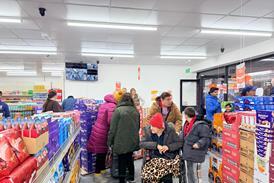
UNP Grocer 44217 Co-Op CEO Shirine Khoury-Haq Manchester001

Shirine Khoury-Haq said her departure was ‘very much a personal decision’

Co-op Group CEO Shirine Khoury-Haq has insisted her decision to step down is not linked to allegations of a “toxic” culture at the top of the business.

During the convenience retailer’s full-year results today, Khoury-Haq announced she was leaving after almost seven years at Co-op, including four as CEO.

During her tenure, she led the business through “significant transformation”, including a 95% reduction in debt and a 30% increase in profit between 2022 and 2024.

She also led the business in fighting off a major cyberattack in 2025, which caused widespread availability issues as Co-op had to temporarily shut down its systems.

Earlier this year, a letter to board members alleged a “toxic” culture within the senior leadership team, describing “fear and alienation” among senior staff who said they felt unable to speak up in front of the leadership team, including Khoury-Haq.

The letter claimed this culture had contributed to falling morale, a series of senior departures, and operational errors following the cyberattack and its decision to create a new group commercial and logistics division.

Khoury-Haq said her departure was not related to the claims.

“I have the privilege of meeting with a group of colleagues that represent all 53,000 of our colleagues,” said Khoury-Haq in post-results media call. “They give us very straight feedback, and we ask them directly to go and talk to 53,000 people and come back to us and tell us what their views were in terms of culture.

“We heard very clearly that this term of toxic issues, they did not recognise it, and they were very clear about that. However, what they did say is that in a couple of our areas where there were reorganisations taking place there was some discomfort there.

“They said to us that there were areas where we had not communicated as clearly as we could have. We’ve taken on that feedback and we will address it. We will continue to speak to our colleagues about anything that’s on their minds, whether it’s culture, whether it’s the state of our business, but we have heard directly from them that they do not recognise this.”

She added that her departure was “very much a personal decision”.

Khoury-Haq’s exit comes as Co-op plunged from £131m underlying operating profit to a loss of £35m in 2025 after taking a £107m hit from the hacking incident during the year. The attack also wiped £285m off its sales as Co-op was forced to shut down its systems in response.

Co-op’s food retail business, which was hit particularly hard by the hack, registered a 2% fall in sales to £7.3bn. It had expected growth of 1% if the cyberattack had not happened.

Federal Retail Trading Services (FRTS), the buying group managed by Co-op Group for the Co-op’s regional societies in the UK, such as OurCoop and Southern Co-op, saw revenue down by 5.4% to £2bn. This was mainly due to stock availability challenges during the cyber incident, with 90% of the societies’ food and drink supplied by Co-op via FRTS.

“FRTS was impacted in the same way as Co-op stores were which was significant,” said Co-op Wholesale MD Katie Secretan. “However, what is not shown is the supply of 220 stores through a separate supply chain through Co-op Wholesale, which provided a necessary supply during a time of disruption.”

Revenue for Co-op’s wholesale arm, which includes supply into the Nisa symbol estate, was £1.3bn, contracting 2.2% against 2024, predominantly driven by market-wide challenges, including declining demand for tobacco. Excluding tobacco sales, wholesale revenue grew 1.3%.

The group added, however, that wholesale growth improved towards the end of the year across value and volume, as it secured contracts with Costcutter and motorway services operator Roadchef.

Co-op Wholesale has recently relaunched its Nisa symbol group with a new fascia and a new commercial model that offers retailers the choice of drops membership fees and surcharges in exchange for sourcing 75% of stock from the wholesaler.

Co-op Wholesale also scrapped fuel levies last year, but with the Middle East conflict driving up petrol and diesel prices, Secretan said she was monitoring the situation.

“We removed our levies and surcharges and that was really important to us to keep things really simple for retailers,” she said. “Now, of course, we can’t predict what those fuel price movements will be in the future.

“Where we are able to, we will continue to keep our proposition really simple. But it’s moving fast, so we’ll monitor that as we go through the next few months.”